

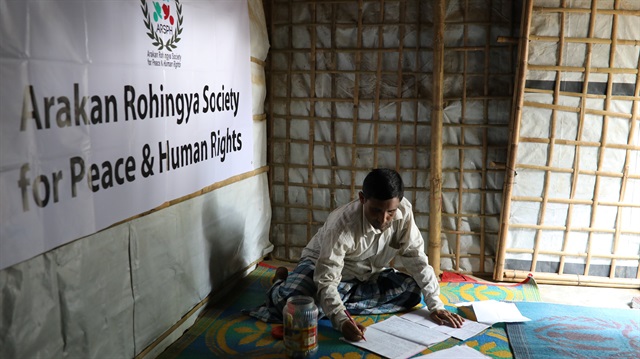
File photo
Myanmar has sought for Bangladesh to replace the term “Forcibly displaced Myanmar nationals” to “Displaced persons from Rakhine State” on registration cards issued to Rohingya refugees in Cox's Bazar.
Myanmar made the demand during a meeting last week, Bangladeshi officials have said.
A 15-member Bangladeshi delegation led by Foreign Minister AH Mahmood Ali visited Myanmar between Thursday and Saturday.
It was the first state-sponsored visit to Myanmar since the Rohingya fled to Bangladesh a year ago.
Human Rights Watch (HRW), however, said in a statement on Wednesday that Bangladesh had “agreed” to the change.
“While changing a few words on a refugee's ID card may seem inconsequential, for the 700,000 Rohingya refugees in Bangladesh who fled ethnic cleansing in Myanmar a year ago, it is essential,” said Bill Frelick, director of Refugee Rights Program of HRW.
Facebook has been “too slow” to address hate speech in Myanmar and is acting to remedy the problem by hiring more Burmese speakers and investing in technology to identify problematic content, the company said in a statement on Thursday.The acknowledgement came a day after a Reuters investigation showed why the company has failed to stem a wave of vitriolic posts about the minority Rohingya.Some 700,000 Rohingya fled their homes last year after an army crackdown that the United States denounced as ethnic cleansing. The Rohingya now live in teeming refugee camps in Bangladesh."The ethnic violence in Myanmar is horrific and we have been too slow to prevent misinformation and hate speech on Facebook,” Facebook said.The Reuters story revealed the social media giant for years dedicated scant resources to combating hate speech in Myanmar, which is a market it dominates and where there have been repeated eruptions of ethnic violence.In early 2015, for instance, there were only two people at Facebook who could speak Burmese monitoring problematic posts.In Thursday’s statement, posted online, Facebook said it was using tools to automatically detect hate speech and hiring more Burmese-language speakers to review posts, following up on a pledge made by founder Mark Zuckerberg to U.S. senators in April.The company said that it had over 60 “Myanmar language experts” in June and plans to have at least 100 by the end of the year.Reuters found more than 1,000 examples of posts, comments, images and videos denigrating and attacking the Rohingya and other Muslims that were on the social media platform as of last week.Some of the material, which included pornographic anti-Muslim images, has been up on Facebook for as long as six years.There are numerous posts that call the Rohingya and other Muslims dogs and rapists, and urge they be exterminated.Facebook currently doesn’t have a single employee in Myanmar, relying instead on an outsourced, secretive operation in Kuala Lumpur – called Project Honey Badger – to monitor hate speech and other problematic posts, the Reuters investigation showed.Because Facebook’s systems struggle to interpret Burmese script, the company is heavily dependent on users reporting hate speech in Myanmar.Researchers and human rights activists say they have been warning Facebook for years about how its platform was being used to spread hatred against the Rohingya and other Muslims in Myanmar.In its statement on Thursday, Facebook said it had banned a number of Myanmar hate figures and organizations from the platform.Bangladeshi delegation visits Myanmar’s Rakhine stateMyanmar upholds blockade of aid to Rohingya Muslims in RakhineMyanmar to ICC: Rohingya jurisdiction request 'should be dismissed'
Facebook says it was 'too slow' to fight hate speech in Myanmar
"This change signals that Myanmar doesn't intend to honour the citizenship rights of Rohingyas, nor acknowledge the cause of their displacement – security force operations that included murder, widespread rape, mass arson, and pillage," HRW added at the statement.
The commissioner of the Bangladesh Refugee Relief Repatriation Commission (RRRC) Mohammad Abul Kalam told Anadolu Agency on Thursday that Myanmar raised the ID card issue.
“The Foreign Ministry is the authority to take final decision to bring the change. We have yet to get any formal decision or instruction on the matter,” he said.
Bangladesh Foreign Minister AH Mahmood Ali on Saturday visited Myanmar’s restive Rakhine state, where security forces have been accused of committing crimes against humanity on the minority Rohingya Muslim community.A high-profile delegation led by Bangladesh Foreign Minister AH Mahmood Ali has toured transit camps as well as newly-built houses in the resettlement areas for the returnees, said Win Myat Aye, Myanmar’s minister of social welfare, relief and resettlement.Since Aug. 25, 2017, more than 750,000 refugees, mostly children and women, have fled Myanmar and crossed into Bangladesh after Myanmar forces launched a crackdown on the minority Muslim community, according to Amnesty International.At least 9,400 Rohingya were killed in Rakhine from Aug. 25 to Sept. 24 last year, according to Doctors Without Borders.In a report published recently, the humanitarian group said the deaths of 71.7 percent or 6,700 Rohingya were caused by violence. They include 730 children below the age of 5.“The delegation visited the area as they wanted to see themselves what we had prepared for the returnees,” said the minister, who was accompanying the visiting delegation.The delegation began four-day visit to Myanmar on Thursday to discuss matters on Rohingya repatriation with Myanmar government.According to a press release issued by Bangladesh’s Foreign Ministry, the visiting foreign minister emphasized on the need for accelerating efforts for conductive environment in the Rakhine state and building houses and villages for the returnees.The Rohingya, described by the UN as the world's most persecuted people, have faced heightened fears of attack since dozens were killed in communal violence in 2012.The UN documented mass gang rapes, killings -- including of infants and young children -- brutal beatings, and disappearances committed by security personnel.In a report, UN investigators said such violations may have constituted crimes against humanity.On Friday, the Bangladeshi foreign minister met with Kyaw Tint Swe, minister of Myanmar’s State Counselor Office in Nay Pyi Taw.After the meeting, Myanmar and Bangladeshi officials said in a joint press release that they agreed on several points including establishing reception centers and transit camps in both countries, combating terrorism, drug-trafficking in border areas as well as repatriation of displaced persons residing along the border between the two neighbors.
Bangladeshi delegation visits Myanmar’s Rakhine state
Rohingya refugees have long expressed doubts on whether they would benefit from rights as citizens if repatriation were to occur.
Executive director of Transparency International Bangladesh, Iftekhar Zaman, on Thursday told Anadolu Agency that identifying Rohingya refugees as Myanmar nationals was necessary for them to acquire their rights as citizens.
“The international community has failed to pay due importance to the humanitarian crisis created by Myanmar on Rohingya people which [puts] Bangladesh in a trap.”
Since Aug. 25, 2017, more than 750,000 refugees, mostly children and women, have fled Myanmar and crossed into Bangladesh after Myanmar forces launched a crackdown on the minority Muslim community, according to Amnesty International.
At least 9,400 Rohingya were killed in Rakhine from Aug. 25 to Sept. 24 last year, according to Doctors Without Borders.
The Rohingya, described by the UN as the world's most persecuted people, have faced heightened fears of attack since dozens were killed in communal violence in 2012.
The UN has documented mass gang rapes, killings -- including of infants and young children -- brutal beatings, and disappearances committed by security personnel. In a report, UN investigators said such violations may have constituted crimes against humanity.