

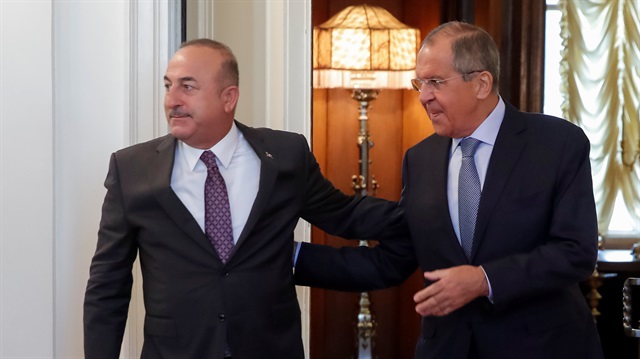
Russia's Foreign Minister Sergei Lavrov meets his Turkish counterpart Mevlut Cavuşoğlu in Moscow, Russia
Turkey and Russia need to continue working together to pursue the cease-fire in Syria, Turkey’s Foreign Minister Mevlüt Çavuşoğlu said on Friday, warning that a possible military solution in the northwestern city of Idlib would be a "disaster."
Speaking to reporters in Moscow after meeting with his Russian counterpart Sergey Lavrov, Çavuşoğlu said: “Preserving the de-escalation zone in Idlib, Syria is important in both humanitarian respects and the fight against terrorism."
Stressing that more than 3 million civilians live in Idlib, he said: “A military solution there would be a disaster. It would be a disaster not only for the Idlib region but also for the future of Syria."
“Separating the civilians from the combatants in Idlib is important for everyone, but a solution through force would lead to a new wave of refugees and a humanitarian catastrophe," he warned.
"A solution by force in Idlib would undermine the trust between Russia and Turkey as well as the trust of the cease-fire participants."
"It is necessary to work in the Astana format on the [existing] cease-fire, it is necessary to work on promoting the political process,” he said, referring to the process that began in Astana, Kazakhstan.
Representatives of the guarantor countries for the Syria cease-fire -- Turkey, Russia, and Iran -- will meet with Staffan de Mistura, the UN’s special Syria envoy, on this point in the near future, added Çavuşoğlu. The issue will also be discussed by the three countries' presidents in Tehran in September, he said.
Çavuşoğlu also said the political process in Syria should be started as soon as possible.
Stating that a list of member candidates for a constitutional committee was summited, Çavuşoğlu said: “Establishing a constitutional committee immediately is important for Syria’s future. We back this process.”
The situation in Idlib is also set to top a meeting between the Russian and Turkish foreign and defense ministers and intelligence chiefs.
Located near the Turkish border, this May Idlib was designated a “de-escalation zone” where acts of aggression are expressly forbidden.
Syria has only just begun to emerge from a devastating conflict that began in early 2011, when the Assad regime cracked down on protesters with unexpected ferocity.
UN officials estimate that hundreds of thousands of people have been killed in the conflict.
The success of Turkey's Operation Euphrates Shield, which was launched two years ago to purge the terrorist threat emanating from northern Syria, decisively foiled the plots of terrorist groups in the region.Euphrates Shield cut off the PKK/PYD/YPG terror groups' access to the Mediterranean Sea and eliminated threats posed by the terrorist group along the Turkish-Syrian border.In its 30-year terror campaign against Turkey, the PKK has taken some 40,000 lives. The terrorist PYD/YPG is the PKK's wing in Syria.Operation Euphrates Shield, which began on Aug. 24, 2016 and ended in March 2017, was aimed at eliminating the terrorist threat along the border in the northern Syrian regions of Jarabulus, Al-Rai, Al-Bab, and Azaz with the use of the Free Syrian Army, backed by Turkish artillery and air cover.More than 3,000 terrorists were also neutralized in the operation.Turkish authorities often use the word "neutralized" in their statements to imply that the terrorists in question either surrendered or were killed or captured.As the operation ensured Turkey's border security, it also cleared members of the Daesh terrorist group as well as the PKK/PYD from northwestern Syria.The operation also blocked a merger of the so-called cantons of the PKK/PYD/YPG terrorist groups along Turkey's border.Moreover, following the Turkish-led operation, tens of thousands of displaced Syrians returned to their liberated hometowns.Two PKK terrorists ‘neutralized’ in eastern TurkeyDisplaced Syrians in Idlib mark Eid despite hardships47,000 more Syrians in Turkey back home for Eid al-AdhaNorthwest Syria returns to normal after Turkish operation
Turkish operation in Syria foiled PKK/YPG terror plots
Civilians in Syria’s northwestern Idlib province, where refugees have sought shelter during the country’s protracted conflict, welcomed the arrival of the Eid al-Adha holiday on Tuesday despite their difficult circumstances.Held by anti-regime opposition factions, Idlib is currently home to some four million Syrians who fled their homes earlier amid attacks by the Assad regime.Mohammed Kaddor, chairman of Idlib’s Ahli refugee camp, told Anadolu Agency that only a limited number of camp residents were able to take part in Eid festivities.“Some have enough money to buy new goods, but most rely on second-hand shops,” he said. “Meanwhile, those without family or money don't leave the camp.”“Orphans and the families of martyrs can’t buy the kinds of food associated with Eid, nor can they buy new clothes,” he added.Noting that the Assad regime had recently deployed troops to opposition-held Idlib, Kaddor said that camp residents feared a possible regime attack on the area.Um Mahmoud, a Turkmen mother who lost her husband earlier to a regime airstrike, said that she -- along with her seven children -- was depending on charitable organizations for her Eid requirements.“If it wasn't for these charitable organizations, we wouldn’t have anything to eat now,” she said gratefully.“I don't have an income or anyone to bring money home,” she added.Um Mahmoud went on to lament the fact that she could not afford any of the items her children wanted.“In line with tradition, all my children want new clothes to wear for the Eid,” she said.Omar Abu Nahla, a resident of Idlib’s Kafr Lusin refugee camp, for his part, said that Idlib had recently seen a fresh influx of refugees from central and southern parts of the country.“My children want new clothes and shoes, but I can't afford this,” he said.“They don’t understand our difficult circumstances; they just want to be happy,” he added.Another camp resident, Samar Sallum, said that he had bought used clothes for his children at a local flea market.Sallum, too, pointed out that camp populations had recently increased due to a fresh refugee influx from Syria’s Homs and Daraa provinces.“It’s always nice to celebrate Eid, but we still need help more than ever,” Sallum told Anadolu Agency.Video: Eid al-Adha celebration in Gaza
Displaced Syrians in Idlib mark Eid despite hardships
Visa-free regime
Russia and Turkey have agreed to establish a mechanism to restore a visa-free regime between the two countries, Russia’s Lavrov also announced.
Russia is ready to lift visa restrictions for the Turkish holders of special and service passports as well as for drivers engaged in cargo transportation between the two countries, Lavrov told reporters after meeting with Çavuşoğlu.
"We have confirmed Russia's readiness to hold talks on simplifying the travel regime for certain categories of Turkish citizens on a reciprocal basis, and we will do this in the near future,” said Lavrov.
“We agreed to establish a mechanism for consultations on the development of agreements on this subject."
Russian Deputy Foreign Minister Sergei Ryabkov said that all options were on the table when it came to Moscow's possible response to a new round of U.S. sanctions, the Interfax news agency reported on Friday.Ryabkov was also cited as saying that Moscow had not yet noted any signs that the United States was ready to normalise relations.Moscow had also noted attempts by Washington to revise tentative agreements reached by President Vladimir Putin and President Donald Trump at last month's Helsinki summit, Interfax cited Ryabkov as saying. Russia says unidentified helicopters provide arms to Daesh, TalibanTurkish, Russian top diplomats to meet in MoscowRussia's Lavrov to meet Saudi counterpart on Aug 29EU unlikely to heed British call for more Russia sanctions'Russia will not stop rocket engine exports to US'
Russia says all options on table for response to US sanctions
'Strategic partner'
Calling Russia a “strategic partner,” Çavuşoğlu stressed the importance of further developing bilateral ties with Russia.
“We will both improve bilateral relations between the two countries for [providing] stability and economic development in the region and we will boost our cooperation on regional matters,” he said.
Without naming any country, he said that some countries and individuals were jealous of Turkey and Russia’s close cooperation and friendship.
Çavuoğlu also expressed pleasure at the growing number of Russian tourists visiting Turkey.
“We will be very happy to welcome some 6 million our Russian friends to our country this year,” he said.
2019 will be declared the Year of Culture and Tourism between the two countries, Çavuşoğlu said, expressing hope that this will serve to attract even more Russian tourists.