

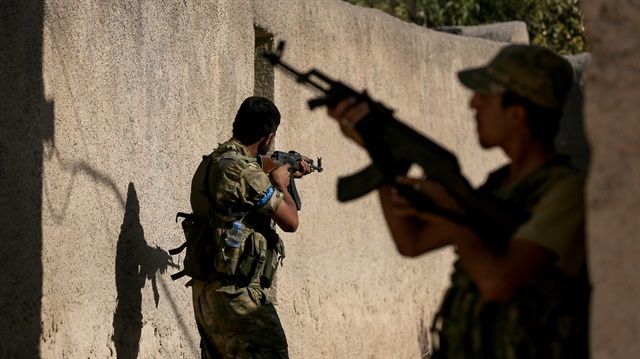
Two years since Turkey launched Operation Euphrates Shield
The success of Turkey's Operation Euphrates Shield, which was launched two years ago to purge the terrorist threat emanating from northern Syria, decisively foiled the plots of terrorist groups in the region.
Euphrates Shield cut off the PKK/PYD/YPG terror groups' access to the Mediterranean Sea and eliminated threats posed by the terrorist group along the Turkish-Syrian border.
In its 30-year terror campaign against Turkey, the PKK has taken some 40,000 lives. The terrorist PYD/YPG is the PKK's wing in Syria.
Operation Euphrates Shield, which began on Aug. 24, 2016 and ended in March 2017, was aimed at eliminating the terrorist threat along the border in the northern Syrian regions of Jarabulus, Al-Rai, Al-Bab, and Azaz with the use of the Free Syrian Army, backed by Turkish artillery and air cover.
More than 3,000 terrorists were also neutralized in the operation.
Turkish authorities often use the word "neutralized" in their statements to imply that the terrorists in question either surrendered or were killed or captured.
As the operation ensured Turkey's border security, it also cleared members of the Daesh terrorist group as well as the PKK/PYD from northwestern Syria.
The operation also blocked a merger of the so-called cantons of the PKK/PYD/YPG terrorist groups along Turkey's border.
Moreover, following the Turkish-led operation, tens of thousands of displaced Syrians returned to their liberated hometowns.
At least two PKK terrorists were "neutralized" in eastern Turkey, an official statement said on Thursday.Turkish authorities often use the word "neutralized" in their statements to imply that the terrorists in question either surrendered or were killed or captured.According to a statement by the governor's office, gendarmerie forces neutralized two armed PKK terrorists, including a woman, during operations in Gurpinar district in the eastern Van province.The operations were launched on Aug. 22-23 by gendarme forces against the terrorists, who were plotting an attack in Gurpinar, the statement said.Security forces also seized two Kalashnikov assault rifles and four hand grenades.In its more than 30-year terror campaign against Turkey, the PKK -- listed as a terrorist organization by Turkey, the U.S. and the EU -- has been responsible for the death of some 40,000 people, including women and children.
Two PKK terrorists ‘neutralized’ in eastern Turkey
Civilians in Syria’s northwestern Idlib province, where refugees have sought shelter during the country’s protracted conflict, welcomed the arrival of the Eid al-Adha holiday on Tuesday despite their difficult circumstances.Held by anti-regime opposition factions, Idlib is currently home to some four million Syrians who fled their homes earlier amid attacks by the Assad regime.Mohammed Kaddor, chairman of Idlib’s Ahli refugee camp, told Anadolu Agency that only a limited number of camp residents were able to take part in Eid festivities.“Some have enough money to buy new goods, but most rely on second-hand shops,” he said. “Meanwhile, those without family or money don't leave the camp.”“Orphans and the families of martyrs can’t buy the kinds of food associated with Eid, nor can they buy new clothes,” he added.Noting that the Assad regime had recently deployed troops to opposition-held Idlib, Kaddor said that camp residents feared a possible regime attack on the area.Um Mahmoud, a Turkmen mother who lost her husband earlier to a regime airstrike, said that she -- along with her seven children -- was depending on charitable organizations for her Eid requirements.“If it wasn't for these charitable organizations, we wouldn’t have anything to eat now,” she said gratefully.“I don't have an income or anyone to bring money home,” she added.Um Mahmoud went on to lament the fact that she could not afford any of the items her children wanted.“In line with tradition, all my children want new clothes to wear for the Eid,” she said.Omar Abu Nahla, a resident of Idlib’s Kafr Lusin refugee camp, for his part, said that Idlib had recently seen a fresh influx of refugees from central and southern parts of the country.“My children want new clothes and shoes, but I can't afford this,” he said.“They don’t understand our difficult circumstances; they just want to be happy,” he added.Another camp resident, Samar Sallum, said that he had bought used clothes for his children at a local flea market.Sallum, too, pointed out that camp populations had recently increased due to a fresh refugee influx from Syria’s Homs and Daraa provinces.“It’s always nice to celebrate Eid, but we still need help more than ever,” Sallum told Anadolu Agency.Video: Eid al-Adha celebration in Gaza
Displaced Syrians in Idlib mark Eid despite hardships
As many as 47,000 more Syrians have left Turkey to celebrate Muslim festival of Eid al-Adha with their relatives in Syria.The Syrians went back to their country through the border gate in the southern Turkish province of Hatay, Anadolu Agency correspondent said on Monday.At first, they made appointments on the internet, then they left Turkey after showing their passports and other official documents at the border gate.They will start returning to Turkey from Aug. 27.This year's Muslim festival of Eid al-Adha is set to be celebrated on Aug. 21.On Saturday, it was reported that over 35,000 Syrians, including children, have left Turkey since early August via the Oncupinar Border Gate in the southeastern province of Kilis.Qasim al-Qasim, an official at the Syrian side of the border gate, told Anadolu Agency on Saturday that 35,840 Syrians went back to their country to celebrate the Eid.Kasim noted that peace has returned in the region after Turkey's counter-terror operations in northwestern Syria.The Syrian people, who used the border gate in Kilis province, will start returning to Turkey from Sept. 3, he added.
47,000 more Syrians in Turkey back home for Eid al-Adha
The secured area in northwestern Syria, which was liberated from terrorist organizations by Turkish forces, finds life returning to normal two years after the start of Turkey’s Operation Euphrates Shield.Turkish Armed Forces liberated a 2,055-square kilometer (nearly 800 square miles) area as part of Operation Euphrates Shield.Turkey made important investments in local infrastructure in the area, especially in education and the public health sector.Operation Euphrates Shield, which began on Aug. 24, 2016 and ended in March 2017, was aimed at eliminating the terrorist threat along the Turkish border in the northern Syrian regions of Jarabulus, Al-Rai, Al-Bab, and Azaz with the use of the Free Syrian Army, backed by Turkish artillery and air cover.At least 1.5 million civilians are already living in these regions, while people who escaped from the attacks and repression continue to return to their home.The population has increased five-fold from January 2018.At least 5,000 police officers were trained by Turkey to keep the area secure.Also, at least 6,000 teachers in 500 schools that have been repaired give lessons to 200,000 students.New hospitals are also being built. Turkey first built one that can treat about 400 patients daily in the Jarabulus district.Moreover, more than 100 mosques were repaired, and 500 religious officials returned to their jobs.
Northwest Syria returns to normal after Turkish operation