

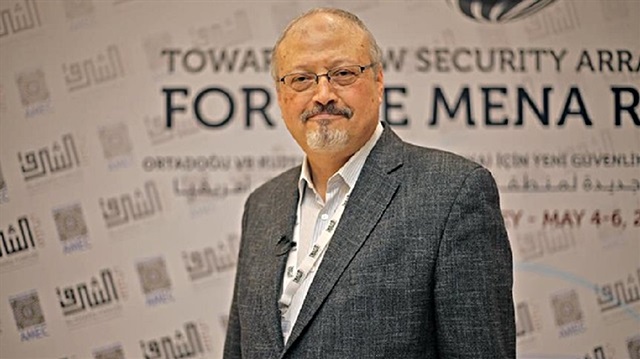
Missing Saudi journalist Jamal Khashoggi
Before his abrupt disappearance early this month, Saudi journalist Jamal Khashoggi had called on Arab youth to avoid the prisons of their respective "dictators" while pursuing the ongoing Arab struggle for freedom.
In an essay written in June for the independent Raseef website, Khashoggi cited a number of personal acquaintances now serving jail for political reasons.
"Being an intellectual isn’t a crime,” he wrote. “The holder of an idea isn’t a criminal, so he’s always unprepared for incarceration.”
Khashoggi went on to tell of a friend of a friend, who, he said, had “ended up in prison last September [and who was] broken by months in solitary confinement”.
Late last year, the Saudi authorities detained dozens of high-profile people -- including princes and cabinet ministers (both former and current) -- in a massive "anti-corruption" sweep.
Saudi billionaire Prince Alwaleed bin Talal and Prince Miteb bin Abdullah, minister for the Saudi National Guard, were both among those rounded up.
Only two months earlier, the Saudi authorities had cracked down on intellectuals and Muslim scholars, including well-known figures such as Salman al-Awda, Waleed Ftaihi, Safar al-Hawali and Ali al-Omari.
The Saudi Scholars Association released a statement on Thursday calling for the removal of Mohammad bin Salman bin Abdulaziz Al Saud from his position as the crown prince of Saudi Arabia.In a statement shared on their official Twitter account, the Saudi Scholars Association dubbed the murder of journalist Jamal Khashoggi as “cruel.”Turkey says Jamal Khashoggi, a Washington Post columnist who was critical of Crown Prince Mohammed bin Salman, was killed by Saudi agents in Riyadh's diplomatic mission in Istanbul on Oct. 2 and his body dismembered. Saudi Arabia denies the allegation.ندعوا أهل الحل والعقد إلى وجوب عزل ولي العهد الأمير محمد بن سلمان فقد بان فسقه واتضح أنه ليس بالعدل ولا من أهل الكفاءة .#المجالس الإسلامية#هيئة_علماء_السعودية #جمال_خاشقجي@alqaradawy @aliqaradaghi pic.twitter.com/A792S2P80Z— هيئة علماء السعودية (@SaudiOlamaa) 18 Ekim 2018 “Our country is now dragged into a dangerous dead-end due to the current crises. Prince Salman, who is responsible for these incidents, has arrested many important figures, and sentenced them to prison,” the statement said.There has been a wave of arrests of academics, writers, and religious figures in the Kingdom since September 2017.The statement went on to say that Salman had wasted public property and that corruption had increased as a result of his poor administration.The Saudi Scholars Association stated that a new crown prince should be appointed, and that those arrested should be freed immediately.US intel ties Saudi Prince to journo’s disappearanceFrance sends mixed signals over Saudi ties after Khashoggi affairUS-Saudi relations in light of Khashoggi case
Saudi Scholars Association calls for Crown Prince Salman to be dethroned
British trade minister Liam Fox has pulled out of a Saudi investment summit next week, the BBC reported on Thursday.Fox was listed as a speaker at the Riyadh summit, which other European ministers and business leaders have also said they will no longer attend following criticism of the kingdom over the disappearance of journalist Jamal Khashoggi.The Department for International Trade was not immediately able to confirm the BBC report. France sends mixed signals over Saudi ties after Khashoggi affairGerman opposition demands end to Saudi arms salesUS-Saudi relations in light of Khashoggi caseDutch pull out of Saudi conference over missing journalistTurkey says results 'expected soon' on Khashoggi case
UK trade minister Fox has pulled out of Saudi investment summit
“Prison has become a tool of governance,” Kashoggi wrote. “It’s no longer a place for criminals; it has become a weapon in the hands of the [dictatorial] state leader, his party, his army and his ruling class.”
He went on to urge Arab youth to find “a viable means for opposing your [respective] regime that does not lead to prison and confrontation”.
“I know this is easier said than done,” he said. “Prison in our world isn’t always punitive; rather, it’s part of political negotiations, lobbying and public control.”
He continued: “Any political party that issues decisions that lead its young cadres to prison is irresponsible... As I always say to the youth in my country: don’t listen to them; avoid prison as much as possible.”
In the same article, Khashoggi calls on the U.S. -- as the global hegemon -- to shoulder its responsibility to confront systematic rights abuses by dictatorial regimes.
Germany’s opposition Left Party has called on the government to suspend weapons sales to Saudi Arabia over the disappearance of Saudi journalist Jamal Khashoggi.Dietmar Bartsch, parliamentary group leaders of the party, sharply criticized Chancellor Angela Merkel’s government for not taking a harsher stance on Riyadh.“The current soft approach of the government, which appears to be due to the big economic deals, is simply not acceptable,” Bartsch said on Thursday in an interview with public television ARD.US-Saudi relations in light of Khashoggi case“One has to stop weapons sales to Saudi Arabia. How one can continue this with such a dictatorship,” he said.Journalist Khashoggi is missing since he entered Saudi Arabia’s consulate in Istanbul on Oct. 2.On that same day, 15 Saudis, including several officials, arrived in Istanbul on two planes and visited the building while Khashoggi was still inside, Turkish police sources said. All of the identified individuals have since left Turkey.Saudi authorities have yet to give a clear explanation of Khashoggi’s fate, while several countries -- particularly Turkey, the U.S. and the U.K. -- have expressed their desire that the matter should be elucidated as soon as possible.Turkey says results 'expected soon' on Khashoggi caseUS rep. introduces bill to ban Saudi arms sales
German opposition demands end to Saudi arms sales
Middle Eastern news headlines have dramatically shifted over the past couple of weeks from the usual fare of Syria, Iraq and Palestine to diplomatic intrigue and stories of assassins murdering journalists. Saudi dissident and Washington Post columnist, Jamal Khashoggi, is feared dead after he was seen entering the Saudi Arabian consulate in Istanbul, but never left. What followed was a flurry of accusations, denials and shuttle diplomacy to extinguish the fires left in the wake of Khashoggi’s disappearance and alleged murder.- Who is Khashoggi?What is perhaps most incredible to me is the sheer outpour of rage directed at the Saudi state for Khashoggi’s disappearance. The outrage is unsurprising, given news stories have suggested that the Saudi columnist was brutally interrogated by a 15-man hit squad sent by Riyadh before being tortured to death [1] over a period of around seven minutes. According to reports, Khashoggi’s body was subsequently dismembered before being made to disappear.This has led to calls for the protection of journalists from state-backed assassins. The main problem here is that Jamal Khashoggi was not a conventional journalist.Turkey says results 'expected soon' on Khashoggi case Khashoggi has had a deep and well-documented connection with the Saudi state since the Soviet invasion of Afghanistan [2], where he worked with the Kingdom’s intelligence service as Riyadh and Washington both supported the jihad against the USSR. He worked as a journalist and travelled throughout Afghanistan, the Middle East and North Africa, likely reporting what he learnt to intelligence handlers.His relationship with high-ranking Saudi royals is also no secret, as he was an advisor to Prince Turki Al Faisal, who was Saudi Arabia’s ambassador to the United States as well as the head of the Kingdom’s intelligence service for 24 years between 1977 and 2001. Far from being a dissident opposed to the Saudi state at a fundamental level, it is important to note that Khashoggi was very much supportive of many of his country’s policies despite his progressive and reformist bent, and had only taken a stand against Riyadh recently, following Crown Prince Mohammad bin Salman’s (MBS) rise to power.One of 15 Saudis that targeted Khashoggi dies in suspicious car accident- US-Saudi relations likely to remain stableAlthough Khashoggi was not a U.S. citizen, he was a permanent resident there and worked for one of the most high-profile newspapers in the country. Therefore, his disappearance has raised hackles and not just eyebrows in Saudi Arabia’s closest ally and backer.Indeed, U.S. President Donald Trump threatened “severe punishment” [3] if it turned out that Saudi Arabia had ordered a hit on the columnist. While Trump would not be drawn on exactly what he meant by punishment, he did say that he would not stop selling arms to Saudi, a country that is currently involved in a military intervention in Yemen against the Iran-backed Houthi Shia militants.Trump also took the crisis as a callous opportunity to essentially squeeze Riyadh for more money, making a speech days after Khashoggi’s disappearance saying that, although he liked King Salman bin Abdulaziz, the Saudi monarch “wouldn’t last two weeks” [4] without US support. As such, Trump said it was only fair that Riyadh paid more for American protection, and as soon as Secretary of State Mike Pompeo landed in the Saudi capital, $100 million was delivered to Washington’s coffers [5].Trump: US requested audio, video on missing journalistThe U.S. administration will continue to protect the Saudi monarchy quite simply because Riyadh’s wealth is so vast. Although Senator Lindsey Graham, normally a staunch supporter of Saudi Arabia, has taken the unusual step of calling on MBS to be ousted by his family as he is a “wrecking ball” [6], Trump has defended the Saudi government, saying that they would be considered innocent until proven guilty [7].Arguably, Trump has a point. To date, there has been a media frenzy surrounding the Khashoggi case, and primarily because the antagonist in this story is Saudi Arabia. There is certainly no doubt about it being suspicious that Khashoggi entered the Saudi consulate and never came out. However, no one yet knows what happened to the Saudi columnist, and most of the information comes from anonymous sources. It is important that authorities provide factual material to media agencies rather than what so far amounts to speculative tidbits that serve to enflame an already tense situation.The pressure caused by the media furore apparently has the Saudi authorities now considering admitting to Khashoggi’s death at the hands of “rogue” agents who may have accidentally killed the journalist in a rendition operation gone horribly wrong. Still, with Trump’s support and the friendship of his son-in-law Jared Kushner, it is likely that top Saudi royals will emerge unscathed while the operatives involved will face harsh punishment. The true tragedy, however, will be that we may never know truly what happened to Jamal Khashoggi, and we may never see his case brought to a just conclusion.By Tallha Abdulrazaq, a researcher at the University of Exeter's Strategy and Security Institute and winner of the 2015 Al Jazeera Young Researcher Award. His research focuses on Middle Eastern security and counter-terrorism issues.[1] https://www.middleeasteye.net/...[2] https://www.middleeasteye.net/...[4] https://edition.cnn.com/2018/1...[5] https://www.nytimes.com/2018/1...[6] https://www.cnbc.com/video/201...[7] https://www.nytimes.com/2018/1...
US-Saudi relations in light of Khashoggi case
“The U.S. State Department issues a report on human rights every year… information contained in these reports is no less accurate than what is reported by independent rights organizations," he asserted.
“But the U.S. is no longer doing anything,” he added. “Only a few sanctions -- if any -- existed. [The U.S.] places maximum sanctions on Iran while forgetting about Egypt and Zimbabwe.”
Both Egypt and Zimbabwe face frequent criticism from international rights groups, which accuse both countries of committing systematic rights abuses.
The Egyptian regime has killed hundreds -- and jailed thousands (some say tens of thousands) -- since its 2013 military coup against the country’s first freely elected president.
And before his ouster last year, Zimbabwean President Robert Mugabe had been accused of committing widespread abuses against members of the country’s political opposition.
A prominent Saudi journalist and intellectual, Khashoggi has remained unaccounted for since Oct. 2, when he entered the Saudi consulate in Istanbul.
Ever since he went missing, speculation has mounted that he was killed by the Saudi authorities, who have yet to provide a convincing explanation for his disappearance.
Meanwhile, several countries -- including Turkey, the U.S. and the U.K. -- have continued to press Riyadh for clarification.