

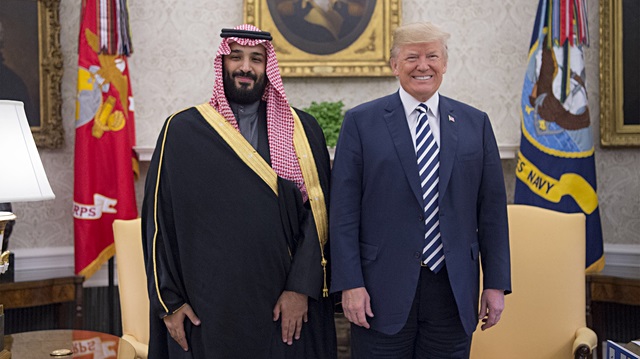
U.S. President Trump meets Crown Prince of Saudi Arabia Al Saud
Middle Eastern news headlines have dramatically shifted over the past couple of weeks from the usual fare of Syria, Iraq and Palestine to diplomatic intrigue and stories of assassins murdering journalists. Saudi dissident and Washington Post columnist, Jamal Khashoggi, is feared dead after he was seen entering the Saudi Arabian consulate in Istanbul, but never left. What followed was a flurry of accusations, denials and shuttle diplomacy to extinguish the fires left in the wake of Khashoggi’s disappearance and alleged murder.
- Who is Khashoggi?
What is perhaps most incredible to me is the sheer outpour of rage directed at the Saudi state for Khashoggi’s disappearance. The outrage is unsurprising, given news stories have suggested that the Saudi columnist was brutally interrogated by a 15-man hit squad sent by Riyadh before being tortured to death [1] over a period of around seven minutes. According to reports, Khashoggi’s body was subsequently dismembered before being made to disappear.
This has led to calls for the protection of journalists from state-backed assassins. The main problem here is that Jamal Khashoggi was not a conventional journalist.
Turkey's justice minister on Thursday said missing Saudi journalist Jamal Khashoggi case is being "thoroughly" investigated and "results are expected to come out soon."Interviewed at Anadolu Agency's Editors' Desk in Ankara, Abdulhamit Gül said Turkish prosecutors are investigating the issue "deeply, successfully and in every step of the way."The Istanbul prosecutors' office will reveal the truth behind the disappearance of Khashoggi, Gül said, adding that "whatever the international law requires will be done."Khashoggi has long been feared killed after he entered the Saudi Consulate building in Istanbul on Oct. 2 and was never seen leaving.On the same day, 15 other Saudis, including several officials, arrived in Istanbul on two planes and visited the consulate while Khashoggi was still inside, according to Turkish police sources. All of the identified individuals have since left Turkey.On Wednesday, crime scene investigation units arrived at the Istanbul residence of Mohammad al-Otaibi around 4.40 p.m. local time (1340 GMT). Al-Otaibi left Turkey for Riyadh on Tuesday.Officials from a joint Turkish-Saudi team completed an investigation into the case early Thursday after searching the Saudi consul general's official residence as well as the Saudi consulate building in Istanbul.The Turkish team concluded its search for evidence in nine hours and left but returned to the Saudi consulate to continue searching the premises.French finance minister to shun Saudi conference over missing journalistOne of 15 Saudis that targeted Khashoggi dies in suspicious car accidentBrunson decisionMinister Gul also spoke on the newly freed American pastor Andrew Brunson."The Turkish judiciary did not make its decision under any influence, under any orders," he said. "This person is not acquitted, the court's verdict was conviction."Gul said Brunson's judicial control and travel ban orders were lifted in accordance with the verdict.Brunson was arrested in December 2016 and charged in the Aegean province of Izmir with being a member of the Fetullah Terrorist Organization (FETO), the group behind a defeated coup earlier that year.After being transferred this July from jail to house arrest, on Friday Brunson was sentenced to just over three years in prison, but released due to time served and his good behavior in custody.The charges against him included spying for both FETO and the PKK, a group recognized as terrorist by the U.S. and EU, and which is responsible for some 40,000 deaths in Turkey, including women and children.US rep. introduces bill to ban Saudi arms salesThousands of terrorists jailedThe justice minister also gave out some statistics about members of terror groups in the country's jails.Gül said there are 1,161 Daesh members, around 32,000 FETO and 10,000 PKK members jailed in Turkey.In its more than 30-year terror campaign against Turkey, the PKK -- listed as a terrorist organization by Turkey, the U.S. and the EU -- has been responsible for the deaths of some 40,000 people, including women and children.US intel ties Saudi Prince to journo’s disappearanceTurkish-Saudi team completes probe at Saudi consulate
Turkey says results 'expected soon' on Khashoggi case
Khashoggi has had a deep and well-documented connection with the Saudi state since the Soviet invasion of Afghanistan [2], where he worked with the Kingdom’s intelligence service as Riyadh and Washington both supported the jihad against the USSR. He worked as a journalist and travelled throughout Afghanistan, the Middle East and North Africa, likely reporting what he learnt to intelligence handlers.
His relationship with high-ranking Saudi royals is also no secret, as he was an advisor to Prince Turki Al Faisal, who was Saudi Arabia’s ambassador to the United States as well as the head of the Kingdom’s intelligence service for 24 years between 1977 and 2001. Far from being a dissident opposed to the Saudi state at a fundamental level, it is important to note that Khashoggi was very much supportive of many of his country’s policies despite his progressive and reformist bent, and had only taken a stand against Riyadh recently, following Crown Prince Mohammad bin Salman’s (MBS) rise to power.
Meshal Saad M. Albostani, one of the 15 suspects who were inside the Saudi consulate when missing journalist Jamaal Khashoggi entered, has died in a suspicious traffic accident. Claims are circulating that Albostani, who is a lieutenant of the Saudi Royal Air Forces, could have been silenced.There is no information about the details of the accident that left Albostani dead.Recordings reveal Khashoggi tortured then dismembered while still aliveAlbostani entered Turkey at 1:45 a.m. local time (2245GMT). He stayed at the Wyndham Grand Hotel and left the country at 9:46 p.m. local time (1846GMT) on a private jet which belonged to the Sky Prime Aviation company.Trump: US requested audio, video on missing journalistKhashoggi, a U.S. resident who wrote columns for the Washington Post and a critic of the Saudi government, has long been feared killed after he entered the Saudi Consulate building in Istanbul on Oct. 2 and was never seen leaving.On the same day, 15 other Saudis, including several officials, arrived in Istanbul on two planes and visited the consulate while Khashoggi was still inside, according to Turkish police sources. All of the identified individuals have since left Turkey.US rep. introduces bill to ban Saudi arms salesWashington Post publishes Khashoggi’s final columnUS intel ties Saudi Prince to journo’s disappearanceTurkish-Saudi team completes probe at Saudi consulate
One of 15 Saudis that targeted Khashoggi dies in suspicious car accident
- US-Saudi relations likely to remain stable
Although Khashoggi was not a U.S. citizen, he was a permanent resident there and worked for one of the most high-profile newspapers in the country. Therefore, his disappearance has raised hackles and not just eyebrows in Saudi Arabia’s closest ally and backer.
Indeed, U.S. President Donald Trump threatened “severe punishment” [3] if it turned out that Saudi Arabia had ordered a hit on the columnist. While Trump would not be drawn on exactly what he meant by punishment, he did say that he would not stop selling arms to Saudi, a country that is currently involved in a military intervention in Yemen against the Iran-backed Houthi Shia militants.
Trump also took the crisis as a callous opportunity to essentially squeeze Riyadh for more money, making a speech days after Khashoggi’s disappearance saying that, although he liked King Salman bin Abdulaziz, the Saudi monarch “wouldn’t last two weeks” [4] without US support. As such, Trump said it was only fair that Riyadh paid more for American protection, and as soon as Secretary of State Mike Pompeo landed in the Saudi capital, $100 million was delivered to Washington’s coffers [5].
The U.S. has requested audio and video evidence concerning Saudi journalist Jamal Khashoggi's disappearance "if it exists," U.S. President Donald Trump said Wednesday.“We have asked for it. If it exists we have asked for it,” Trump told reporters in the Oval Office, adding it "probably does" exist.Trump said he was waiting to be briefed on the missing journalist from Secretary of State Mike Pompeo when he returns from his trip to Ankara and Riyadh.Khashoggi has not been since he entered the Saudi consulate in Istanbul on Oct. 2 as fears mount he was killed in the diplomatic facility.US rep. introduces bill to ban Saudi arms salesMultiple reports have cited audio and video recordings containing grisly details of Khashoggi's alleged killing at the hands of Saudi operatives after he entered the consulate.On the same day Khashoggi entered the consulate, 15 other Saudis, including several officials, arrived in Istanbul on two planes and visited the building while Khashoggi was still inside, Turkish police sources said. All of the identified individuals have since left Turkey.Trump continued to stand by Saudi Arabia after saying earlier this week that Khashoggi's disappearance could have been the work of "rogue killers," but said he is "not giving cover at all" to Riyadh, whom he repeatedly called a close U.S. ally.“They’re an important ally, but I want to find out what happened, where is the fault, and we will probably know that by the end of the week,” Trump added.Saudi Arabia has yet to give a sufficient answer for Khashoggi's fate more than two weeks after he went missing, but continue to deny any role in his disappearance.US intel ties Saudi Prince to journo’s disappearanceTurkish-Saudi team completes probe at Saudi consulate
Trump: US requested audio, video on missing journalist
The U.S. administration will continue to protect the Saudi monarchy quite simply because Riyadh’s wealth is so vast. Although Senator Lindsey Graham, normally a staunch supporter of Saudi Arabia, has taken the unusual step of calling on MBS to be ousted by his family as he is a “wrecking ball” [6], Trump has defended the Saudi government, saying that they would be considered innocent until proven guilty [7].
Arguably, Trump has a point. To date, there has been a media frenzy surrounding the Khashoggi case, and primarily because the antagonist in this story is Saudi Arabia. There is certainly no doubt about it being suspicious that Khashoggi entered the Saudi consulate and never came out. However, no one yet knows what happened to the Saudi columnist, and most of the information comes from anonymous sources. It is important that authorities provide factual material to media agencies rather than what so far amounts to speculative tidbits that serve to enflame an already tense situation.
The pressure caused by the media furore apparently has the Saudi authorities now considering admitting to Khashoggi’s death at the hands of “rogue” agents who may have accidentally killed the journalist in a rendition operation gone horribly wrong. Still, with Trump’s support and the friendship of his son-in-law Jared Kushner, it is likely that top Saudi royals will emerge unscathed while the operatives involved will face harsh punishment. The true tragedy, however, will be that we may never know truly what happened to Jamal Khashoggi, and we may never see his case brought to a just conclusion.
By Tallha Abdulrazaq, a researcher at the University of Exeter's Strategy and Security Institute and winner of the 2015 Al Jazeera Young Researcher Award. His research focuses on Middle Eastern security and counter-terrorism issues.
[1] https://www.middleeasteye.net/...[2] https://www.middleeasteye.net/...
[4] https://edition.cnn.com/2018/1...
[5] https://www.nytimes.com/2018/1...