

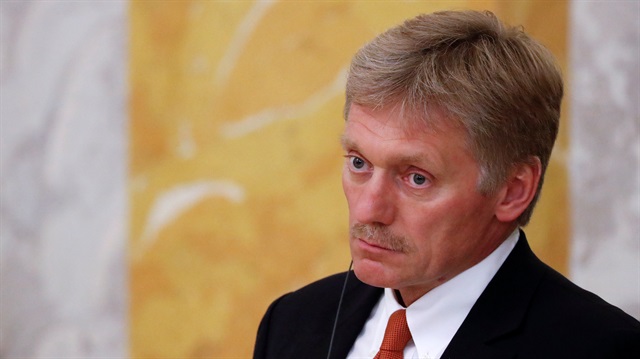
Kremlin spokesman Dmitry Peskov
The Kremlin said on Wednesday it needed to understand if there was political will in Washington to cooperate with Russia as it prepared for a meeting between U.S. National Security Adviser John Bolton and his Russian counterpart Nikolai Patrushev.
The two men are due to meet in Geneva for talks on Thursday in the first high-level meeting since the Russian and U.S. presidents held talks in Helsinki in July.
U.S. President Donald Trump met Russian President Vladimir Putin last month, an event Moscow quickly chalked up as a triumph. However, a new salvo of U.S. sanctions was announced in the wake of the meeting after Trump came under fire at home for his handling of the summit.
"The worsening of bilateral relations is continuing, we need to identify some kind of areas for cooperation and also to understand if there are any such areas and whether our counterpart (the United States) has a desire for this," Kremlin spokesman Dmitry Peskov told reporters on a conference call.
Peskov said Putin had met his Security Council on Wednesday to discuss problems in U.S.-Russia relations ahead of the meeting between Bolton and Patrushev.
During a trip to Israel on Wednesday, Bolton told Reuters that Russian forces were "stuck" in Syria and that Moscow was looking for other countries to fund post-war reconstruction there.
Russia launched an intervention in Syria in 2015, turning the tide of the war in favour of its ally, Syrian President Bashar al-Assad.
Peskov said Moscow disagreed with Bolton's statement, saying Moscow was helping to facilitate the return of refugees to Syria and to start the reconstruction process.
"The statement that Russia is stuck is not correct, even more so coming from our colleagues in Washington. We shouldn't forget that American soldiers are also on Syrian territory," said Peskov.
Castigated by U.S. President Donald Trump as relying too much on Russian gas supplies, German Chancellor Angela Merkel heads to Azerbaijan this week to discuss the development of a southern pipeline to deliver gas to Europe from the Caspian.The visit underscores Merkel's openness to finding alternative sources of affordable gas even as she remains committed to the Nord Stream 2 pipeline, which will carry gas directly from Russia under the Baltic Sea to Germany."We have a big interest in further developing the Southern Corridor," a senior German government official said."This is part of the EU's diversification strategy of getting gas from other regions, not just Russia, to Europe."In Baku, Merkel will discuss energy issues, including improving the infrastructure to help transport gas from Azerbaijan to Europe via Turkey, officials said.Azerbaijan looks set to play a crucial role as it plans to launch the second stage of a gas pipeline from the vast Shah Deniz field to Europe. Shah Deniz II is expected to produce 16 billion cubic metres (bcm) of gas a year from 2020, with 10 bcm earmarked for Europe and 6 bcm for Turkey and Georgia.Later, gas could be brought from Turkmenistan, Iran and Iraq to Europe. In a sign of progress, Iran, Russia, Kazakhstan, Turkmenistan and Azerbaijan agreed in principle this month on how to divide the potentially huge oil and gas resources of the Caspian Sea.However, the southern pipeline is dwarfed by Nord Stream 2, a Gazprom initiative that will double Russia's export capacity to Europe to 110 bcm. That pipeline is welcomed by much of German industry, which wants as much cheap gas as possible.Last month Trump, who is pressing Germany to buy more U.S. liquefied natural gas, lambasted Germany as being "a captive" of Russia due to its dependence on Russian energy, a charge Germany denies. Trump has called Nord Stream 2 "horrific".Germany imported 39 percent of its gas from Russia in the first half of 2018, figures from state foreign trade authority BAFA showed.Merkel discussed energy in talks with Russian President Vladimir Putin at a palace outside Berlin at the weekend. She is trying to assuage some Nord Stream 2 critics by ensuring Ukraine does not suffer from lower gas transit revenues.Merkel also travels to Georgia and Armenia on her three-day trip, which starts on Thursday. She will hold talks with Azeri President Ilham Aliyev on Saturday.
After Trump attack on Russia ties, Merkel eyes Azeri gas
Russia's Foreign Ministry said on Wednesday it regretted Washington's refusal to take part in Afghanistan peace talks in Moscow on Sept. 4.Russia invited 12 countries, including the United States, to the talks, which are taking place as Moscow pushes for a more prominent role in Afghanistan.
Russia regrets US refusal to attend Moscow talks on Afghanistan
The U.S. sanctioned two Russian shipping companies and six of their ships Tuesday over alleged violations of UN and U.S. sanctions on North Korea.The two shipping companies -- Primorye Maritime Logistics Co Ltd and Gudzon Shipping Co LLC -- are suspected of transferring petroleum products to the North in violation of UN-mandated caps on such imports.The companies are alleged to own the Russian-flagged Patriot ship, which the Treasury Department said participated in two ship-to-ship transfers of roughly 3,500 tons of oil to North Korea-flagged ships. The purchaser of the oil transfers was ultimately Taesong Bank, which the Treasury said is linked to the Workers' Party of Korea Office 39, a secretive group "which engages in illicit economic activities for North Korean leadership."“Ship-to-ship transfers with North Korea-flagged vessels from Russia or elsewhere of any goods being supplied, sold, or transferred to or from the DPRK are prohibited under the UN Security Council resolutions on North Korea and are sanctionable under U.S. law,” Treasury Secretary Steven Mnuchin said in a statement.Americans are now generally prohibited from doing business with the two Russian shipping firms, and any assets they have in the U.S. have been frozen.Six of their vessels are also affected including the Patriot, Neptun, Bella, Bogatyr, Partizan and Sevastopol.In a separate announcement, the U.S. said it blacklisted two individuals and two companies for working on behalf of a company the U.S. sanctioned in June for seeking to provide the Russian government with underwater equipment and diving systems.Marina Igorevna Tsareva allegedly worked on behalf of Divetechnoservices, the sanctioned company, as well as Vela-Marine Ltd., which was blacklisted Tuesday by the Treasury.Anton Aleksandrovich Nagibin is also suspected of helping Divetechnoservices circumvent U.S. sanctions.Slovakia-based Lacno S.R.O. was sanctioned for working with Divetechnoservices.
US sanctions Russian shipping firms, individuals
Russian Deputy Foreign Minister Sergei Ryabkov on Tuesday sharply criticized new U.S. sanctions against Russia linked to North Korea.The U.S. operates on the principle of "the worse, the better", Rybkov said in a statement posted on the Russian Foreign Ministry website that detailed the sanctions for alleged violations of UN and U.S. sanctions on North Korea."We oppose the stubborn, blinkered and aggressive approach of the Americans to solve bilateral and international problems with a calm, methodical work on a constructive agenda,” he said. “We responded and will respond so the sanctions in a manner that will not harm our own interests.”The U.S. Treasury Department sanctioned two shipping companies, Primorye Maritime Logistics Co Ltd and Gudzon Shipping Co LLC, on Aug. 21 that are accused of transferring petroleum products to North Korea in violation of UN-mandated caps on such imports.Six vessels are also affected including the Patriot, Neptun, Bella, Bogatyr, Partizan and Sevastopol.In a separate announcement, the U.S. said it blacklisted two individuals - Marina Tsareva and Anton Nagibin, as well as the two companies, Divetechnoservices and Slovakia-based Lacno S.R.O., for working on behalf of a company the U.S. sanctioned in June for seeking to provide the Russian government with underwater equipment and diving systems.Trump not the isolationist many feared, says UK foreign minUS sanctions hurt NATO alliance, says Turkish FMRussia's Putin still hopes for better US ties despite sanctionsIran says its economy not in 'dead-end' from US sanctions
Russian Foreign Ministry slams new US sanctions