

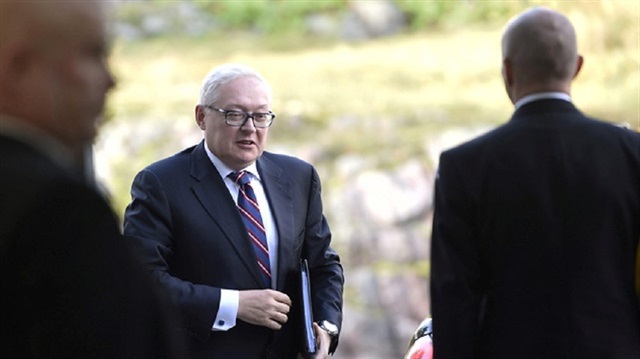
Russian Deputy Foreign Minister Sergei Ryabkov
Russian Deputy Foreign Minister Sergei Ryabkov on Tuesday sharply criticized new U.S. sanctions against Russia linked to North Korea.
The U.S. operates on the principle of "the worse, the better", Rybkov said in a statement posted on the Russian Foreign Ministry website that detailed the sanctions for alleged violations of UN and U.S. sanctions on North Korea.
"We oppose the stubborn, blinkered and aggressive approach of the Americans to solve bilateral and international problems with a calm, methodical work on a constructive agenda,” he said. “We responded and will respond so the sanctions in a manner that will not harm our own interests.”
The U.S. Treasury Department sanctioned two shipping companies, Primorye Maritime Logistics Co Ltd and Gudzon Shipping Co LLC, on Aug. 21 that are accused of transferring petroleum products to North Korea in violation of UN-mandated caps on such imports.
Six vessels are also affected including the Patriot, Neptun, Bella, Bogatyr, Partizan and Sevastopol.
In a separate announcement, the U.S. said it blacklisted two individuals - Marina Tsareva and Anton Nagibin, as well as the two companies, Divetechnoservices and Slovakia-based Lacno S.R.O., for working on behalf of a company the U.S. sanctioned in June for seeking to provide the Russian government with underwater equipment and diving systems.
U.S. President Donald Trump has not been the isolationist that many feared he would be, Britain's Foreign Secretary Jeremy Hunt said ahead of his first trip to the United States in the role.Later on Tuesday Hunt will call on the European Union to follow the United States in extending sanctions on Russia in a speech in Washington, and he said that the United States remained Britain's closest ally."It's important... whatever the controversies around Donald Trump, to recognise that actually he has not been the isolationist president that many feared he would," Hunt told BBC radio, in an interview recorded before his departure to Washington.
Trump not the isolationist many feared, says UK foreign min
In an opinion piece to USA Today, Turkish Foreign Minister Mevlut Cavusoglu said on Monday the U.S. attempts to undermine Turkish economy hurt the NATO alliance.The article outlined the Turkish commitment to the alliance, both in policy and military support, and stressed that the way to solve the tensions between Ankara and Washington is through diplomacy, not tariffs."President [Donald] Trump was right when he called on members of the North Atlantic Treaty Organization to step up their defense spending. But new American sanctions targeting Turkey — and the threat of more to come — alienate one of the few NATO allies that has been ahead of the curve," Cavusoglu wrote.The foreign minister highlighted the country's commitment to NATO's defense spending, both committing to their guideline to spend 2 percent of the country's global domestic product (GDP) on defense, and already surpassing the NATO guideline of spending 20 percent on military equipment. Turkey also hosts the alliance's second largest military force."The economic sanctions Mr. Trump’s administration is imposing on Turkey, however, are poised to disrupt any atmosphere of cooperation — all while global threats demand that we strengthen, not weaken, the ties that bind us together," he said.On Syria, Cavusoglu cited a statement by a U.S. official saying that Turkey "suffered more casualties from terrorism in the past several years than any other Ally," and highlighted the strategic importance of its Incirlik air base which is being used by the U.S.-led coalition forces to fight Daesh terrorists in Syria."Over the past two years, we have arrested hundreds of suspected ISIS [Daesh] members, helping to prevent the group’s spread to Western capitals. In the face of this threat, Turkey has been the tip of the spear," Cavusoglu added.He also recalled that Turkey welcomed millions of Syrian refugees, being one of the few countries to do so.The tariffs sanctioned by the U.S. on Turkey will not just harm Turkey, but also harm the U.S. and Europe, according to Cavusoglu.He used the warning by the U.S. Chamber of Commerce, which told President Donald Trump that his actions "harm the U.S. economy and undermine American global leadership"."This reckless escalation needs to stop," said Cavusoglu, adding that both countries agree on a wide range of issues although they may have different views on significant ones."For everyone’s sake, we should address our disagreements with diplomacy, rather than threats and provocation, and with a commitment to facts and perspective," Cavusoglu added.Turkey and the U.S. are currently experiencing rocky relations following Washington’s imposition of sanctions on two government ministers for not releasing American pastor Andrew Brunson, who faces terrorism-related charges in Turkey.On Aug. 10, President Donald Trump ramped up his attack on Turkey by doubling U.S. tariffs on Turkish aluminum and steel imports. Last Wednesday, in retaliation, Turkey increased tariffs on several U.S.-origin products, including alcohol and tobacco products and cars.
US sanctions hurt NATO alliance, says Turkish FM
Russian President Vladimir Putin still hopes to pull Moscow's ties with Washington out of a deep crisis, but nobody will go into mourning if this ambition is not reciprocated by the United States, the Kremlin said on Monday.Moscow is bracing itself for a slew of new U.S. sanctions despite Putin meeting U.S. President Donald Trump at a summit in Helsinki in July, an encounter both sides said went well.Initial Russian triumphalism after the summit turned sour however as anger over what some U.S. lawmakers saw as an over deferential Trump performance galvanised a new sanctions push.The U.S. State Department has said it will impose fresh sanctions by the end of this month, while bi-partisan legislation from senators calls for other curbs to be widened.Moscow is also bracing itself for potential U.S. measures designed to frustrate its Nord Stream 2 gas pipeline project.Kremlin spokesman Dmitry Peskov told reporters on a conference call that the new U.S. sanctions proposals were unfriendly, illegal and would harm world trade."Let's wait and see what will happen, if anything," said Peskov, saying any Russian response would be dictated by Russia's own national interests."The Russian president is hoping for the best and, despite all this, wants to pull our bilateral ties out of the deep crisis they are in. He (Putin) still has that desire. But at the same time nobody plans to go into mourning if our approach is not reciprocated by Washington." 
Russia's Putin still hopes for better US ties despite sanctions
Iran's vice president said on Saturday the Islamic Republic would resist pressures from U.S. sanctions by relying on its oil and other natural resources."It is a critical moment for our economy, but we are not in a dead end ... this country has plenty of human and natural resources that can rely on,” Eshagh Jahangiri was quoted as saying by the IRNA news agency.German rail operator phases out Iran projects'Putin may meet leaders of Turkey, Iran at summit in Sept'US is trying to make Iran 'surrender' through sanctions
Iran says its economy not in 'dead-end' from US sanctions