

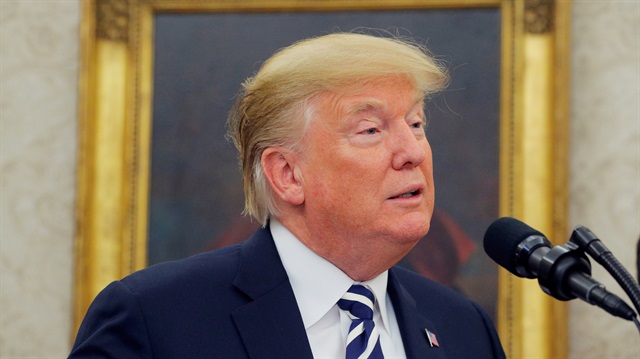
U.S. President Donald Trump
President Donald Trump said Monday he would meet with Iran's leadership without preconditions as the countries grapple with the consequences of his decision to pull the U.S. out of a landmark nuclear accord.
"I would certainly meet with Iran if they wanted to meet," Trump told reporters at a joint press conference with Italian Prime Minister Giuseppe Conte at the White House, caging his words by saying he is unsure if Iran is ready to talk but insisting that talks could be beneficial.
“Speaking to other people, especially when you’re talking about potentials of war and death and famine and lots of other things, you meet. There’s nothing wrong with meeting," Trump added.
Earlier Monday, Iran's foreign ministry dismissed the possibility of holding talks with Washington, saying "it is not possible to have talks with a U.S. administration that adopts hostile policies against Iran".
Trump elicited Iran's furor in May when he unilaterally pulled the U.S. out of the 2015 nuclear accord the five permanent members of the UN Security Council and Germany struck with Iran. The deal saw Tehran accept unprecedented curbs and inspections on its nuclear program in exchange for billions of dollars in sanctions relief.
The U.S.'s negotiating partners have been seeking to shore up the agreement and its restrictions on Iran's nuclear program. But following his announcement, Trump and his administration have been seeking to get others to follow suit with the threat of sanctions that are expected to take effect next week.
Officials from Turkey, Russia and Iran were holding technical talks Monday in Sochi, Russia, ahead of a 10th round of Syria peace talks in Astana, Kazakhstan, slated for July 31st.The Astana talks will address the latest situation in de-escalation zones in Syria's Idlib, the return of the refugees, the release of prisoners and the formation of a committee that will rewrite Syria's constitution.UN officials and Jordan are taking part in Monday's talks as observers while the U.S. again opted not to send a representative.The main Syrian opposition group is represented by Ahmed Tuma, the former premier of the Syrian interim government, and the regime is represented by Bashar Jaafari, the regime's permanent representative to the UN.During the 9th Astana meeting held on May 14-15, all parties agreed to maintain the de-escalation zones and the cease-fire regime.However, Assad's forces and his allies took control of the de-escalation zones in Homs region, Daraa and in Quneitra following a heavy offensive.Last week, the regime began military build-up in southwestern Idlib in a bid to attack Syria’s northwestern Turkmen Mountain region, which is located within the de-escalation zones.Idlib is set to be a top issue during the next Astana meeting as the Turkish delegation is expected to underline the importance of maintaining the cease-fire regime in the region.Separately, Russia for the first time is expected to bring up the issue of the return of refugees and displaced persons during the meeting.Russian officials have recently visited Turkey, Jordan and Lebanon, which host the majority of Syria's refugees.UN Special Envoy for Syria Staffan de Mistura is expected to meet with the Turkish, Russian and Iranian officials on the formation of a constitutional committee.The regime and opposition had each submitted to de Mistura a list of 50 candidates to represent them in the constitutional committee.
Turkey, Russia, Iran meet ahead of Syria talks
Iran's currency plunged to another record low on Sunday, dropping past 100,000 rials to the U.S. dollar as Iranians brace for Aug. 7 when the United States is due to reimpose a first lot of sanctions on their economy.In May the United States pulled out of a 2015 deal between world powers and Tehran under which international sanctions on Iran were lifted in return for curbs on its nuclear programme.Washington decided to reimpose sanctions on Iran upon its withdrawal, accusing it of posing a security threat, and has told countries they must halt all imports of Iranian oil from Nov. 4 or face U.S. financial measures.On Sunday, the Iranian rial plunged to 111,500 against one U.S. dollar on the unofficial market, down from about 97,500 rials on Saturday, according to foreign exchange website Bonbast.com. Other websites said the dollar was exchanged between 108,500 and 116,000 rials.The rial has lost about half of its value since April because of a weak economy, financial difficulties at local banks and heavy demand for dollars among Iranians who fear the effects of sanctions.U.S. President Donald Trump has called the agreement one of the worst deals ever negotiated but in a bid to salvage the accord, Iran’s European partners in the nuclear deal are preparing a package of economic measures to offset the U.S. pullout.However, France said earlier this month that it was unlikely European powers would be able to put together an economic package for Iran that would salvage its nuclear deal before November.On Aug. 7, the United States will reimpose sanctions on the purchase or acquisition of U.S. dollars by the Iranian government, Iran's trade in gold and precious metals, and on the direct and indirect sale, supply and transfer to or from Iran of graphite, raw or semi-finished metals, coal and industrial-related software.Sanctions also will be reapplied to the importation into the United States of carpets and foodstuffs made in Iran, and on certain related financial transactions.Iran’s oil exports could fall by as much as two-thirds by the end of the year because of the new U.S. sanctions, putting oil markets under huge strain amid supply outages elsewhere in the world. 
Iran currency extends record fall as US sanctions loom
The first round of sanctions, largely targeting Iran's banking sector, are set to take effect Aug. 6. A second, more robust wave of oil-related sanctions is set to snap back Nov. 4.
With “Washington's hostile measures against Tehran and its efforts to put economic pressure on the country and impose sanctions, there will remain no possibility for talks,” Iran's Foreign Ministry spokesman Bahram Qasemi told reporters.
Trump maintained, however, that talks would be "good for the country. Good for them, good for us. And good for the world," and said he believes Iran will be willing to sit down eventually.
"I do believe that they will probably end up wanting to meet, and I’m ready to meet anytime they want to," he said.
Iran’s Foreign Ministry on Monday dismissed the possibility of holding any talks with the United States.“It is not possible to have talks with a U.S. administration that adopts hostile policies against Iran,” ministry spokesman Bahram Qasemi told a press conference in Tehran.He said the administration of Donald Trump has proved it was untrustworthy.With “Washington's hostile measures against Tehran and its efforts to put economic pressure on the country and impose sanctions, there will remain no possibility for talks,” he said.Iran woos local investors as U.S. sanctions loom, currency fallsIran's Gen. Soleimani warns Trump: 'War will destroy everything you own'In May, Trump withdrew the U.S. from the nuclear deal, which was signed in 2015 between Iran and the P5 1 group of nations (the five permanent members of the UN Security Council plus Germany).The 2015 deal places restrictions on Iran’s nuclear program in exchange for billions of dollars in sanctions relief.During his electoral campaign in 2016, Trump had criticized the agreement, describing it as the “worst deal” he had ever seen.Other members of the P5 1, however, say the deal in its current form represents the best means of reigning in Iran's nuclear program.
Iran denies any ‘possible’ talks with US
Shutdown
Trump continued to double down on his threat to shut down the U.S. government if Congress does not sign off on his border security proposals, emphasizing that in addition to his long list of measures, "border security includes the wall" he has promised to build on the U.S.'s southern border.
"If we don’t get border security, after many, many years of talk within the United States, I would have no problem doing a shutdown," he said. "I would be certainly willing to consider a shutdown if we don’t get proper border security."
The last government shutdown that affected government services occurred in January and lasted only three days. Another brief shutdown in February lasted under half a day.
Government funding will expire at the end of the current fiscal year, which concludes at the end of September.
The prospect of a shutdown has rattled Republicans ahead of November's midterm elections, where they are seeking to maintain their slim hold on the Senate and maintain their majority in the House.
Senate Majority Leader Mitch McConnell conceded Friday that funding for Trump's wall would "probably" have to wait until after the midterms.