

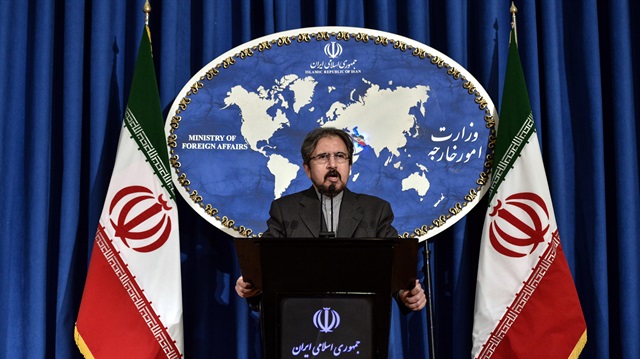
File photo: Iranian Foreign Ministry spokesman Bahram Qasemi
Iran’s Foreign Ministry on Monday dismissed the possibility of holding any talks with the United States.
“It is not possible to have talks with a U.S. administration that adopts hostile policies against Iran,” ministry spokesman Bahram Qasemi told a press conference in Tehran.
He said the administration of Donald Trump has proved it was untrustworthy.
With “Washington's hostile measures against Tehran and its efforts to put economic pressure on the country and impose sanctions, there will remain no possibility for talks,” he said.
Iran plans to offer price and tax incentives to private investors to take over idle state projects and help boost the economy, state media reported on Saturday, as the country faces likely U.S. sanctions and the exit of many foreign companies.In May the United States pulled out of a multinational deal to lift sanctions against Iran in return for curbs on its nuclear programme, and Washington has told countries they must halt all imports of Iranian oil from Nov. 4 or face U.S. financial measures.The new Iranian plan, along with action against alleged financial crime, appears to be aimed at easing concern over the U.S. decision.The probable return of sanctions has triggered a rapid fall of Iran’s currency, protests by bazaar traders usually loyal to the Islamist rulers, and a public outcry over alleged profiteering.The plan will offer attractive prices and flexible terms as well as tax holidays for investors who agree to take over some of the 76,000 government projects which are unfinished or idle, Vice-President Eshaq Jahangiri said on state television."Over the past few months, the country's liquidity has gone into housing, foreign exchange and gold coins, raising prices and provoking public concerns," Jahangiri was quoted as saying by the website of the state broadcaster."A main issue in the meeting ... was to find solutions to push liquidity towards employment and activating manufacturing," Jahangiri added after the meeting attended by President Hassan Rouhani, and the heads of parliament and the judiciary.Pulling OutThe sanctions start to come into effect in August but some European companies investing in Iran and with big U.S. operations have already announced they will pull out of business deals with Tehran.The Iranian rial plunged to a record low against the U.S. dollar on the unofficial market on Saturday. The dollar was offered for as much as 97,500 rials, compared to about 85,500 a week ago, according to foreign exchange website Bonbast.com.The currency has lost more than half of its value this year because of a weak economy, financial difficulties at local banks and heavy demand for dollars among Iranians who fear the effects of sanctions.Judiciary spokesman Gholamhossein Mohseni Ejei said on Saturday that 18 people had been arrested over alleged profiteering from foreign exchange dealings and the illegal importing of luxury cars, state television reported.In late December, demonstrations which began over economic hardship spread to more than 80 Iranian cities and towns. At least 25 people died in the unrest, the biggest expression of public discontent in almost a decade.Demonstrators initially vented their anger over high prices and alleged corruption, but the protests took on a rare political dimension, with a growing number of people calling on Supreme Leader Ayatollah Ali Khamenei to step down. 
Iran woos local investors as U.S. sanctions loom, currency falls
The chief of Iran's Quds force said on Thursday that U.S. President Donald Trump should address him when threatening the Islamic Republic, the Iranian Young Journalists' Club reported."As a soldier, it is my duty to respond to Trump's threats ... If he wants to use the language of threat ... he should talk to me, not to the president (Hassan Rouhani)," Major-General Qassem Soleimani was quoted as saying in the central city of Hamedan.Iran has dismissed a warning from Trump that Tehran risked dire consequences “the like of which few throughout history have suffered before” if it made threats against the United States.Erdoğan: Iran is both our neighbour and strategic partnerIran's Quds force chief says Red Sea no longer secure with US presenceIran's Quds force chief Qassem Soleimani said on Thursday that the Red Sea was not secure with the presence of American troops in the area, Iran's Arabic-language Al Alam television reported."The Red Sea which was secure is no longer secure with the American presence ... (U.S. President Donald) Trump should know that we are nation of martyrdom and that we await him," Qasem Soleimani was quoted as saying.The Red Sea is one of the most important trade routes in the world for oil tankers.With economy faltering, Iran appoints two new heads of key agenciesUS 'ready' to make new Iran deal amid heated exchange
Iran's Gen. Soleimani warns Trump: 'War will destroy everything you own'
In May, Trump withdrew the U.S. from the nuclear deal, which was signed in 2015 between Iran and the P5 1 group of nations (the five permanent members of the UN Security Council plus Germany).
The 2015 deal places restrictions on Iran’s nuclear program in exchange for billions of dollars in sanctions relief.
During his electoral campaign in 2016, Trump had criticized the agreement, describing it as the “worst deal” he had ever seen.
Other members of the P5 1, however, say the deal in its current form represents the best means of reigning in Iran's nuclear program.