

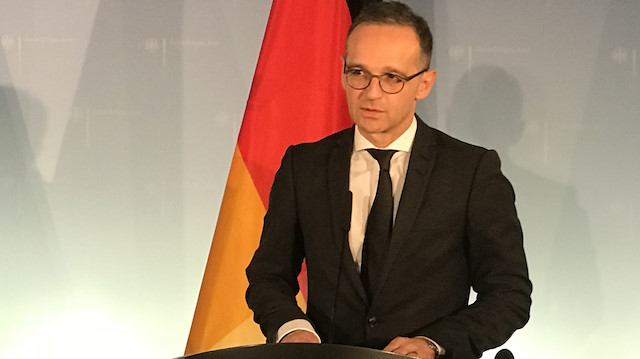
German FM Heiko Maas
Germany cannot accept China’s “re-education” camps for Uighur Muslims, said the country’s Foreign Minister Heiko Maas on Tuesday.
Many refer to China’s Xinjiang Uighur Autonomous Region -- home to many ethnic minority groups, including Turkic Uighur people -- as East Turkestan.
They believe that the Uighur are among a number of Turkic tribes that inhabit the region, and consider it to be part of Central Asia, not China.
The world should ignore "gossip" about China's Xinjiang region and trust authorities there, the Chinese government's top diplomat said on Tuesday when asked if Beijing would allow international observers to inspect camps holding Muslims there.Western countries including Canada, France, Germany, and the United States have called on China to close down camps in Xinjiang, where activists say as many as 1 million members of the Uighur minority and other Muslims are being detained.China has said in the past that Xinjiang faces a threat from Islamist militants and separatists. It rejects all accusations of mistreatment and denies mass internment.Germany cannot accept China’s camps for Uighur MuslimsAfter initial blanket denials, however, Chinese officials have said some people guilty of minor offences were being sent to "vocational" training centres, where they are taught work skills and legal knowledge aimed at curbing militancy.State Councillor Wang Yi told reporters after a meeting with Germany's foreign minister, Heiko Maas, that he hoped people would understand and support the Xinjiang regional government's efforts to combat terrorism, put an end to the spread of extremism and provide for social stability."(People) should not listen to gossip or rumour, because the Xinjiang regional government, of course, understands the situation in Xinjiang best, and not some other people or organisations," said Wang, who is also foreign minister.China triples spending to expand detention camps for Uighur Muslims"The efforts are completely in-line with the direction the international community has taken to combat terrorism, and are an important part of the global fight against terrorism," Wang said."If we can take care of prevention, then it will be impossible for terrorism to spread and take root," he said.Reports of mass detentions and strict surveillance of Uighurs and other Muslims have prompted the United States to consider sanctions against officials and companies linked to suspected human rights abuses.Researchers have noted that spending on security-related construction in Xinjiang tripled in 2017, and that despite the "vocational training" campaign, Xinjiang government data shows employment has not markedly improved.China rejects Western concerns on alleged Uighur mass detentionsWest calls on China to close Uighur detention campsSecurity spending soars in China's troubled Xinjiang region: reportActivists urge deep scrutiny of China at UN rights gathering this week
China says world should ignore 'gossip' about Xinjiang
Established under the pretext of “political reeducation” for China’s Muslim population, Beijing has amped up its construction of detention camps in the past three months, expanding them by an additional 700,000 square meters, according to satellite imagery.
China’s Muslim incarceration camps have attracted heavy criticism from the international community as Beijing continually denied their existence and repeatedly rejected allegations of abuses against the country’s Uighur minority for years, opting to call them “vocational camps” instead.
Xinjiang region is home to around 10 million Uighurs. The Turkic Muslim group which makes up around 45 percent of the population of Xinjiang, has long accused China’s authorities for cultural, religious and economic discrimination.
German Foreign Minister Heiko Maas will raise human rights issues in Xinjiang province of China on his upcoming visit to the country, his spokesperson said on Friday.“From our point of view, the situation in Xinjiang is worrying. Foreign Minister Maas will raise the issue with his Chinese counterpart,” Maria Adebahr told a news conference in Berlin.Adebahr said during the visit beginning on Sunday, delegations will also review preparations for the next human rights dialogue meeting between Germany and China, which is scheduled for December.Muslims in Xinjiang face repression: German parliamentOn Thursday, German lawmakers called on China to end repressive policies against Uighur Muslims in northwestern Xinjiang, an autonomous region of the country.During a debate at the parliament, lawmakers from opposition parties and Chancellor Angela Merkel’s coalition government, urged Chinese authorities to end massive surveillance in the region, and abolish arbitrary detention of up to one million people in internment camps.
German FM to raise Uighur concerns on China visit
Western countries including Canada, France and Germany called on China on Tuesday to close down detention camps, which activists say hold 1 million Uighurs and other Muslims.At a debate at the U.N. Human Rights Council in Geneva -- which reports on human rights in each U.N. member state every five years and is reviewing China's record this week -- Beijing said it protected the freedoms of ethnic minorities.But one after another, Western countries spoke out against what they described as a deterioration in China's human rights since the last review, especially over its treatment of Muslims in the western province of Xinjiang.Beijing should "halt massive imprisonment" and "guarantee freedom of religion and belief, including in Tibet and Xinjiang," France's ambassador Francois Rivasseau said. Germany called for an end to "all unlawful detention including unconstitutional mass detention of Uighurs and other Muslims in Xinjiang."Security spending soars in China's troubled Xinjiang region: reportCanada's envoy Rosemary McCarney said Ottawa was "deeply concerned by credible reports of mass detention, repression and surveillance of Uighurs and other Muslims in Xinjiang."Canada recommends that China release Uighurs and other Muslims who have been detained arbitrarily and without due process for their ethnicity or religion," she said. Similar statements were made by diplomats from Australia and Japan.In his opening speech, Le Yucheng, China's vice minister for foreign affairs, made no mention of the allegations of mass detentions."We protect the rights of ethnic minorities in accordance with law, all 55 ethnic groups are represented in the National Congress and Chinese Communist Party," he said.A United Nations panel of human rights experts said on Aug. 10 it had received many credible reports that 1 million ethnic Uighurs in China were being held in what resembles a "massive internment camp that is shrouded in secrecy."China has said in the past that Xinjiang faces a threat from militants and separatists. It rejects all accusations of mistreatment and denies mass internment, although Chinese officials have said some citizens guilty of minor offences were being sent to vocational centres to work.Around 1,000 Tibetan and Uighur protesters from around Europe protested outside the U.N. headquarters in Geneva during the debate.
West calls on China to close Uighur detention camps