

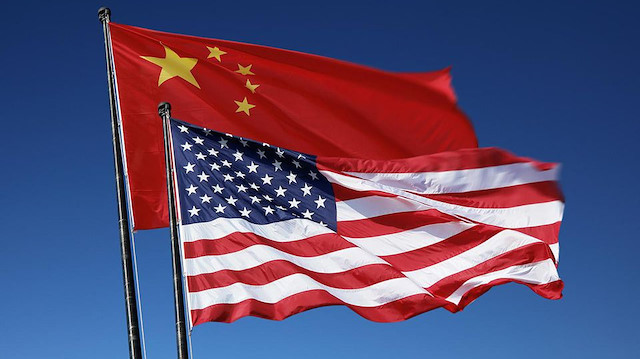
File photo
China and the United States discussed the road map for the next stage of their trade talks on Tuesday, during a telephone call between Vice Premier Liu He and U.S. Treasury Secretary Steven Mnuchin and Trade Representative Robert Lighthizer.
This month in Argentina, U.S. President Donald Trump and Chinese President Xi Jinping agreed to a truce that delayed the planned Jan. 1 U.S. increase of tariffs to 25 percent from 10 percent on $200 billion worth of Chinese goods.
Lighthizer said on Sunday that unless U.S.-China trade talks wrap up successfully by March 1, new tariffs will be imposed, clarifying there is a "hard deadline" after a week of seeming confusion among Trump and his advisers.
China's commerce ministry, in a brief statement, said Liu had spoken to Mnuchin and Lighthizer on Tuesday morning, Beijing time, on a pre-arranged telephone call.
A Chinese court has ordered a sales ban of some older Apple Inc iPhone models in China for violating two patents of chipmaker Qualcomm Inc, though intellectual property lawyers said enforcement of the ban was likely still a distant threat.The case, brought by Qualcomm, is part of a global patent dispute between the two U.S. companies that includes dozens of lawsuits. It creates uncertainty over Apple's business in one of its biggest markets at a time when concerns over waning demand for new iPhones are battering its shares.Apple said on Monday that all of its phone models remained on sale in mainland China and that it had filed a request for reconsideration with the court, the first step in a long appeal process that could end up at China's Supreme Court."It's incredibly unlikely, I'd say almost impossible (that Apple would have to stop sales)," said a Beijing-based IP lawyer who is not directly connected with the Qualcomm case but has worked with large U.S. tech firms.Apple assembler Foxconn considering iPhone factory in Vietnam"In all likelihood it will drag on for some time. It's worth keeping in mind that this is just one battle in a larger rift", he said, referring to the legal fight between Qualcomm and Apple that stretches from European courts to South Korea.Qualcomm said in a statement the Fuzhou Intermediate People's Court in China found Apple infringed two patents held by the chipmaker and ordered an immediate ban on sales of older iPhone models, from the 6S through the X.Apple said the trio of new models released in September were not part of the case."Qualcomm's effort to ban our products is another desperate move by a company whose illegal practices are under investigation by regulators around the world," Apple said.Amazon to allow Apple Music on its Echo speakersReuters couldn't immediately reach the court for comment.China, Hong Kong and Taiwan are Apple's third-largest market, accounting for about one-fifth of Apple's $265.6 billion in sales in its most recent fiscal year.Qualcomm, the biggest supplier of chips for mobile phones, filed its case in China in late 2017, arguing that Apple infringed patents on features related to resizing photographs and managing apps on a touch screen.US Supreme Court weighs antitrust dispute over Apple App StoreCOURT BATTLE OVER DETAILSIn July, the same court banned the import of some microchips by Micron Technology Inc into China, citing violation of patents held by Taiwan's United Microelectronics Corp (UMC) .In the provincial Chinese court, which is separate from China's specialized intellectual property courts in Beijing, one party can request a ban on an opponent's product without the opponent getting a chance to present a defense.IP lawyers said that an appeal process could take the case up to the Fujian provincial high court and then go as far as the Supreme Court in Beijing, a process that would likely take many months given the high-profile nature of the case.To enforce the ban, Qualcomm separately will have to file complaints in what is known as an enforcement tribunal, where Apple will also have a chance to appeal.Yiqiang Li, a patent lawyer at Faegre Baker Daniels, said the Chinese injunction could put pressure on Apple to reach a global settlement with Qualcomm.Apple shares rose less than 1 percent to $169.60, recovering from an early drop when it became clear phones were still on sale, and Qualcomm stock rose 2.2 percent to $57.24.TRADE WAR IMPACT?The ruling comes as Beijing and Washington are locked in a tense trade dispute. The two sides have agreed to trade negotiations that must be concluded by March 1.While IP lawyers said the case wasn't directly political, most agreed it could be drawn into broader Sino-U.S. trade tensions, where technology and IP have been a core focus.The specific iPhone models affected by the preliminary ruling in China are the iPhone 6S, iPhone 6S Plus, iPhone 7, iPhone 7 Plus, iPhone 8, iPhone 8 Plus and iPhone X.Erick Robinson, a patent lawyer in Beijing and former Qualcomm lawyer, said that while Chinese courts had become fairer in recent years, nationalism could sometimes be a factor in rulings.Qualcomm is a key technology vendor to China's rising smart phone brands such as Xiaomi Corp, Oppo, Vivo and OnePlus, while Apple competes directly against Huawei Technologies Co Ltd, China's top homegrown maker of premium-priced smartphones, whose CFO was arrested this month for allegedly violating U.S. sanctions."There is probably a political play here. Apple is a direct competitor to the biggest companies in China, whereas Qualcomm is a supplier," Robinson said.Qualcomm officials said tensions between the two nations had no bearing on the ruling. The company has had its share of troubles in China, from an unfavorable 2014 antitrust ruling to regulatory limbo that doomed its $44 billion bid for Dutch chipmaker NXP Semiconductors. 
China court bans sales of older iPhone models in Apple-Qualcomm global battle
"Both sides exchanged views on putting into effect the consensus reached by the two countries' leaders at their meeting, and pushing forward the timetable and roadmap for the next stage of economic and trade consultations work," the ministry said.
It did not elaborate.
A U.S. Treasury spokesman confirmed that the call with Liu took place, but offered no further details. The U.S. Trade Representative's office did not immediately respond to a query about the call.
The Harvard-education Liu, Xi's top economic advisor, is leading the talks on the Chinese side.
In comments reported separately by state television on Tuesday, the Chinese government's top diplomat, State Councillor Wang Yi, said if China and the United States cooperated, it would benefit the whole world.
A second day of court Monday brought no resolution to the question of whether a senior executive of Chinese tech giant Huawei would be granted bail, with the hearing resuming tomorrow.The arrest of the company’s chief financial officer, Meng Wanzhou, on Dec. 1 at Vancouver International Airport was at the request of the American government. The U.S. wants Meng, the daughter of Huawei’s founder and chief executive Ren Zhengfei, extradited to the U.S. to face fraud charges.A bail hearing Friday was extended to Monday and Meng spent the weekend in a Canadian jail.Huawei is suspected of operating a subsidiary company that Meng maintained as a separate firm and then used that company to illegally do business with Iran in violation of U.S. sanctions.Her lawyer, David Martin, argued Monday that although she had access to substantial sums of money, she is not a flight risk because his client “is a woman of character and dignity” and “deeply respectful of the rule of law”.He also said she would not flee because it would embarrass the Chinese government.Martin proposed that if Meng was granted bail, she would submit to electronic monitoring and that a private security team would follow her while she would pay the costs. He also said she would reside at her Vancouver home while her case proceeded.Her arrest in Vancouver on Saturday brought a sharp rebuke from the Chinese government.It also sent stock markets plunging over fears the incident would kill a temporary trade war ceasefire brokered by U.S. President Donald Trump and Chinese President Xi Jinping.Prime Minister Justin Trudeau told reporters Thursday that politics did not play a role in Meng’s arrest for possible extradition to the United States.U.S. authorities asked for Canada to detain Meng and Thursday, U.S. National Security Adviser John Bolton said he also knew in advance of the arrest.The tension with Beijing has prompted Canada to prepare for a possible cyber attack from China on its communication network.Huawei is the world’s largest supplier of telecommunications network equipment and second-biggest maker of smartphones behind Samsung.
Huawei exec remains behind bars in Canada
"If China and the United States are antagonistic, then there are no winners, and it will hurt the whole world," the television channel cited him as saying.
Global markets are jittery about a growing clash between the world's two largest economic powers over China's huge trade surplus with the United States and Washington's claims that Beijing is stealing intellectual property and technology.
The arrest of a top executive at China's Huawei Technologies Co Ltd has also roiled global markets amid fears that it could further inflame the China-U.S. trade row.