

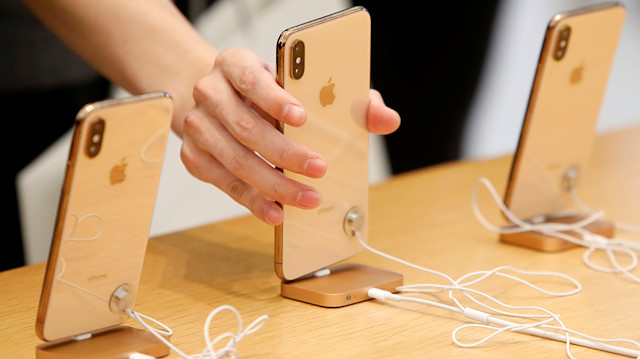
File photo
A Chinese court has ordered a sales ban of some older Apple Inc iPhone models in China for violating two patents of chipmaker Qualcomm Inc, though intellectual property lawyers said enforcement of the ban was likely still a distant threat.
The case, brought by Qualcomm, is part of a global patent dispute between the two U.S. companies that includes dozens of lawsuits. It creates uncertainty over Apple's business in one of its biggest markets at a time when concerns over waning demand for new iPhones are battering its shares.
Apple said on Monday that all of its phone models remained on sale in mainland China and that it had filed a request for reconsideration with the court, the first step in a long appeal process that could end up at China's Supreme Court.
"It's incredibly unlikely, I'd say almost impossible (that Apple would have to stop sales)," said a Beijing-based IP lawyer who is not directly connected with the Qualcomm case but has worked with large U.S. tech firms.
Apple Inc's biggest iPhone assembler, Foxconn, is considering setting up a factory in Vietnam to mitigate any impact of an ongoing trade war between the United States and China, Vietnamese state media reported.The report comes after several executives interviewed by Reuters last week singled out Vietnam and neighbouring Thailand as preferred destinations should they need to shelter operations from the trade war, braving hurdles such a lack of skilled labour and inadequate infrastructure."Foxconn Group and the Hanoi People's Committee are working together to open an iPhone manufacturing facility in Vietnam to negate the impacts of the U.S.-China trade war," the Vietnam Investment Review reported on Monday.The newspaper cited Vu Tien Loc, head of the Vietnam Chamber of Commerce and Industry, as raising the matter with Prime Minister Nguyen Xuan Phuc at a meeting on Nov. 22."We are discussing the possibility of this with Foxconn," Loc told Reuters, without elaborating. Hanoi People's Committee Chairman Nguyen Duc Chung declined to comment.Taiwan's Foxconn, formally Hon Hai Precision Industry Co Ltd , told Reuters it "follows a strict company policy of not commenting on any matters related to current or potential customers, or any of their products".In trade talks on Saturday, U.S. President Donald Trump and Chinese President Xi Jinping agreed not to introduce any tariffs for 90 days as negotiations continue.
Apple assembler Foxconn considering iPhone factory in Vietnam
"In all likelihood it will drag on for some time. It's worth keeping in mind that this is just one battle in a larger rift", he said, referring to the legal fight between Qualcomm and Apple that stretches from European courts to South Korea.
Qualcomm said in a statement the Fuzhou Intermediate People's Court in China found Apple infringed two patents held by the chipmaker and ordered an immediate ban on sales of older iPhone models, from the 6S through the X.
Apple said the trio of new models released in September were not part of the case.
"Qualcomm's effort to ban our products is another desperate move by a company whose illegal practices are under investigation by regulators around the world," Apple said.
Amazon.com Inc said on Friday Apple Music will become available on its Echo smart speakers starting Dec. 17, signaling increasing collaboration between the tech heavyweights.Apple Music subscribers who own Echo devices will be able to listen to Apple Inc's library of 50 million songs, Amazon said in a blog post.Earlier this month, Amazon said it would carry more Apple products globally in time for the holiday shopping season.Amazon had said it would sell the latest editions of Apple's iPhone, iPad and other devices in the United States, Europe, Japan and India in coming weeks.Apple also has a HomePod smart speaker, which uses the Siri voice assistant and competes against similar offerings from Amazon and Alphabet Inc's Google. 
Amazon to allow Apple Music on its Echo speakers
Reuters couldn't immediately reach the court for comment.
China, Hong Kong and Taiwan are Apple's third-largest market, accounting for about one-fifth of Apple's $265.6 billion in sales in its most recent fiscal year.
Qualcomm, the biggest supplier of chips for mobile phones, filed its case in China in late 2017, arguing that Apple infringed patents on features related to resizing photographs and managing apps on a touch screen.
U.S. Supreme Court justices on Monday will take up Apple Inc's effort to bury a lawsuit seeking damages from the company for allegedly monopolizing the market for iPhone software applications and forcing consumers to overpay.The justices will hear arguments in Apple's appeal of a lower court's decision to revive the proposed class-action lawsuit by a group of iPhone users. The lawsuit accused the Cupertino, California-based technology company of violating federal antitrust laws by requiring apps to be sold through the company's App Store and then taking a 30 percent commission from the purchases.The case hinges on how the justices will apply one of its past decisions to the claims against Apple. That 1977 ruling limited damages for anti-competitive conduct to those directly overcharged rather than indirect victims who paid an overcharge passed on by others.The iPhone users, including lead plaintiff Robert Pepper of Chicago, filed the suit in a California federal court in 2011, claiming Apple's monopoly leads to inflated prices compared to if apps were available from other sources.Though developers set the prices of their apps, Apple collects the payments from iPhone users, keeping a 30 percent commission on each purchase. One area of dispute in the case is whether app developers recoup the cost of that commission by passing it on to consumers. Developers earned more than $26 billion in 2017, a 30 percent increase over 2016, according to Apple.The company, backed by Republican President Donald Trump's administration as well as the U.S. Chamber of Commerce, told the justices in legal papers that siding with the iPhone users who filed the lawsuit would threaten the burgeoning field of e-commerce, which generates hundreds of billions of dollars annually in U.S. retail sales.The plaintiffs, as well as antitrust watchdog groups, said closing courthouse doors to those who buy end products would undermine antitrust enforcement and allow monopolistic behavior to expand unchecked. The plaintiffs were backed by 30 state attorneys general, including from Texas, California and New York.The plaintiffs said app developers would be unlikely to sue Apple, which controls the service where they make money, leaving no one to challenge anti-competitive conduct.The company sought to have the antitrust claims dismissed, arguing that the plaintiffs lacked the required legal standing to bring the lawsuit. A federal judge in Oakland, California threw out the suit, saying the consumers were not direct purchasers because the higher fees they paid were passed on to them by the developers.But the San Francisco-based 9th U.S. Circuit Court of Appeals revived the case last year, finding that Apple was a distributor that sold iPhone apps directly to consumers.
US Supreme Court weighs antitrust dispute over Apple App Store
COURT BATTLE OVER DETAILS
In July, the same court banned the import of some microchips by Micron Technology Inc into China, citing violation of patents held by Taiwan's United Microelectronics Corp (UMC) .
In the provincial Chinese court, which is separate from China's specialized intellectual property courts in Beijing, one party can request a ban on an opponent's product without the opponent getting a chance to present a defense.
IP lawyers said that an appeal process could take the case up to the Fujian provincial high court and then go as far as the Supreme Court in Beijing, a process that would likely take many months given the high-profile nature of the case.
To enforce the ban, Qualcomm separately will have to file complaints in what is known as an enforcement tribunal, where Apple will also have a chance to appeal.
Yiqiang Li, a patent lawyer at Faegre Baker Daniels, said the Chinese injunction could put pressure on Apple to reach a global settlement with Qualcomm.
Apple shares rose less than 1 percent to $169.60, recovering from an early drop when it became clear phones were still on sale, and Qualcomm stock rose 2.2 percent to $57.24.
TRADE WAR IMPACT?
The ruling comes as Beijing and Washington are locked in a tense trade dispute. The two sides have agreed to trade negotiations that must be concluded by March 1.
While IP lawyers said the case wasn't directly political, most agreed it could be drawn into broader Sino-U.S. trade tensions, where technology and IP have been a core focus.
The specific iPhone models affected by the preliminary ruling in China are the iPhone 6S, iPhone 6S Plus, iPhone 7, iPhone 7 Plus, iPhone 8, iPhone 8 Plus and iPhone X.
Erick Robinson, a patent lawyer in Beijing and former Qualcomm lawyer, said that while Chinese courts had become fairer in recent years, nationalism could sometimes be a factor in rulings.
Qualcomm is a key technology vendor to China's rising smart phone brands such as Xiaomi Corp, Oppo, Vivo and OnePlus, while Apple competes directly against Huawei Technologies Co Ltd, China's top homegrown maker of premium-priced smartphones, whose CFO was arrested this month for allegedly violating U.S. sanctions.
"There is probably a political play here. Apple is a direct competitor to the biggest companies in China, whereas Qualcomm is a supplier," Robinson said.
Qualcomm officials said tensions between the two nations had no bearing on the ruling. The company has had its share of troubles in China, from an unfavorable 2014 antitrust ruling to regulatory limbo that doomed its $44 billion bid for Dutch chipmaker NXP Semiconductors.