

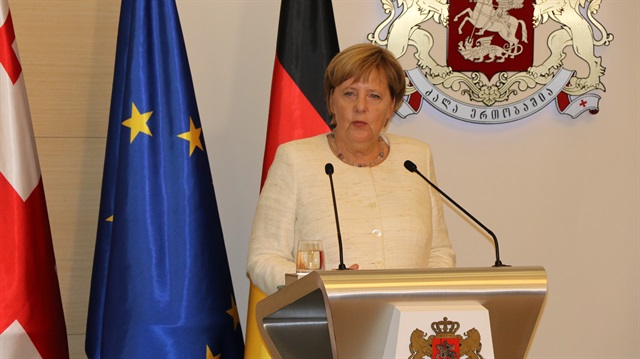
German Chancellor Angela Merkel in Tbilisi
A planned sub-sea pipeline that will bring gas directly from Russia under the Baltic Sea will not make Germany dependent on Russia for energy, German Chancellor Angela Merkel told university students in the Georgian capital Tbilisi.
On the second day of a trip to the countries of the Caucasus, many of which have an uneasy relationship with their larger northern neighbour, Merkel reaffirmed that Berlin wanted to make sure that Russia would continue to deliver some gas via Ukraine even after the Nord Stream 2 pipeline was finished.
Critics of the pipeline, which is being developed by Russian state gas giant Gazprom, say it will deprive Ukraine of crucial leverage over its eastern neighbour.
German Chancellor Angela Merkel started her visit to Georgia and was greeted by Georgian Prime Minister Mamuka Bakhtadze on Thursday.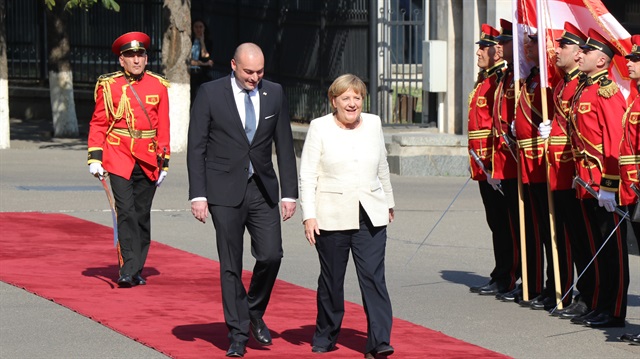
Germany's Merkel begins visit to Georgia
German Chancellor Angela Merkel said on Thursday she had taken no decision yet on who she wanted to be the next president of the European Central Bank, adding that discussions were only just starting on top European jobs to be filled next year."Discussions about the personal decisions to be made in conjunction with elections to the European Parliament are now slowly starting to take place," she told a news conference on a visit to Georgia."That means no decisions at all have been taken and the post of European Central Bank chief is to be filled much later, so I can't confirm any wishes I have. Rather, we will wait for the developments and then see how the German positions develop."
Germany's Merkel has made no decision on next ECB chief
The European Central Bank should roll back its stimulus programme now that inflation is consistent with its target, Bundesbank President Jens Weidmann said on Thursday, warning against a delay in normalisation after years of central bank support.The ECB agreed in June to end massive bond purchases by the close of the year, but Weidmann, an outspoken critic of the central bank's easy-money policy, said this should be just the first step in a process that might take years."It's also time to begin exiting the very expansionary monetary policy and the non-standard measures, especially considering their possible side effects," Weidmann told reporters."This normalisation process will probably take place only gradually over the next few years. That's exactly why it has been so important to actually get the ball rolling without undue delay," he said.Weidmann was in the spotlight this week after the newspaper Handelsblatt said Chancellor Angela Merkel was giving up on promoting him to succeed ECB chief Mario Draghi next year. She was focusing now on securing the European Commission presidency for a German candidate, the newspaper said.Weidmann made no reference to the ECB succession in his remarks.Draghi has also guided markets for an interest rate hike only after next summer, a timeline some hawks consider too soft given that inflation has rebounded, the bloc is into its sixth year of expansion and employment is at record highs.Weighing on the debate whether inflation is already high enough, Weidmann said that the ECB's projection of 1.7 percent for 2020 is "broadly consistent" with the bank's mandate of close to but below 2 percent, a view contrary to Draghi's take.Inflation rose to 2.1 percent last month, mostly on higher energy prices. It is likely to fall back below 2 percent in the coming months as domestic price pressures remain muted."However, they are likely to intensify as aggregate capacity utilisation increases," Weidmann said about domestic prices. "They will thus counteract waning impetus from other components of the inflation rate, such as energy prices." European shares nudge higher, trade tariffs dent autosChina says will continue to fight back against US tariffsSterling falls from 12-day high as Brexit risks return
ECB must not delay rolling back stimulus: Weidmann