

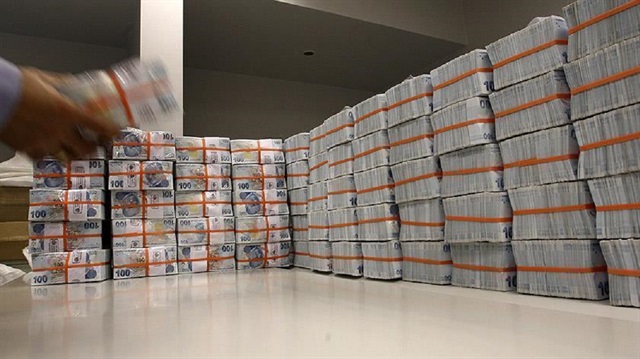
File photo
Turkey's central government's budget balance posted a surplus of 1.13 billion Turkish liras ($237 million) last month, the Treasury and Finance Ministry announced Wednesday.
In July, Turkey's budget revenues reached 61.8 billion Turkish liras ($13 billion), up nearly 18 percent year-on-year, according to the official data.
Budget expenditures in July were 60.7 billion Turkish liras ($12.8 billion), an annual hike of around 17.8 percent.
Excluding interest payments, the central government's budget balance saw a surplus of 9 billion Turkish liras ($1.95 billion) last month.
In the first seven months of the year, the budget saw a deficit of 45 billion Turkish liras ($10.74 billion).
The use of installments for credit card shopping and loans in Turkey will be governed by new regulations under a decree published in the Official Gazette on Wednesday.The term of installment payments for credit cards cannot exceed 12 months for purchases of goods and services, says the decree.For electronic appliances, the period is three months, as well as six months for expenditures on computers, travel, logistics, and accommodation, and nine months for spending on health, social services, and taxes.Banking watchdog puts new limits on FX swapsIn addition, purchases of telecommunications, alcoholic beverages, cosmetics, food, meals, fuel, jewelry, office equipment, gift cards, and expenses abroad cannot be split into installments.According to the Official Gazette, vehicle loans can last no longer than 48 months, consumer loans 36 months, and computer/cellphone loans six months.The regulation enters into force on Sept. 1 and is carried out by Turkey's Banking Regulation and Supervision Agency's (BDDK).On Aug. 2, the BDDK released draft proposals to support financial stability and macroeconomic equilibrium in Turkey.Turkey raises tariffs on US-origin productsThe proposals aim to encourage conscious consumption and cautious borrowing, the agency said.Mehmet Ali Akben, head of the BDDK, told Anadolu Agency: "The proposals aim to bring down inflation, the current deficit, imports and household indebtedness."
Turkey limits installment plans for credit cards, loans
A total of 123,878 houses were sold in Turkey in July, marking a 6.9 percent rise over the same period last year, the country's statistics agency announced Wednesday.Some 57,617 houses were sold for the first time while the rest were second-hand sales, according to the Turkish Statistical Institute (TurkStat)."For the house sales of July 2018, Istanbul had the highest share of house sales with 15.7 percent and 19,503 sold house," the agency said in a statement.Turkish private sector's foreign long-term loans dropTurkey's largest city was followed by the capital Ankara and the Aegean province of Izmir with 12,119 units (9.8 percent of all sales) and 6,322 units (5.1 percent of all sales), respectively."House sales with mortgage had a 24.5 percent share of all house sales in Turkey," it added.Last year, the overall residential property sales amounted to 1.4 million in Turkey with a 5.1 percent annual hike over 2016.Turkey's unemployment rate slips to 9.7 pct in MaySales to foreignersOfficial data showed that property sales to foreigners in July rose by 65.6 percent year-on-year, reaching 2,858 units.Istanbul led with 956 sales, followed by Antalya, Bursa, Yalova, and Sakarya.Among foreigners, most sales were made to Iraqi nationals with 584 houses, TurkStat said.Turkey's Borsa Istanbul up at open"The followers of Iraq were Iran with 321 house sales, Saudi Arabia with 211 house sales, Russia with 173 house sales and Kuwait with 171 house sales," the statement noted.Last year, foreigners purchased over 22,000 properties in Turkey. Iraqis were again at the top spot with 3,805 house purchases, followed by Saudi nationals (3,345), Kuwaitis (1,691), Russians (1,331), and Afghans (1,078).TurkStat will release its next property sales report -- for August -- in Sept. 19.Turkey raises tariffs on US-origin products
Turkish housing sales up in July
Turkey's budget revenues reached 415.4 billion Turkish liras ($99 billion) from January to July, rising 18.1 percent from the same period last year.
During the same period, budget expenditures rose nearly 22.5 percent compared to same period last year, totaling 460.4 billion Turkish liras ($109.9 billion).
Tax revenues totaled 349.2 billion Turkish liras ($83.3 billion) over the same period.
The budget balance excluding interest payments saw a surplus of some 3 billion Turkish liras ($716 million) in the January-July period.
The average U.S. dollar/Turkish lira exchange rate in July was 4.76, while one dollar was trading for 4.19 liras on average in the first seven months this year, according to the Turkish Central Bank.