

File photo
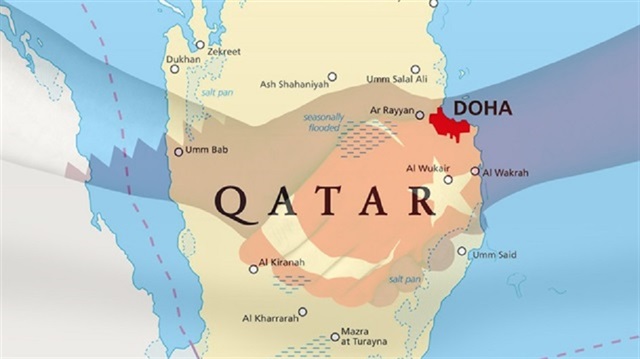
Turkish Trade Minister Ruhsar Pekcan will meet with Qatari Minister of Economy and Commerce Sheikh Ahmed bin Jassim bin Mohamed al-Thani in order to ink a Trade and Economic Partnership agreement on Tuesday.
The deal aims to reduce Turkey’s account deficit and ensure investments from Qatar continue to flow to Turkey.
The Trade and Economic Partnership agreement also targets a comprehensive liberalization of goods between Turkey and Qatar for goods and services, and to reduce the cost of refined oil products and natural gas. The deal also covers telecommunications and financial services.
Qatar's exports to Turkey in the first seven months of 2018 reached $611 million, while imports amounted to $195 million.
Turkish contractors have undertaken 137 projects in Qatar to date, valued at $14.8 billion.
A senior Saudi official on Friday appeared to confirm local media reports that the kingdom is considering digging a canal to separate the Qatari peninsula from the mainland and turn it into an island, amid a year-long dispute between the neighbours."As a citizen, I am impatiently waiting for the details of the implementation of the East Salwa island project, this great historic project that will change the region's geography," Saud al-Qahtani, a senior adviser to Saudi Crown Prince Mohammed bin Salman, wrote on Twitter.Qatari authorities did not immediately respond to a request for comment.Qahtani has mentioned the project on Twitter over the past few months, but Friday's tweet was the clearest reference yet to an initiative which critics dismiss as a public relations tactic aimed at intimidating Qatar rather than a serious plan.US aiding Saudi war crimes in Yemen: NY TimesSaudi Arabia, the United Arab Emirates, Bahrain and Egypt cut diplomatic, trade and transport ties with Qatar in June 2017, accusing it of supporting terrorism. Doha denies that charge and says the boycott is an attempt to impinge on its sovereignty.The dispute has eluded mediation efforts by the United States and Kuwait, with both sides trying to secure the support of Western allies through diplomacy, media and business deals.Reports about the canal first emerged on Sabq, a news website close to the government in April. Unnamed sources described Saudi plans to build a military base and a nuclear waste dump beside a 60 kilometre (37 mile) channel measuring 200 metres wide and 20 metres deep and stretching across the entire border with Qatar.The cost was estimated at 2.8 billion riyals ($747 million).Further reports in the newspaper Makkah in June said Riyadh was moving ahead with the plans, with five unnamed companies invited to bid on the project and a winner to be announced in September.US goes to WTO to challenge Russian response to Trump's steel tariffs
Saudi official hints at plan to dig canal on Qatar border
"Economic hitmen" are targeting emerging economies like Turkey, John Perkins, economist and author of Confessions of an Economic Hit Man, said.“I have no doubt that there are economic hitmen targeting emerging economies like Turkey’s,” Perkins said in an interview to Anadolu Agency on Monday.“These days, they work for many different governments not just the United States. They also work for every major corporation. They pit one country against another in order to arrange huge tax benefits, wage rates and other labor conditions, and numerous other policies that benefit their corporations, but hurt the people of the country.” he said.He added that Turkey could make use of new souces of external financing by diversifying its options.Turkey aims to boost clean energy deployment“I would encourage Turkey to stay away from the IMF [International Monetary Fund]. Today there are many other options, like the one from Qatar. Countries like Turkey should use the leverage these offer, forcing the IMF and other financial institutions from China, United States, and the Gulf countries to compete with each other. That way Turkey will have many options to strike better deals. It should do everything possible to avoid more foreign debt,” Perkins said.“I can say that the emerging markets should stand strong against debt. Countries like Iceland, Argentina, and Ecuador provide an example of how this can be done. My advice to emerging market countries is that they band together, refuse to pay debts they were taken on unjustly, through corruption, or by governments that were not supported by the citizens.“Countries like Turkey should definitely be negotiating with Russia, China, the Gulf countries, etc. I don’t think they necessarily need to form alliances, but should use the leverage these countries offer to strike deals that are much more beneficial to their people.”Turkey's Borsa Istanbul up at openBring US 'to its sense'He also criticized U.S. President Donald Trump's foreign policy moves. “It appears that President Trump has his heart set on disrupting traditional international relationships and global economics. As you well know, Turkey is not the only country where he has imposed sanctions and tariffs. His policies are extremely dangerous for the United States, Turkey, and the entire world,” he added.He said that the international community should work together to bring the U.S. administration "to its senses".He notes that economic hitmen are much more prevalent today than, for instance, in the 1970s when he was chief economist at the major international consulting firm Chas. T. Main. “When I had that job, it was relatively generic. We wanted to make profits and gain control of resources for American corporations. Usually my company didn’t care which corporations made those profits, as long as we were assured of playing an advisory role throughout the process. Today, there are still people with a job like mine. More than back in my day,” he said.“In addition, every major international corporation, from Walmart to Nike to Exxon (and everything in between) has its own version of economic hitmen. They try to strike deals that benefit them and usually hurt the country. Furthermore, today there are economic hit men from many other countries, including Russia and China. Globalization has created huge opportunities for economic hit men around the planet.”Perkins says that he has advised the World Bank, United Nations, the IMF, the U.S. Treasury Department as well as Fortune 500 corporations and leaders of countries in Africa, Asia, Latin America, and the Middle East.
'Economic hitmen target emerging economies like Turkey'