

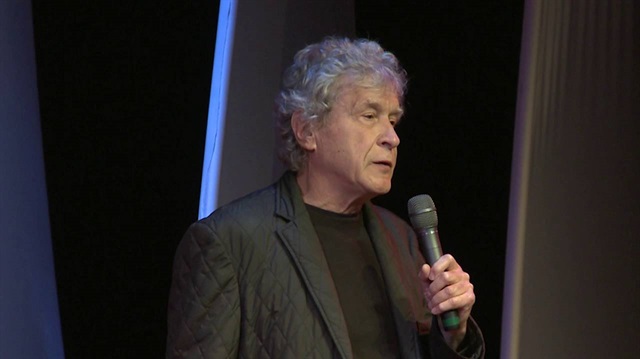
John Perkins
"Economic hitmen" are targeting emerging economies like Turkey, John Perkins, economist and author of Confessions of an Economic Hit Man, said.
“I have no doubt that there are economic hitmen targeting emerging economies like Turkey’s,” Perkins said in an interview to Anadolu Agency on Monday.
“These days, they work for many different governments not just the United States. They also work for every major corporation. They pit one country against another in order to arrange huge tax benefits, wage rates and other labor conditions, and numerous other policies that benefit their corporations, but hurt the people of the country.” he said.
He added that Turkey could make use of new souces of external financing by diversifying its options.
Turkey revised its renewable energy target for 2023, with additional steps to increase the share of clean electricity production from 31 percent to more than 50 percent by 2023.In May 2018, Turkey's Energy Watchdog head said that installed electricity capacity increased by 181 percent from 32 thousand MW over the last 15 years up to 90 thousand MW. The share of renewable electricity capacity out of total installed capacity reached 46 percent in May while renewable electricity generation was around 30 percent.In 2013, in accordance with Turkey's National Renewable Energy Action Plan, Turkey's renewable electricity share was 29 percent and the share of installed clean energy capacity was around 40 percent.After hitting 31 percent of renewable electricity production in August 2018, Turkey's authorities took concrete investment steps to revise its renewable target for 2023.On August 3, Turkish President Recep Tayyip Erdoğan announced that the country's 100-day action plan to develop the domestic energy sector with domestic energy sources including wind, solar and geothermal power.Previously he said Turkey aimed to have a foreign trade volume of $1 trillion and $2 trillion in gross domestic product.As part of the country's 100-day action plan, the country aims to use more renewables through a series of tenders for solar power plants with a total capacity of 3 gigawatts (GW) and with an anticipated investment of nearly $4.8 billion.The country also plans to boost its both wind and solar capacity by 10,000 MW each in the coming decade through renewable energy resources zone (YEKA) tenders.The Turkish Ministry of Energy and Natural Resources will accept applications up to Oct. 23 for one of the biggest offshore wind plants in the world at 1,200 MW, which will also be the first of its kind in the country.The Ministry will soon begin appraising consortium applicants for the wind tender, the date and place of which has yet to be confirmed. The ceiling price for one megawatt-hour in the reverse bid auction has been set at $8.Part of the tender stipulates that the winning investor, who submits the lowest bid, will sign an energy purchase agreement with Turkey's energy and natural sources ministry for the first 50 terawatt-hours of electricity production starting from the first commissioning of the plant.The tender specifications require 60 percent local equipment production and call for 80 percent of the engineers employed to be of Turkish origin.Saros and Gallipoli located in the Marmara region and Kiyikoy in the Thrace were named the candidate regions for the power plant in March.Solar energy developments In April, Turkey's former Energy and Natural Resources Minister, Berat Albayrak, said that as Turkey ranks second after China in terms of world energy growth demand, it would increase its energy capacity amid a process of continuous development in the sector.Albayrak asserted that new technology is an important element in Turkey's evolving renewables sector."We have seen in the last 20 years that the role of renewable energy has changed a lot and costs have dramatically fallen thanks to advanced technology," Albayrak said.Meanwhile, to bolster Turkey's electricity sector, Serhat Cecen, the head of Turkey's Electricity Distribution Services Association (ELDER) said that around $23 billion was allocated for electricity distribution and privatization over the last 10 years.A total of $13 billion was used for distribution and retail while $10 billion was allocated for the privatization of production facilities.Loans covered 80 percent of the total amount for privatization while equities met the remaining 20 percent.Despite the power sector expenditure, Turkey places importance on energy efficiency and aims to save $30.2 billion by 2033 thanks to its National Energy Efficiency Action Plan announced in April. Both residential and industrial energy efficiency will play an important role in the action plan in which nearly $1 billion in savings would emerge from energy efficiency transformation in 1.7 million residences, and $10 billion in savings would be achieved in the industrial sector by 2023.The plan includes 55 actions to develop energy efficiency measures throughout various sectors in industry, transport, construction, agriculture, and energy generation and transformation.Albayrak said that energy efficiency is crucially important for a country like Turkey, which is not rich in conventional energy resources.With the help of the action plan, investments of nearly $10.9 billion are expected by 2023, Albayrak asserted, adding that as a result 20,000 would be employed in the energy sector from mining to renewables, and upstream to natural gas.The country will also be relieved of its obligation to invest $4.2 billion for the construction of power plants up to that time, the minister confirmed in March.
Turkey aims to boost clean energy deployment
“I would encourage Turkey to stay away from the IMF [International Monetary Fund]. Today there are many other options, like the one from Qatar. Countries like Turkey should use the leverage these offer, forcing the IMF and other financial institutions from China, United States, and the Gulf countries to compete with each other. That way Turkey will have many options to strike better deals. It should do everything possible to avoid more foreign debt,” Perkins said.
“I can say that the emerging markets should stand strong against debt. Countries like Iceland, Argentina, and Ecuador provide an example of how this can be done. My advice to emerging market countries is that they band together, refuse to pay debts they were taken on unjustly, through corruption, or by governments that were not supported by the citizens.
“Countries like Turkey should definitely be negotiating with Russia, China, the Gulf countries, etc. I don’t think they necessarily need to form alliances, but should use the leverage these countries offer to strike deals that are much more beneficial to their people.”
Turkey's benchmark stock index started Monday up 0.82 percent or 735.34 points to open at 90,921.33 points, after a four-and-a-half-day break for the Muslim holiday of Eid Al-Adha.The BIST banking and holding sector indices rose 0.68 and 0.08 percent, respectively.All sectors started the day up while the mining sector index showed the top performance at the opening -- up 2.56 percent.On Monday last week, Borsa Istanbul's BIST 100 index rose 1.64 percent to close at 90,185.99 points.The U.S. dollar/Turkish lira exchange rate fell 6.0820 as of 9.30 a.m. local time (0630GMT), compared with last week's closing rate of 6.1230.The euro/lira rate was up at 7.0690 on Monday morning, versus 7.0000 at the previous close, while one British pound traded for 7.8350 Turkish liras, up from 7.7240 at last Monday's close.The price of Brent oil was $76.03 per barrel as of 09.45 a.m. local time (0645GMT) Monday, down from $76.13 at the previous close.
Turkey's Borsa Istanbul up at open
Bring US 'to its sense'
He also criticized U.S. President Donald Trump's foreign policy moves.
“It appears that President Trump has his heart set on disrupting traditional international relationships and global economics. As you well know, Turkey is not the only country where he has imposed sanctions and tariffs. His policies are extremely dangerous for the United States, Turkey, and the entire world,” he added.
He said that the international community should work together to bring the U.S. administration "to its senses".
He notes that economic hitmen are much more prevalent today than, for instance, in the 1970s when he was chief economist at the major international consulting firm Chas. T. Main.
“When I had that job, it was relatively generic. We wanted to make profits and gain control of resources for American corporations. Usually my company didn’t care which corporations made those profits, as long as we were assured of playing an advisory role throughout the process. Today, there are still people with a job like mine. More than back in my day,” he said.
“In addition, every major international corporation, from Walmart to Nike to Exxon (and everything in between) has its own version of economic hitmen. They try to strike deals that benefit them and usually hurt the country. Furthermore, today there are economic hit men from many other countries, including Russia and China. Globalization has created huge opportunities for economic hit men around the planet.”
Perkins says that he has advised the World Bank, United Nations, the IMF, the U.S. Treasury Department as well as Fortune 500 corporations and leaders of countries in Africa, Asia, Latin America, and the Middle East.