

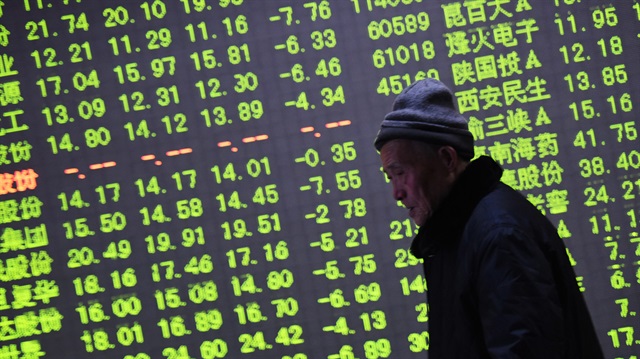
File photo: An investor walks past an electronic screen showing stock information at a brokerage house in China
China's stock markets ended higher on Thursday, as investors looked past new tariffs Washington and Beijing slapped on each other's goods in the latest escalation of the trade war between the world's two largest economies.
The Shanghai Composite index ended 0.4 percent higher. The country's blue-chip index also gained 0.4 percent.
Both indexes had traded lower in the morning session, but turned higher after the new tariffs were officially implemented at 0401 GMT on Thursday.
The United States and China enacted 25 percent tariffs on $16 billion worth of the other's goods, following through on threats made earlier this month.
While the immediate market reaction to the tariffs taking effect on Thursday was muted, investors and analysts will look to see how the increased trade barriers impact corporate earnings in months ahead.
"The tariffs were fully expected by the market. But the future of the discussions and how the U.S. and China will play the game remain great unknowns at the moment," said Zhang Gang, an analyst at Central China Securities in Shanghai.
"The correction in A-shares over the past few days has already basically reflected the negative factors pulling down the market," he said.
Trade volumes were relatively light, with about 9.84 billion shares traded on the Shanghai exchange, roughly 72.6 percent of the market's 30-day moving average of 13.57 billion shares a day.
European shares edged up on Thursday after the latest round of U.S.-China tariffs kicked in, hurting trade-sensitive autos stocks but boosting demand for sectors seen as more insulated from an escalating trade dispute.The STOXX 600 was up 0.2 percent, buoyed by tech, healthcare, and consumer staples stocks - "defensives" which investors reach for as safer bets in times of uncertainty for their strong earnings growth and high dividend payouts.The United States and China implemented 25 percent tariffs on $16 billion worth of each other's goods early on Thursday, bringing to $50 billion the value of imports subjected to tariffs on either side since early July, with more in the pipeline.Autos stocks were the worst-performing for a second day. On Wednesday a surprise profit warning from tyre maker Continental sank the stock and hit the sector, already one of the worst impacted by tariff fears.Continental fell a further 2.8 percent, bottom of the DAX, taking its losses to 15 percent since Wednesday's open.Carmakers Daimler, BMW and Volkswagen fell 0.6 to 0.8 percent, while Valeo, Renault, Michelin and Peugeot were the biggest CAC 40 fallers.Outside of trade war moves, shares in budget airline Ryanair jumped 4.7 percent to the top of the STOXX after the Irish pilots' union Forsa said it has reached an agreement in an ongoing labour dispute.Danish medical equipment, supplies and distribution company Ambu sank more than 10 percent at the open after its third-quarter results, with traders saying earnings and revenues numbers had missed analysts' targets.Gaming and casino software company Playtech rose 4.8 percent after its half-year profit loss came in smaller than expected. It said competition and tougher regulation in Asian markets had caused the fall in profits.Swiss telecoms group Sunrise Communications rose 5 percent after it increased its guidance for full-year 2018 EBITDA.Building materials firm CRH also gained 3.7 percent after reporting first-half margins held steady and striking a positive tone for earnings in the second half of the year. China says will continue to fight back against US tariffs'US disregard of legal process unacceptable’: Presidential aide
European shares nudge higher, trade tariffs dent autos
The new tariffs on U.S. and Chinese goods bring to $100 billion the combined value of both country's products hit by tariffs since early July, and threaten to deepen the risks to global growth posed by the Sino-U.S. trade war.
The smaller Shenzhen index ended up 0.6 percent and the start-up board ChiNext Composite index was higher by 1.1 percent.
So far this year, the Shanghai and CSI300 stock indexes have both fallen 17.6 percent, making them the world's worst-performing major indexes. Shanghai stocks have declined 5.1 percent this month.
Among the day's winners was Ping An Insurance Group Co of China, which extended a rally this week to end 2 percent higher. The company on Tuesday reported its largest half-yearly profit in at least a decade.
The rise in Ping An shares helped to lift financial sector sub-index, which gained 0.5 percent.
Consumer and healthcare firms, which have been battered in recent weeks by a confidence-sapping vaccine scandal, also rebounded, with the consumer staples sector up 0.4 percent and the healthcare sub-index up 0.8 percent.
But real estate shares fell 1.3 percent amid a cloudy outlook for the sector.
China's commerce ministry said on Thursday that Beijing will have to continue to fight back against the latest implementation of U.S. tariffs on $16 billion of Chinese goods.China will file a complaint with the World Trade Organization (WTO) against the U.S. action, the ministry also said in a statement on its website.The latest round of U.S., Chinese import tariffs on each other's goods took effect as of 0401 GMT on Thursday. 'China is aiming to use pressure to affect elections': Taiwan presidentUS, China to resume trade talks in Washington amid low expectationsDollar falls after Trump criticizes FedUS tariffs to have negative impact on economy: Survey
China says will continue to fight back against US tariffs
Some developers also weighed in Hong Kong, where the Hang Seng index was down 0.6 percent at 0735 GMT. The China Enterprises index was off by 0.5 percent.
Developer Sino-Ocean hit a one-year low after the company said its first-half profits fell 12.7 percent from a year earlier. Index component China Resources Land was 2.8 percent lower.
Also pulling down shares in Hong Kong was Li & Fung Ltd , which fell to a six-week low after it posted sharply lower first-half profits and forecast a challenging environment for retailers.
China Overseas Land gained 1.7 percent after announcing a 7.2 percent rise in first-half profits, despite the company noting "abortive land auctions" in many cities in China in the first half.
Currency markets were unfazed by the imposition of new tariffs, with market observers noting that the impact of the tariffs on China's yuan had long been priced in.
The currency's fall on Thursday reflected instead a rebound in the U.S. dollar in overseas markets, with the People's Bank of China setting the midpoint of the yuan's daily trading band at 6.8367 per dollar on Thursday, 96 pips weaker than Wednesday's fixing.
At 0735 GMT, the spot yuan was trading at 6.8712 per dollar, 324 pips weaker than the previous day's close.