

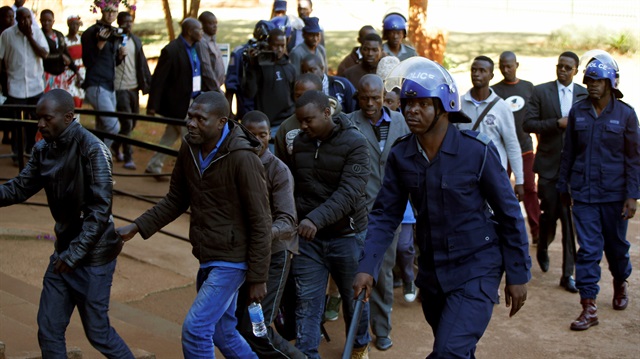
Some of the 16 people detained after police sealed off the building of Opposition Movement for Democratic Change (MDC) on Thursday, appear in court in the capital Harare, Zimbabwe
Twenty-seven members of the opposition Movement for Democratic Change (MDC) appeared in a Zimbabwe court facing public violence charges on Saturday after six people were killed in post-election protests that were met by a military crackdown.
Soldiers and tanks rolled into the capital Harare on Wednesday after protests erupted against President Emmerson Mnangagwa's ruling ZANU-PF party's landslide win in the House of Assembly vote.
The army's clampdown on civilians and the opposition's allegations that the vote was rigged revealed the deep fissures in Zimbabwean society that developed during the four-decade rule of Robert Mugabe, when the security forces became a byword for heavy-handedness.
The U.S. on Friday welcomed Zimbabwe’s historic presidential elections, hailing them as an important step in overcoming the nation’s political and economic crises."Zimbabwe’s July 30 elections presented the country with an historic chance to move beyond the political and economic crises of the past and toward profound democratic change," State Department spokesperson Heather Nauert said in a press statement.Zimbabwe's Mnangagwa calls for unity, rival questions election resultNoting the high turnout by Zimbabweans to cast their votes, Nauert said the U.S. remains centered on helping the country through this transition and working with the new government on political, economic and human rights issues.Incumbent Emmerson Mnangagwa was declared the winner of the presidential poll by a narrow margin.Mnangagwa, a 75-year-old former spy chief, succeeded Robert Mugabe in November after a military coup.Zimbabwe opposition leader demands 'proper, verified' election resultsThe Zimbabwe Election Commission said Mnangagwa, of the ruling Zimbabwe African National-Patriotic Front (Zanu-PF), won 50.8 percent of the vote while 44.3 percent went to Nelson Chamisa of the opposition Movement for Democratic Change Alliance (MDC Alliance).
US lauds Zimbabwe’s historic presidential poll
The 27 MDC members were arrested on Thursday at the party's headquarters. Their lawyers said the MDC members were innocent and were delivering election results from provinces when arrested.
Prosecutors said the accused were positively identified by police and that witnesses would testify against them.
The MDC members were not formally charged by Harare Magistrate Francis Vhitorini and will be held in custody in prison until they return to court on Monday.
If found guilty, they face up to 10 years in jail.
Water cannon and more than a dozen anti-riot police were stationed outside the perimeter of the court house while others remained camped outside the MDC headquarters.
President Emmerson Mnangagwa called on Friday for Zimbabwe to unite behind him after he was declared winner of national elections, but the opposition leader questioned the outcome and demanded "proper and verified" results be released.The election, the first since the army removed 94-year-old Robert Mugabe from office in November, passed off relatively smoothly on the day, raising hopes of a break from a history of disputed and violent polls.But an army crackdown on opposition supporters in which six people were killed and opposition claims that the vote was rigged revealed the deep rifts in Zimbabwean society that developed during Mugabe's four decades in power, when the security forces became a byword for heavy-handedness.After three days of claims and counterclaims, 75-year-old Mnangagwa - a former spy chief under Mugabe - secured victory.Zimbabwe opposition leader demands 'proper, verified' election resultsHe polled 2.46 million votes against 2.15 million for 40-year-old opposition leader Nelson Chamisa, the Zimbabwe Electoral Commission (ZEC) announced in the early hours of Friday morning."This is a new beginning. Let us join hands, in peace, unity and love, and together build a new Zimbabwe for all," Mnangagwa said on Twitter.But his efforts to rehabilitate the image of a country synonymous with political repression and economic collapse were also undermined by a police raid on the headquarters of Chamisa's Movement for Democratic Change (MDC).Mnangagwa received 50.8 percent of the vote, just edging over the 50 percent mark needed to avoid a runoff. The delays in announcing the presidential results and the narrow margin of victory fuelled the opposition accusations of rigging.Galeri: Zimbabwean voters queue to cast their ballotsHe now faces the challenge of persuading the international community that the army crackdown and lapses in the election process will not derail his promise of political and economic reforms needed to fix a moribund economy.European Union observers said on Wednesday the elections had several problems, including media bias, voter intimidation, and mistrust in the electoral commission. Its final assessment will be critical in determining whether Zimbabwe can return into the international fold.VERIFY"The immediate priorities for Mnangagwa and his government will be to continue on the path of restoring the economy and boosting exports, helped by international engagement," said Christopher Dielmann, economist at Exotix Capital."By many accounts, this imperfect election delivered sufficient transparency, especially in relation to past results in the country, that should allow reengagement to occur relatively smoothly."Chamisa, who earlier accused the election commission of trying to rig the vote, said on Friday it should release "proper and verified" results."I thought the force of will would prevail over will of force," he said in a tweet, without elaborating.South Africa President Cyril Ramaphosa, current chair of the Southern African Development Community, urged all Zimbabweans to accept the poll results. https://tmsnrt.rs/2LWcHfmThe streets of the capital Harare were quiet early on Friday, with traffic thinner than usual. Water cannon and anti-riot police remained outside the MDC offices, a reminder of the clashes between opposition and the security forces this week."We are not happy with this election but what can we do?" said Patience Sithole, a cleaner in Harare."We don't trust these observers, we don't trust these courts. I'm not sure things will ever change in Zimbabwe."The Herald newspaper, which acts as a mouthpiece for the government, hailed the election as reflecting the will of the majority and admonished the opposition."Unfortunately in Zimbabwe we have allowed to grow and flourish a culture of rabble-rousing and sham protests of alleged rigging whenever a party loses that this has become a default mode in the opposition," a Herald editorial said.
Zimbabwe's Mnangagwa calls for unity, rival questions election result
Three of the victims from Wednesday's clashes were buried on Saturday, the MDC said.
Mnangagwa on Friday urged Zimbabweans to unite after he was declared the first elected head of state since Mugabe's removal from power. MDC leader Nelson Chamisa insisted he had won and pledged to challenge the result.
On Saturday, Chamisa said he was aware of his supporters' anxieties and that he carried their hopes and aspirations.
Zimbabwe's opposition leader Nelson Chamisa on Friday said the country's electoral commission should release "proper and verified" results of the first national election since Robert Mugabe left office.The commission earlier declared President Emmerson Mnangagwa the winner of the ballot.EU calls for calm in Zimbabwe after election violenceIn comments referring to the commission, Chamisa said on his Twitter page that "the level of opaqueness, truth deficiency, moral decay & values deficit is baffling."
Zimbabwe opposition leader demands 'proper, verified' election results
"You voted but they cheated. Over 2.5 million votes can't be ignored. We're doing all to secure your vote (and) defend your WILL. Change is coming," he wrote on Twitter.
The first post-Mugabe election had been cast as a watershed moment that would rid the former British colony of its global pariah status and begin a recovery in its failed economy.
But Mnangagwa's bid to repair the image of a nation known for repression and economic collapse was further hurt by a police raid on the MDC headquarters and the dispersal of journalists before Chamisa's news conference on Friday.
International election observers have cited several problems, including media bias and mistrust in the electoral commission.
On Saturday, the British government said it was deeply concerned by the post-election violence and the "disproportionate response from the security forces."