

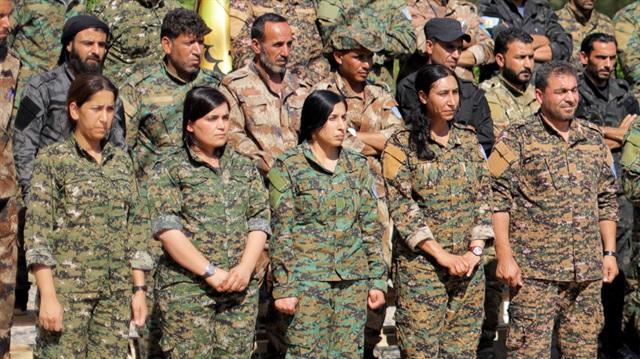
File photo
The YPG/PKK terrorist group is reportedly in talks with Syria’s Assad regime on the proposed transfer of the northern city of Manbij to the latter, with both parties planning to provide local security.
Although some observers have claimed that the YPG/PKK has entirely withdrawn from Manbij, indications suggest that the group still maintains an active presence in the city.
While the terrorist group and the Assad regime appear to be stepping up their partnership, Turkish and U.S. forces have continued to conduct joint patrols in the region as part of a deal aimed at purging the area of the YPG/PKK presence.
According to information obtained by Anadolu Agency correspondents based in the region, the “military council” of the so-called Syrian Democratic Forces (SDF) -- a regional proxy for the PKK terrorist group -- and Assad regime officials are holding regular talks over Manbij’s political fate.
Earlier this month, regime officials and YPG/PKK representatives from northeastern Iraq’s Qandil Mountain region held talks in Aleppo.
On Sunday, both sides reportedly met once again -- in the same city -- to discuss the same issue.
Turkish aid agencies have been providing hot meals and humanitarian relief to hundreds of thousands of civilians in cooperation with the Turkish Armed Forces (TAF) in Syria’s Afrin since troops entered the northwestern region.İbrahim Altan, head of the Turkish Red Crescent, said, “A total of 1.494.040 plates of food have been produced and distributed to civilians, as well as 80,000 loaves of bread. Following that, we delivered boxes containing dry food to families.”Turkey's Humanitarian Relief Foundation (IHH), another Turkish NGO in the region, has distributed an estimated $50 million worth of aid and reached 70.000 people.The Disaster and Emergency Management Presidency of Turkey (AFAD), Turkish Red Crescent and Turkish army jointly conducted humanitarian efforts in 139 points, reaching 335.000 civilians by providing 163.818 food packages and sanitary items. “We have intensified our efforts in Afrin, in the region of Operation Olive Branch. We have started to provide humanitarian relief to people living in Afrin’s town center and districts, right after the military operation was complete,” Altan continued.Underlining that they work with specialists on cross-border operations Altan said, “We have been providing humanitarian aid to Syrians both living in Turkey and Syria. On the other hand, we have been helping civilians in the regions cleared of terror elements".“We continue to distribute humanitarian aid materials by going to the villages that have not been reached before and the regions that were previously unreachable,” he concluded.On Jan. 20 Turkey launched Operation Olive Branch to remove YPG/PKK and Daesh terrorists from Afrin. On March 18, Turkish troops and Free Syrian Army members liberated its city center, on the 58th day of the operation. Demining and sweeping activities are ongoing in the region.
Turkish NGOs bring peace, aid to Syria’s Afrin
A third convoy of evacuees from Syria’s southwestern Quneitra province arrived in opposition-held Idlib province on Monday, in line with an agreement between the Bashar al-Assad regime and armed opposition groups.The convoy of 46 buses and 29 vehicles carried around 1,893 evacuees, according to an Anadolu Agency reporter in the region.The evacuees were taken to temporary refugee centers in Idlib and Aleppo’s western countryside.Second evacuation convoy from Quneitra arrives in IdlibSo far, some 6,000 people have been evacuated from Quneitra to Idlib.Under the deal, more convoys are expected to follow from the southwestern province, which is located adjacent to the Israeli-occupied Golan Heights region.The agreement provides opposition fighters with a safe exit to Idlib in exchange for surrendering their heavy weapons.A similar deal was implemented recently in Syria’s southwestern Daraa province, according to which regime forces -- along with Russian military police -- were allowed to deploy along the nearby border with Jordan.Syria has only just begun to emerge from a devastating conflict that began in 2011 when the Assad regime cracked down on demonstrators with unexpected ferocity.
Third convoy of evacuees from Quneitra arrives in Idlib
Sunday’s meeting in Aleppo was reportedly attended by Syrian Baath Party officials Fadel Jabbar, Abdullah Hussein and Ahmad Gabhan.
The YPG/PKK, for its part, was represented at the meeting by Mohamed Karidi (commander of the group’s “Manbij military council”), Ibrahim Bennawi, Mohamed Guweyshi and Shukri al-Awni.
According to sources close to the meeting, attendees discussed means of opposing Turkish military intervention in northern Syria and the anticipated return of regime forces to Manbij.
The Assad regime and the YPG/PKK have reportedly agreed to form a joint “police force” to secure the area composed of pro-regime tribesmen and YPG/PKK terrorists.
On Sunday, the group’s “military council” reiterated its refusal -- via social media -- to relinquish control of Manbij to the Turkish Armed Forces, asserting its preference for handing the city over to the Damascus regime.
- Turkey/US patrols
Since June 18, Turkish and U.S. forces have been conducting joint security patrols of the region.
The patrols come as part of a Turkish-U.S. agreement aimed at stabilizing Manbij and securing the YPG/PKK’s withdrawal from the area.
In its more than 30-year terror campaign against Turkey, the PKK -- of which the YPG is the Syrian branch -- has claimed some 40,000 lives, including women and children.
Should the Manbij model prove successful, Turkey will push for a similar arrangement in eastern Syria.
Ankara says the presence of terrorist groups near its border constitutes a clear and present threat and has launched a series of military operations with the stated aim of clearing the region of terrorist elements.
In August 2016, U.S.-backed YPG/PKK terrorists established a foothold in Aleppo's Manbij district on the pretext of fighting the Daesh terrorist group.
According to estimates, ethnic Arabs account for more than 90 percent of Manbij’s population.
Syria has only just begun to emerge from a devastating conflict that began in 2011 when the Assad regime cracked down on demonstrators with unexpected ferocity.
*Ali Murat Alhas contributed to this report from Ankara