

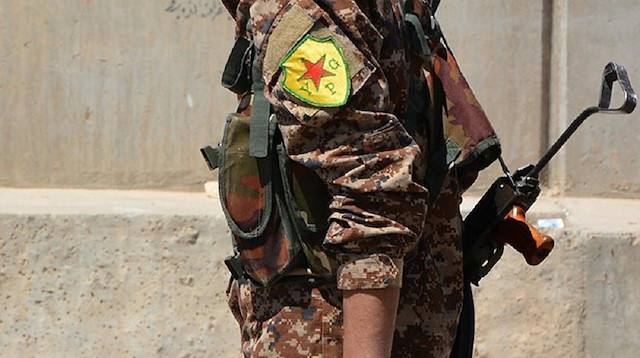
The YPG/PKK terrorist group opened fire on protesters against high taxes and oppression by the group in Al-Hasakah province in northeastern Syria.
The YPG/PKK terrorist group has opened fire on protesters against high taxes and oppression by the group in Al-Hasakah province in northeastern Syria, according to local sources.
The protest took place in Ash-Shaddadi district in the province, and YPG/PKK terrorists used heavy weapons to disperse the demonstrators, the sources said.
The demonstrations began in the province three days ago but escalated on Monday when YPG/PKK terrorists attacked civilians with mortar fire.
A number of demonstrators were reportedly injured.
Meanwhile, a state of calm prevailed in the district on Tuesday as the terrorist group shut routes in both directions in the district.
Ash-Shaddadi district is adjacent to the Iraqi border at an intersection point of Al-Hasakah and Deir Ez-Zor provinces. Both provinces have witnessed demonstrations against the YPG/PKK terrorist group.
Safin Dizayi, a spokesman for northern Iraq's Kurdish Regional Government (KRG), has described the PKK terrorist group’s continued presence in Iraq’s Sinjar district as “unacceptable”.Speaking to Anadolu Agency on Monday, Dizayi spoke about the KRG’s relations with the federal government in Baghdad and the PKK’s ongoing presence in Sinjar, which is located in Iraq’s northern Nineveh province."The deployment of the Hashd al-Shaabi [a predominantly Shia fighting force affiliated with the Iraqi army] has allowed the PKK and its local affiliates to dominate the region," he said.Turkey and Syrian opposition conduct ‘peace op’ in AfrinAsserting that PKK loyalists had prevented the region’s legitimate administration from entering Sinjar, Dizayi said that a chronic lack of public services, security challenges, and the presence in Sinjar of illegal groups had dissuaded displaced local resident from returning home. “Sinjar must be stabilized with a view to allowing residents to return to the region,” he said. “The Baghdad government must take steps to ensure the departure of these groups from Sinjar.”Dizayi added: “Sinjar’s legitimate administration must be allowed to return; otherwise, the district will fall into chaos.”US-backed PKK moves drug cultivation industry to Syria’s ManbijErbil-Baghdad ties The KRG spokesman went on to call for the “normalization” of relations between Baghdad and Erbil, the KRG’s administrative capital."After last year’s political turbulence [between the KRG and the Iraqi government], there is now a more favorable atmosphere," he said. Noting that certain quarters had raised objections to the KRG’s share of Iraq's 2019 draft budget, Dizayi pointed out that a KRG delegation had recently held talks with Iraqi officials to discuss the issue. Eleventh Astana talks for Syria to be held on Nov. 28-29“Kurdish political parties now enjoy a notable presence in Iraq’s government and parliament,” he said.“Relations are gradually normalizing again,” he added. “The KRG’s share in Iraq’s draft budget, along with other outstanding issues, are in the process of being settled." On the resumption of oil exports from Kirkuk to Turkey’s Ceyhan Port, Dizayi said: "If exports had resumed on Jan. 1, we would have realized $6 billion in revenue, which could have been used to resolve a number of the country’s problems, especially in Basra.”For the past several months, Iraq’s southern Basra province has seen sporadic public demonstrations to demand improved public utilities and more job opportunities. Turkey’s mini drone neutralizes 18 PKK terroristsTurkey-KRG relationsAccording to Dizayi, relations between the KRG and Ankara remain friendly despite recent political turbulence in the region.“Relations came under a bit of strain following last year’s incidents, but they remained intact,” he said.He went on to note that the KRG’s ties with Turkey had seen “ups and downs” since they were first established in the early 1990s."Our current relations with Turkey are very good, but they could be even better,” Dizayi said, adding: “We are very pleased with the recent cooperation we’ve seen with Turkey in a range of fields.”
PKK presence in Iraq's Sinjar ‘unacceptable’: KRG
The Turkish Armed Forces (TAF) and opposition members from the Syrian National Army imposed a curfew on Sunday to conduct a “peace operation” in order to capture suspects who are in cooperation with Kurdistan Workers' Party (PKK) terrorists and the Assad regime in Syria's northwestern Afrin.The operation was carried out by three armed divisions of the National Army and a total of 2,000 Free Syrian Army (FSA) members, targeting the headquarters of the groups and terrorists who harass civilians and seek to harm peace in the region.It started early in the morning in Afrin’s city center, Jindares and Shaykh al-Hadid, and particularly targeted the Ahrar al-Sharqiya and Shuhadaa Hasakah groups.Ahrar al-Sharqiya consists of members mostly from Syria’s Deir ez-Zor Governorate, and Shuhadaa Hasakah is comprised of people from the capital city of al-Hasakah Governorate, located in the far northeast of Syria.Syria regime, Iran-backed groups propagating Shia faithA great deal of weapons and ammunitions were seized and hundreds arrested during the operation.Colonel Haitham Afisi, head of the National Army, divulged the details of the peace operation to Yeni Şafak daily, and said that preparations started three days ago, aiming to capture those who backed the PKK’s terror activities and tried to provide intelligence to the Assad regime to undermine and tarnish Turkey’s Operation Olive Branch.On Jan. 20, Turkey launched Operation Olive Branch in coordination with FSA troops to clear PKK/YPG and Daesh terrorists from Afrin amid growing threats from the region.The PKK is listed as a terrorist organization by Turkey, the European Union and the United States. The PKK has been conducting armed violence in the southeastern part of Turkey since 1984. More than 40,000 people, mostly civilians, have been killed in the three-decade long conflict.Video: Members of criminal gang surrender to TAF, FSA in Syria’s Afrin
Turkey and Syrian opposition conduct ‘peace op’ in Afrin
The Assad regime and Iran-backed terror groups are attempting to propagate the Shia faith in Sunni-majority Syria, local sources told Anadolu Agency.In Syria’s eastern oil-rich Deir ez-Zor province, the regime and Iran-backed groups are forcing people to recite a Shia-style call to prayer in the Mayadin and Abu Kamal districts near the Iraqi border, said the sources, who asked not to be named due to security concerns.At least 20 imams who refused to recite the Shia call to prayer were dismissed, the sources said, while a number of others were detained.Unlike the Sunni call to prayer, Shias add the refrain, “I bear witness that Ali is the guardian of Allah”.Located near the Iraqi border, Deir ez-Zor is home to Syria’s largest oilfields. Eleven of the country’s largest oilfields are located east of the Euphrates River, which snakes through Deir ez-Zor province.Syria has only just begun to emerge from a devastating conflict that began in 2011 when the Assad regime cracked down on demonstrators with unexpected ferocity.US-backed PKK moves drug cultivation industry to Syria’s ManbijEleventh Astana talks for Syria to be held on Nov. 28-29Russia, Turkey, Iran to hold Syria talks Nov. 28-29
Syria regime, Iran-backed groups propagating Shia faith