

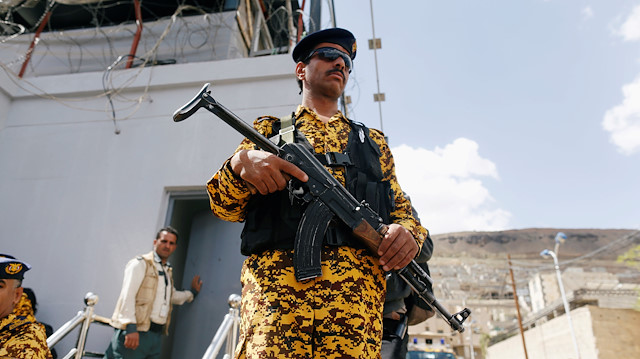
A police trooper stands guard as wounded Houthi fighters demonstrate outside the United Nations offices to demand for medical treatment abroad, in Sanaa, Yemen.
Houthi rebels in Yemen said on Monday they were halting drone and missile attacks on Saudi Arabia, the United Arab Emirates and their Yemeni allies, responding to a demand from the United Nations.
The Iranian-aligned group, which has been battling the Saudi-backed government for nearly four years, also said it was was ready for a broader ceasefire if the Saudi-led coalition "wants peace".
International pressure has mounted on Yemen's warring parties to end the war that has killed more than 10,000 people and pushed the country to the verge of starvation.
The move from the Houthi group came after the coalition ordered a halt in its offensive against Yemen's main port city Hodeidah, which has become the focus of the war.
"We announce our initiative...to halt missile and drone strikes on the countries of aggression," Mohammed Ali al-Houthi, the head of the Houthis' Supreme Revolutionary Committee, said in a statement.
The decision was based on discussions with U.N. special envoy Martin Griffiths to show "good faith" and support peace efforts, he said.
Griffiths is trying to salvage peace talks after a round in September collapsed when the Houthis did not show up. He hopes to convene talks before the end of the year in Sweden to agree on a framework for peace under a transitional government.
Yemen's parties have given "firm assurances" they are committed to attending peace talks, Griffiths told the U.N. Security Council on Friday.
Saudi Arabia's King Salman on Monday reiterated the kingdom's support for U.N. efforts to end the war.
Tired Of War
Yemenis cautiously welcomed the announcement on Monday.
"We pray that this will be the real beginning of peace in Yemen, we are all tired of this war," said Mona Ibrahim, a teacher in the capital Sanaa, which has been under Houthi control since September 2014.
"We just want to live like other humans," Mohammed al-Ahdal, a resident of Hodeidah said.
The Houthi defence ministry said it would respond to any hostilities from the coalition.
Houthi-run Al Masirah TV reported later on Monday that Houthi forces fired a ballistic missile on Saudi-backed forces in the desert of Midi, bordering Saudi Arabia.
The Houthis say their missile attacks on Saudi Arabia are in retaliation for air raids on Yemen by the Western-backed coalition, which entered Yemen's war in 2015 to try to restore the Saudi-backed government of President Abd-Rabbu Mansour Hadi.
The coalition has carried out thousands of air strikes in the impoverished country that have hit schools, markets and hospitals, killing hundreds of people - though it says it does not target civilians.
The Houthis last July unilaterally halted attacks in the Red Sea to support peace efforts, after Riyadh temporarily suspended oil exports through a strategic Red Sea channel following attacks on crude tankers.
Western allies including the United States have called for a ceasefire ahead of the renewed U.N. efforts.
Western countries have provided arms and intelligence to the Arab states in the alliance, but have shown increasing reservations about the conflict since the murder of U.S.-based Saudi dissident journalist Jamal Khashoggi at the Saudi consulate in Istanbul last month.
A senior security official was killed in a drive-by shooting in Yemen’s southern city of Aden on Sunday, according to a local resident.Three gunmen opened fire on Brigadier-General Fahd Gharama as he left his home in the city, killing him on the spot, the resident said on condition of anonymity due to restrictions on speaking to media.Seven people, including six female students, were injured in the attack.No group has yet claimed responsibility for the attack.Gharama is the deputy commander of the UAE-backed Security Belt forces in Aden.Aden serves as the temporary capital of the Yemeni government, which fled Yemen in 2015 after Shia Houthi rebels overran much of the country, including capital Sanaa a year earlier.Since mid-2015, Aden has seen bombings and assassination incidents targeting security and government headquarters, preachers, mosque imams, along with army and security officers.Yemen gov’t says to swap prisoners with Houthi rebelsUN: Yemeni parties to attend peace talks in SwedenUS senators seek clampdown on Saudis over Yemen, Khashoggi murderClashes stop in Yemeni port citySaudi-led coalition orders halt in assault on Yemen's Hodeidah
Top security official shot dead in Yemen’s Aden
Saudi Arabia is defying U.S. calls to mend ties with Qatar despite signs that pressure to end another regional crisis, the Yemen war, has had an impact on Riyadh since the killing of a prominent journalist.Jamal Khashoggi's murder at the Saudi consulate in Istanbul on Oct. 2 caused a global outcry, opened Saudi Arabia to the possibility of sanctions and damaged the image of Crown Prince Mohammed bin Salman.Washington believes it has more influence over Riyadh as its ally tries to repair the damage to the kingdom's standing, and wants to use this leverage to end the Yemen war and rebuild Gulf unity against Iran, four sources familiar with the matter said.On one front, there is movement.In an apparent response to U.S. and British pressure for a ceasefire in Yemen by the end of this month, the Saudi-led coalition fighting Iran-aligned Houthi rebels halted an offensive on the main port city of Hodeidah on Thursday.Maintaining pressure on Riyadh, Washington imposed sanctions on 17 Saudi officials for their role in Khashoggi's killing later on Thursday, and U.S. senators introduced draft legislation which, if it became law, would suspend arms sales to Saudi Arabia over the journalist's death and the Yemen war.Saudi authorities did not respond to requests for comment. A U.S. State Department spokeswoman said Washington had been calling for a resolution throughout the Qatar and Yemen crises."We continue to engage on both of these issues with our partners in the region, including Saudi Arabia," the spokeswoman, Heather Nauert, said."Gulf unity is essential to our common interests of confronting Iran’s malign influence, countering terrorism, and ensuring a prosperous future for all of our Gulf partners."Qatar Rift Runs DeepThe United States sees Saudi Arabia as a crucial player in the efforts to build unity in the Gulf to contain Iran's influence in the Middle East, and Secretary of State Mike Pompeo visited Riyadh soon after Khashoggi's killing.But Washington sees the Yemen war as a destabilising factor in the region and wants an end to the conflict, which has killed more than 10,000 people and pushed Yemen to the brink of famine.Saudi Arabia and its ally, the United Arab Emirates, also now have reasons to exit the war as it has proved costly and reached stalemate.Since the death of Khashoggi, a Saudi national and U.S. resident who was critical of the Crown Prince, U.S. officials have also sought to sway Riyadh over its row with Qatar.Gulf unity, which Washington considers a bulwark against Iran, was shattered when Saudi Arabia, the UAE, Bahrain and Egypt severed trade and transport ties in June 2017, accusing Doha of supporting terrorism and Iran -- charges Doha denies."They are seizing the opportunity to try to end the Qatar dispute," a source with knowledge of U.S. policy said.Washington had wanted Gulf unity restored, to help contain Iran's influence in the region, before new sanctions went into force against Tehran over its nuclear programme on Nov. 4, two of the sources said.Western hopes that Riyadh might mend ties with Doha had been raised by a comment Prince Mohammed made on the strength of Qatar's economy at an investment forum on Oct. 25.Yemen gov’t says to swap prisoners with Houthi rebelsUN: Yemeni parties to attend peace talks in SwedenUS senators seek clampdown on Saudis over Yemen, Khashoggi murderClashes stop in Yemeni port cityBut diplomats and Gulf sources say they have seen no new ideas or concrete moves by Riyadh or its allies to end the row with tiny but wealthy Qatar."I don't see any change on Qatar. The crown prince's message was interpreted wrongly. He was sending a message to America ... 'Don't get worried about Qatar because you still have a strong economy in Qatar'," one Arab diplomat told Reuters.Each of the boycotting countries is an ally of Riyadh and has longstanding political and security differences with Qatar.A Gulf source said Prince Mohammed, known as MbS, would avoid any move that could be interpreted as weakness as he tries to recover from the diplomatic fallout over Khashoggi.Riyadh offered contradictory explanations for Khashoggi's disappearance before saying he was killed in a rogue operation. King Salman, who stepped in to defuse the crisis, has stood by his chosen heir, in whose hands he has concentrated power.Containing The CrisisKuwait said this month there was a "positive view to contain the Gulf crisis," and a source familiar with U.S. policy said diplomats were putting forward a plan on Qatar.But neither side seems ready to cede ground.Qatar's foreign ministry spokeswoman said last month that Khashoggi's death should serve as a "wake-up call". Qatar Airways Chief Executive Akbar al-Baker said on Tuesday he did not expect a thaw soon."I am very pessimistic about this. With the current (Saudi and UAE) leadership I don't see that there is any way that things may be loosened up," he told reporters. "The only face-saving way for them to get out is to apologise."Abu Dhabi says the dispute is not a priority, according to three diplomats and other sources familiar with Gulf policy."The Qataris are raising the price for resolving the crisis," said one Western diplomat. "The Emiratis are happy to keep the Qataris isolated."Qatar and UAE authorities did not respond to requests for comment.Riyadh and Abu Dhabi continue to reassure Washington that the dispute will not deter the formation of a proposed Middle East security alliance, which would include Doha, diplomats said.They said the UAE still strongly supports MbS against Iran and on his economic and social reforms, seen by Abu Dhabi as essential to replicating the UAE model of a business-friendly, tolerant Muslim society to combat extremism."The Emiratis see Saudi Arabia as the only choice to lead the region. They haven't blinked in their belief that Riyadh's reform plans are the best and only option," said Elizabeth Dickinson, Senior Analyst for the Arabian Peninsula at the International Crisis Group.Saudi account of Khashoggi killing 'unsatisfying'New York Times posts video on slain Saudi journalistUS not considering extradition of FETÖ leader: TrumpTrump says US to issue Khashoggi report early next week
Saudi Arabia defies US pressure to end Qatar row after Khashoggi killing
The Yemeni government said on Saturday it will swap prisoners with the rebel Houthi group.“The Yemeni government is close to reaching a deal with the UN envoy about a draft for exchanging captives, detainees…and those placed under house arrest,” Yemeni delegate to the United Nations Ahmed Awad bin Mubarak said in a statement to the UN Security Council.He said the government has agreed to swap prisoners and captives with Houthi rebels.“We are keen on taking confidence-building measures and freeing the captives,” he said.There was no comment from the Shia Houthi group on the report.Impoverished Yemen has remained wracked by violence since 2014, when Houthi rebels overran much of the country, including the capital, Sanaa.The conflict escalated in 2015 when Saudi Arabia and its Sunni-Arab allies launched a devastating air campaign in Yemen aimed at rolling back Houthi gains.The ongoing violence has destroyed much of Yemen’s infrastructure, including water and sanitation systems, prompting the UN to describe the situation as one of “the worst humanitarian disasters of modern times”.US senators seek clampdown on Saudis over Yemen, Khashoggi murderSaudi-led coalition orders halt in assault on Yemen's HodeidahTwo protesters shot dead in eastern Yemen
Yemen gov’t says to swap prisoners with Houthi rebels
Warring factions in Yemen have confirmed they will attend peace talks in Sweden, UN Special Envoy to Yemen Martin Griffiths said Friday."This is a crucial moment for Yemen. I have received firm assurances from the leadership of the Yemeni parties," said Griffiths at a UN Security Council meeting. "They are committed to attending these consultations. I believe they are genuine."Griffiths said he will head to Sanaa next week, and would travel with the delegation to the consultations in Sweden, if necessary.The UN envoy noted he was close to "solving the preparatory issues that will allow us to make this happen.""With increased international attention, has come a renewed commitment from the Yemeni parties to work on a political solution," Griffiths said.Impoverished Yemen has been wracked by violence since 2014 when Shia Houthi rebels overran much of the country, including the capital, Sanaa, and al-Hudaydah province.The conflict escalated in 2015 when Saudi Arabia and its Sunni-Arab allies launched a massive air campaign in Yemen aimed at rolling back Houthi gains and shoring up the country’s pro-Saudi government.The violence has devastated Yemen’s basic infrastructure, including its health and sanitation systems, prompting the UN to describe the situation as “one of the worst humanitarian disasters of modern times”.The announcement by Griffiths came after the chief of the UN's World Food Programme (WFP) David Beasley gave an update on the humanitarian situation in Yemen."This is not on the brink of a catastrophe. This is a catastrophe," Beasley said at a news conference.According to the WFP, 18 million people in Yemen are food insecure, and between 12 to 14 million people are severely food insecure."These are people, literally, marching toward the brink of starvation," Beasley added.Last week forces loyal to Yemen's internationally-recognized government launched a fresh military operation to retake al-Hudaydah -- and its two strategic seaports -- from Houthi rebels.On Tuesday, the UN's humanitarian affairs chief Mark Lowcock called for a cease-fire to the ongoing conflict, which led to a halt in clashes in the port city of al-Hudaydah, according to Yemeni security forces.US senators seek clampdown on Saudis over Yemen, Khashoggi murderClashes stop in Yemeni port citySaudi-led coalition orders halt in assault on Yemen's HodeidahTwo protesters shot dead in eastern Yemen
UN: Yemeni parties to attend peace talks in Sweden
Yemeni security sources reported Thursday that clashes have stopped in the port city of al-Hudaydah since late Wednesday.Military operations in al-Hudaydah were stopped based on an agreement between the Yemeni government and the UN, Asil es-Sakledi, head of the press office of Amalika Brigade told Anadolu Agency.Sakledi said operations stopped due to allow representatives of international aid organizations to reach food stores and evacuate civilians from conflict areas.He said military forces created "safe corridors for evacuation".The Houthi rebel group said in a statement there is no serious communication about the political solution or the cease-fire.The UN's humanitarian affairs chief Mark Lowcock called Tuesday for a cease-fire in Yemen's ongoing conflict to facilitate the flow of direly needed international assistance.Already the Arab world's poorest nation prior to the start of the conflict, Yemen has remained wracked by violence since 2014 when the Houthis overran much of the country, including the capital, Sanaa.The conflict escalated in 2015 when Saudi Arabia and its Arab allies launched a devastating air campaign in Yemen aimed at rolling back Houthi gains.
Clashes stop in Yemeni port city