

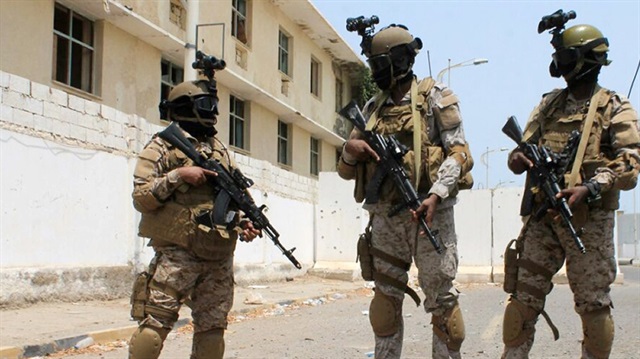
File photo
The Yemeni army has captured the Baqem Directorate in the northwestern Saada province from Houthi rebels, a military source said Thursday.
If confirmed, Baqem would be the first directorate of Saada -- a traditional Houthi stronghold -- to fall to the army.
Brigadier-General Yasser al-Harthi, commander of the army’s 102nd Brigade, said that “dozens” of Houthi fighters had been killed or captured in the fighting.
Yemeni President Abd Rabbuh Mansour Hadi left the Egyptian capital, Cairo, on Wednesday for Saudi Arabia after a three-day visit.“President Hadi left Cairo for Riyadh after a 3-day business visit,” his office director Abdullah al-Alimi said on Twitter.He described Hadi’s talks in Cairo with President Abdel-Fattah al-Sisi as "successful".Al-Alimi said the Yemeni leader has obtained “serious pledges” from Egyptian authorities about facilitating the living of Yemenis in Egypt.Hadi has been living in Riyadh since he fled Yemen in 2015 after the Shia Houthi group overran much of the country, including capital Sanaa one year earlier.The conflict escalated in 2015 when Saudi Arabia and its Arab allies launched a massive air campaign in Yemen aimed at rolling back Houthi gains and shoring up the country’s pro-Saudi government.
Yemeni president leaves Egypt for Saudi capital
Anadolu Agency, however, has yet to independently verify al-Harthi’s assertions.
Yemen has remained wracked by violence since 2014, when Shia Houthi rebels overran much of the country, including capital Sanaa.
The conflict escalated the following year when Saudi Arabia and its Sunni-Arab allies launched a massive air campaign in Yemen aimed at rolling back Houthi gains.
Despite their defeat, an estimated 20,000-30,000 Daesh fighters are still in Syria and Iraq, according to a UN report published Monday.The report on Daesh and Al-Qaeda, which was presented to the Security Council, said a smaller number of Daesh fighters had made their way to Afghanistan, where there are now 3,500-4,500 fighters. There are also 3,000-4,000 militants in Libya.The report further noted that although Daesh was militarily defeated in 2017, it was able to regroup early this year. Within Syria and Iraq, it has been able to revert its structure to that of a "covert network".While the Daesh threat may have been eliminated on the surface, the UN said there are still "sleeper cells" throughout Iraq, where it is able to launch attacks without controlling any territory.Iraqi forces uncover Daesh tunnels near MosulMeanwhile in Somalia, Yemen and South Asia, Al-Qaeda has been showing resiliency compared to Daesh. In Yemen, there are 6,000-7,000 Al-Qaeda fighters compared to 250-500 Daesh fighters.The Al-Shabab terrorist organization, which is affiliated with Al-Qaeda, is the strongest force in Somalia and has launched numerous attacks in and around the capital of Mogadishu.Al-Qaeda is also active in the Sahel region of Africa on the border between Niger and Mali via its affiliate group Jama'at Nusrat al-Islam wal-Muslimin, according to the UN.
Thousands of Daesh fighters remain in Syria, Iraq: UN