

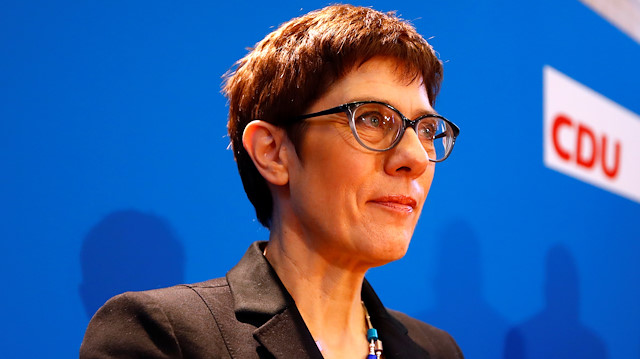
Chancellor Angela Merkel's protege, Annegret Kramp-Karrenbauer, addresses a news conference to promote her candidacy to succeed the German leader as chief of their conservative Christian Democrats (CDU) in Berlin, Germany, November 7, 2018.
Pitching to succeed Angela Merkel as Christian Democrat (CDU) leader, Annegret Kramp-Karrenbauer promised on Wednesday a new chapter for Germany in which "people feel at home here" after a period of political turmoil marked by the rise of the far-right.
Should she secure the CDU leadership, Kramp-Karrenbauer, 56, would be in pole position to succeed Merkel as chancellor.
But polls show Kramp-Karrenbauer, who is the conservative party's general secretary, lags businessman Friedrich Merz, 62, in the race. Merkel said last week she would vacate the CDU leadership at a party congress in December, heralding the end of a 13-year era in which she has dominated European politics.
As heir to Merkel's centrist cause, Kramp-Karrenbauer could probably cohabit as party leader with Merkel as chancellor, which she wants to remain until the end of the parliamentary term in 2021.
The New World Order (NWO) is no longer an issue of conspiracy theories. Foreign Affairs (FA), the famous U.S. magazine of the Council on Foreign Relations, certified its existence and its bad shape. Why? Among other culprits – new international actors – there is Donald Trump, because he challenged the fundamentals of the U.S.-based global order, according to think tank analyses. Of course it is not the first warning but the first in plain language that shows fear, concern and no longer brilliant assessment.In Europe and the Western media, there is a charge that could end a journalistic career. Conspiracy theorist or “conspirator” is a label that marks several information actors out of the establishment “frame,” putting all “named” journalists in a special club, a blacklist doomed to stay in a dark corner of the media system. Do you want to be published? Do you want be broadcasted? So you had to avoid touching upon issues like New World Order, trilateral conspiracy, the wrongdoings of Davos bad guys, financial regime and all stories out of the main frame of the media. It was like that till a few years ago when the number of media operators dissatisfied about their mission, which was almost totally bent to outlets’ line which was far from the truth, steeply-increased. The often-quoted George Orwell stated: “Intellectual honesty is a crime in any totalitarian country, but even in England it is not exactly profitable to speak and write the truth (…) The further a society drifts from the truth, the more it will hate those who speak it.” But now things have become so bad for the old order that partisan scholars started to speak out about the crisis and we can better understand because it is in stormy waters. When control of public opinion becomes a constant delivering of true lies, the system isn’t sustainable anymore.Too many “red lines” about independent information were not only overpassed but simply cancelled. For example, Panagiotis Roumeliotis, who is a Greek economist, Pasok party member and national representative at the IMF, exposed the way financial institutions tried to manage the economic crisis in Greece by fabricating news. We know the final outcome: an economic and social earthquake that badly-hit poor people to allow Greece to pay back German and French bank credits: a scandal that showed the greedy soul of the EU, pushed and supported by global financial interests. The IMF trained information actors so that “Greek journalists can promote the positions of the IMF and the European Commission in Greek media”. According to Roumeliotis, the seminars and training classes took place in Washington D.C., as well as various sessions taking place in Greece. This was a perfect “spin machine”. Now this system, which brought about so much social detriment, left room to populist and sovereigntist waves across the Atlantic shorelines. Complains started to rise but contents of establishment players tell another story.“The order that has structured international politics since the end of World War II is fracturing”: that is the incipit of an article of FA’s latest issue, clearly titled “The Committee to Save the World Order.” But the continuation of that sentence shows immediately some fragility of the strategic assessment. “Many of the culprits are obvious. Revisionist powers, such as China and Russia, want to reshape global rules - wrote the two FA scholars - to their own advantage. Emerging powers, such as Brazil and India, embrace the perks of great-power status but shun the responsibilities that come with it. Rejectionist powers, such as Iran and North Korea, defy rules set by others. Meanwhile, international institutions, such as the UN, struggle to address problems that multiply faster than they can be resolved.” Sure competitors in the international scene want to challenge leadership, that’s obvious.The key point, the origin of the crisis is that this system failed to share prosperity and stability. It was too big and too ambitious to properly deal with, so different social, political and economic environments worldwide. Something went wrong along the way after the end of Cold War. Less than a decade later, the order spread wealth, letting a new middle class rise in a wide range of development countries. The NAFTA treaty, at the beginning, put a grid, a model for further framework agreements. Low/middle tech production had to migrate to the third world, while developed countries had to focus on high-tech industries and point-zero services. Easy migration should build a cheap labor market without borders. An economic swap that failed immediately, igniting salary stagnation, even in the U.S., and social problems in Europe. That is – very briefly - the main reason, because the order has lost efficacy, influence and power. China, Russia, Brazil and rising countries just do their job, curving their own interest in a world mainly controlled by a U.S.-networked economy. Fostering democracy and helping fair development was supposed to be the tool to conquer hearts and minds during the ‘90s. The “third way” of Anthony Giddens was the framework by which European leftist parties justified the move of their voters toward the “market” magic world. European leftist leadership was simply blackmailed (because of Moscow’s embarrassing ties or corruption) to implement the “job.” As always, market amateurs (leftists) failed to understand when the system turned down, downgrading steeply and squandering the labor market without setting any alternative choice or buffer zone for large layers of workers, who were hit by globalization, high-tech revolution in production and the end of intermediation jobs in many fields.The newest culprit, however, according to U.S. thinkers, is a surprise: the United States, the very country that championed the order’s creation. “Seventy years after U.S. President Harry Truman sketched the blueprint for a rules-based international order to prevent the dog-eat-dog geopolitical competition that triggered World War II, U.S. President Donald Trump has upended it.” The list of sins is awful: Trump has raised doubts about Washington’s security commitments to its allies, challenged the fundamentals of the global trading regime, abandoned the promotion of freedom and democracy as defining features of U.S. foreign policy, and abdicated global leadership. All these arguments show one thing: the once brilliant FA, which was spun off from Henry Kissinger’s foreign policy tool (the Council on Foreign Relations) that shaped the U.S.’s strategic stance from the ‘60s to a decade ago, is disconnected from reality. They are so far from reality to propose a sacred alliance: France, Germany, Italy, the United Kingdom, and the EU in Europe; Australia, Japan, and South Korea in Asia; and Canada in North America are the obvious candidates to supply the leadership that the Trump administration will not. So the strategic think-tank, founded in 1921, which numbers 4,900, among them senior politicians, more than a dozen secretaries of state, CIA directors, bankers, lawyers, professors, and senior media figures, is not able to understand that no help will come, from Europe for example, because the political map of the EU is changing rapidly. Next summer, after the EU vote, sovereigntist parties could lead Brussel. Even the Asian scenario could change due to the China will to control its main supply route in the Southern China Sea. The situation is so fragile that in October even the Irish rock star Bono Vox, who was invited to EU parliament, called to support the European framework and migrant policy that so many Europeans dislike, basically a call against the big political change on the horizon. But is too little and too late (if not ridiculous) and exposes the fading of old world order and its last chance.
New World Order exposed and in bad shape
For Kramp-Karrenbauer, the challenge is to define her own profile distinct from Merkel's, while remaining loyal to the chancellor.
"This is the end of the era," Kramp-Karrenbauer, who German media have nicknamed "AKK" after her initials, told reporters in Berlin. "We have to thank Angela Merkel for a great deal."
"My experience is ... that one always stands on the shoulders of one's predecessor," she added, stressing the need for political stability in uncertain times.
"We need to work out a way for people here to feel at home - people who have lived here a long time and people who have arrived more recently," she added, with reference to the upheaval caused by Germany's migrant crisis in 2015.
Germany on Tuesday criticized new U.S. sanctions against Iran, warning that they may lead to “destabilization” and strengthen “radical forces” in the country.“We think that this step is wrong,” German Foreign Minister Heiko Maas told a news conference in Berlin, adding that Germany would take appropriate measures, together with its EU partners, to keep the nuclear agreement with Iran alive.“We are taking necessary measures so that the Iranian economy would not collapse fully, and lead to a destabilization situation that would actually support the radical forces in Iran,” he said.Facing new sanctions, Iranians vent anger at rich and powerfulGermany’s top diplomat also warned that new sanctions on Iran may further escalate tensions in the Middle East and become a threat to Europe’s security.He underlined that the agreement signed with Iran in 2015 was the most effective way to prevent Tehran from developing nuclear technology for military purposes.“We are now working to forge new instruments within the European Union, such as the special purpose vehicle, to make sure that business can still be done with Iran,” he said.World powers agreed in 2015 to lift economic sanctions imposed on Iran in return for the latter agreeing to limit its nuclear activity to peaceful and civilian purposes.But in May, U.S. President Donald Trump unilaterally withdrew from the nuclear agreement, accusing Tehran of cheating on the agreement, also known as the Joint Comprehensive Plan of Action (JCPOA).The agreement was signed between Iran and the five permanent UN Security Council members -- US, China, Russia, France, and Britain -- plus EU heavyweight Germany.
Germany says US sanctions would strengthen radicals in Iran
She laid out the challenges of delivering prosperity and social cohesion but did not spell out any specific policy prescriptions.
It could prove harder for Merkel to remain chancellor with Merz as CDU leader, as he lost out to her in a power struggle in 2002 and has since pursued a successful business career.
GOVERNMENT EXPERIENCE
Kramp-Karrenbauer's advantage over the other two candidates, Merz and Health Minister Jens Spahn, is that she has won an election - albeit in the small western state of Saarland - and served as state premier there.
She is on the CDU's left on economic policy, being a strong advocate of the minimum wage. Before the 2013 national election she suggested the top rate of tax be raised to 53 percent.
But she is conservative on social issues, opposing advertising for abortions, and caused controversy in 2015 by saying allowing same-sex marriages could open the door to incest and polygamy.
Vowing "not to pursue an election campaign against others", Kramp-Karrenbauer delivered a message of party cohesion and said that if she won the leadership she would seek to work with Merz and Spahn, who lags the other two candidates in polls.
Merz is chairman of the German arm of the U.S. hedge fund BlackRock, whose Munich offices prosecutors searched on Tuesday as part of Germany's largest post-war fraud investigation, a person with knowledge of the matter said. BlackRock says it is fully cooperating with the investigation covering the period of 2007-2011.
Merz took his role at BlackRock only in 2016 and has condemned illicit dividend stripping, but his role at the world's biggest fund manager risks reflecting poorly on him in socially-minded Germany.
In an election, Merz's right-wing pitch could draw back some CDU voters from the anti-immigration Alternative for Germany, which has gained from unease among some voters about the influx of more than 1 million asylum seekers since 2015.
Kramp-Karrenbauer is more likely to be able to form a coalition with the rising force in German politics - the Greens, now the second-strongest party.