

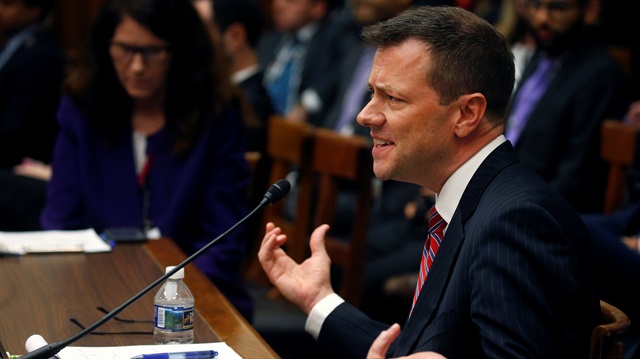
FBI Deputy Assistant Director Peter Strzok testifies before the House Committees on Judiciary and Oversight and Government Reform joint hearing on "Oversight of FBI and DOJ Actions Surrounding the 2016 Election" in the Rayburn House Office Building in Washington, U.S.
The White House has ordered that a wider group of lawmakers have access to classified information about an informant the FBI used to investigate possible ties between the Trump campaign and Russia, the New York Times reported on Thursday, citing two American officials with knowledge of the decision.
The White House order to allow all members of the House and Senate intelligence committees to see the classified documents - rather than a smaller group of lawmakers known as the "Gang of Eight" - was made despite concerns by intelligence and law enforcement officials that the move could lead to leaks, the Times said.
President Donald Trump directly criticised Prime Minister Theresa May's Brexit strategy, saying it had probably killed off hope of a U.S.-British trade deal and that she had failed to take his advice on how to negotiate with the European Union.In an interview published just hours before he was due to have lunch with May and tea with Queen Elizabeth on Friday, Trump chided the "very unfortunate" results of the prime minister's Brexit negotiation."If they do a deal like that, we would be dealing with the European Union instead of dealing with the UK, so it will probably kill the deal," Trump told the Rupert Murdoch-owned Sun newspaper."I would have done it much differently," he told The Sun, which urged its readers to back Brexit before a referendum in June 2016. "I actually told Theresa May how to do it, but she didn't listen to me."Video: Trump met by wall of protesters outside Blenheim PalaceAfter a tumultuous week for May, when her Brexit Secretary David Davis and Foreign Secretary Boris Johnson resigned in protest at the Brexit plan, Trump heaped praise on Johnson, saying he "would be a great prime minister".Such public criticism by a sitting U.S. president of a British prime minister while on a visit to the United Kingdom publicly undermines May in her party, her country and abroad.When asked about the comments, May's spokesman said she was looking forward to sitting down with Trump to talk him through the negotiating stance.As Britain prepares to leave the EU on March 29, 2019, supporters of Brexit have made much of the so-called special relationship with the United States and the benefits of forging closer trade ties with the world's biggest economy.'EU will not be divided over US tariffs'Many have cast May's plan as a betrayal, including lawmakers in her divided Conservative Party, who have warned that she might face a leadership challenge.White House spokeswoman Sarah Sanders said the president "likes and respects Prime Minister May very much," adding that he said in the interview she "is a very good person” and that he "never said anything bad about her".BREXIT AND TRUMPFor supporters, Trump and Brexit offer the prospect of breaking free from what they see as obsolete institutions and rules.But for many British diplomats, Brexit marks the collapse of a 70-year strategy of trying to balance European integration with a U.S. alliance based on blood, trade and intelligence sharing.London mayor says preposterous for Trump to blame crime on immigrationTrump has frequently angered British politicians. Late last year, May criticised him for retweeting a message by a member of a British far-right group, and the speaker of parliament has said Trump would not be welcome to address the chamber.More than 64,000 people have signed up to demonstrate in London against Trump's visit. On Friday, protesters began preparations to fly a large balloon over parliament depicting the president as an orange, snarling baby.On Thursday, May invoked World War Two leader Winston Churchill as she addressed Trump and business leaders at a black-tie dinner at Blenheim Palace, the 18th century country house where Churchill was born."Mr. President, Sir Winston Churchill once said that 'to have the United States at our side was, to me, the greatest joy'," May told Trump, according to a text of her speech."The spirit of friendship and cooperation between our countries, our leaders and our people, that most special of relationships, has a long and proud history," she said, adding that the United States was "not just the closest of allies but the dearest of friends".Outside the mansion, northwest of London, a couple of thousand booing demonstrators lined the road. It was one of more than a hundred protests police expected during Trump's four-day trip."I think it’s a travesty of British values. How can we roll out the red carpet for someone who stands for everything we stand against?" said academic Emily Jones, 40, one of those protesting outside Blenheim Palace.While Trump's trip was not the full state visit he was originally promised, he was heralded by military bands on his arrival in the country and at Blenheim, and he is scheduled to take the tea with Queen Elizabeth. 
Trump says May's Brexit plan kills hope of a US trade deal
Some American officials believe the reason the White House made the decision was to provide political ammunition to President Donald Trump's Republican allies who have argued that the Federal Bureau of Investigation's probe was opened in July 2016 as an effort to keep Trump from becoming president, the Times reported.
The White House did not immediately respond to a request from Reuters for comment.
South Korean President Moon Jae-in on Friday urged North Korea and the United States to move forward on a pact to end Pyongyang's nuclear programme."If Chairman Kim (Jong Un) keeps the promise of denuclearisation, he will be able to lead his country into prosperity," Moon said in a speech during a visit to Singapore."This path is never easy, but if the agreements at the summit are implemented with sincerity, the goal can be achieved," he added, referring to Kim's meeting with U.S. President Donald Trump in the wealthy city state last month.South Korea is willing to build an economic community with the North once the effort to root out Pyongyang's nuclear ambitions is completed, Moon added. Trump shares 'very nice' letter from North Korea's KimKim wants North Korea to be 'normal': South's leader
S.Korea's Moon urges North, United States to move forward on denuclearisation
According to the Times and other media reports, the FBI sent the informant, an American academic who teaches in Britain, to talk to Trump campaign advisers in the summer of 2016 after the agency had received evidence that the aides had suspicious contacts with Russia. The use of informants is commonplace in counterintelligence and criminal investigations.
The FBI at the time was investigating whether anyone in Trump's campaign worked with Russia to help tip the election in Trump's favor. The investigation is now being led by Special Counsel Robert Mueller.