

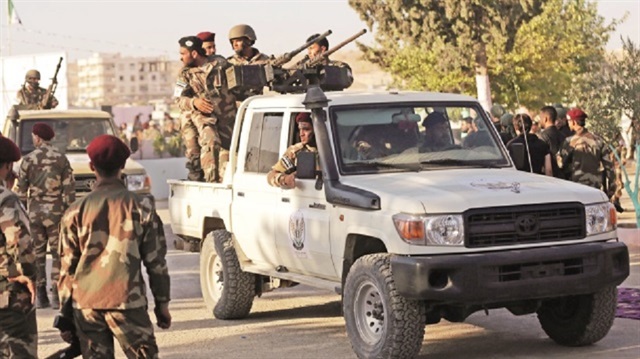
File photo
The Assad regime has amassed over 5,000 troops in Hilsea, Tel Madiq, Jisr ash-Shugur, Soran, Murak and the Turkmen Mountain area, all of which surround Syria’s Idlib, over the past three days. The 4th Armored Division, an elite formation of the Syrian Army commanded by Bashar al-Assad’s brother, has been stationed in the Idlib area.
The Syrian opposition, which has fought incessantly against the barbarities and massacres of the Assad regime, has declared that it will not allow the regime to capture Idlib, which is the last opposition-held stronghold in Syria.
“We will not allow Idlib, which is our last fort, to become like Ghouta. We are preparing to wage a life or death type of war across Idlib. Idlib will not become a Ghouta, Dara, Homs or Aleppo, as we will fight until our last drop of blood is shed,” Idlib’s Security Department General Fuad Suat told Yeni Şafak.
Turkish and U.S. troops on Monday completed their 29th round of patrols in the northern Syrian city of Manbij as part of a deal to rid the area of the YPG/PKK terror group.In a statement, the Turkish General Staff said forces of both countries conducted separate coordinated patrols in the region between areas liberated by Turkey's Operation Euphrates Shield and Manbij.Patrols by Turkish and U.S. troops in the region began on June 18.The Manbij deal between Turkey and the U.S. focuses on the withdrawal of the PKK-affiliated YPG terror group from the city in order to stabilize the region.In its more than 30-year terror campaign against Turkey, the PKK has taken some 40,000 lives, including many women and children. The YPG is its Syrian branch.Should the Manbij model prove a success, Turkey will push for a similar arrangement in eastern Syria.Turkey has said the presence of terror forces near its border constitutes a threat and has launched military operations and other efforts to rid the region of terrorists.
Turkey, US conduct 29th round of patrols in Manbij
Over the past four months, the Assad regime has increased by 1 percent its control over Syria, now controlling 109,136 of Syria’s total area of 185,180 square kilometers.
With Russian air support, the Assad regime has recently seized previously opposition-held areas of Eastern Ghouta, Daraa, and Quneitra.
Hundreds of thousands of opposition fighters to defend Idlib
Suat stated that they have been fighting for seven years and that they will exhibit a great resistance in Idlib, where thousands of opposition fighters who have not surrendered to Assad have sheltered. He added that at present, 150,000 armed fighters were ready to defend Idlib, and that this figure would swell to 200,000.
After losing Damascus’ Eastern Ghouta suburb in April, the military opposition and anti-regime armed groups left the Daraa and Quneitra provinces to regime forces, within the framework of a deal.
The number of people killed when an explosion ripped through a building in opposition-held northwestern Syria has climbed to 69 including 17 children, the Syrian Observatory for Human Rights reported on Monday.The explosion happened in a residential building in the town of Sarmada in Idlib province near the Turkish border on Sunday. Idlib forms part of the last major opposition stronghold in Syria. Video: Boy rescued from under rubble in Syria’s Idlib
Death toll in Syria blast climbs to 69
The opposition’s area of dominance nationwide thus fell to 18,625 square kilometers, or about 10 percent of Syria.
Today the opposition maintains control over the northwestern province of Idlib, western Aleppo, northern rural areas of Mt. Turkmen in Latakia, and the Al-Tanf region, near Syria’s borders with Iraq and Jordan.
Foreign militias fight for Assad regime
“Assad and his allies have dispatched 5,000 people around Idlib in the last three days. The forces that will clash with us in this region are mostly foreign militias, including the PKK, terrorists linked to Mihraç Ural from Lattakia and militias from Pakistan, Afghanistan, Iran, Iraq, Lebanon and Bahrain. The forces that will attack Idlib are composed of 65 percent of foreign mercenaries, and we will defend our lands from occupying forces,” Suat said.
The YPG/PKK terror group continued forced recruitment of men aged between 18 and 30, despite the U.S. and Turkey deal to rid the area of the terror group’s elements.According to a document dated June 18 that was published by the social media accounts of the so-called military council of the terror group on Sunday, YPG/PKK warned Manbij men aged between 18 and 30 to submit to terror group by Aug. 20.The terror group threatened those unwilling to join the ranks of the terror group with detention and punishment.Occupying some 27.7 percent of the Syrian soils, the terror group forces the youth living under occupation to bear arms.Reacting to the YPG/PKK policy of forced recruitment, local shopkeepers in Manbij had taken down the shutters in April.In August 2016, the terror group seized Manbij district of Aleppo, located west of Euphrates River, with the support of the U.S. More than 90 perent of the Manbij population is composed of Arabs.Terrorist PKK/YPG sell US weapons at blackmarketYPG/PKK terrorists, Syrian regime collaborate on Manbij- US-Turkey joint roadmap for ManbijPatrols by Turkish and U.S. troops in the region began on June 18. So far, 28 coordinated/independent patrols have been carried out by both sides.The Manbij deal between Turkey and the U.S. focuses on the withdrawal of the PKK-affiliated YPG terror group from the city in order to stabilize the region.In its more than 30-year terror campaign against Turkey, the PKK has taken some 40,000 lives, including many women and children. The YPG/PKK is its Syrian branch.Should the Manbij model prove a success, Turkey will push for a similar arrangement in eastern Syria.Turkey has said the presence of terror forces near its border constitutes a threat and has launched military operations and other efforts to rid the region of terrorists.* Ali Murat Alhas contributed to this story from Ankara
YPG/PKK continues forced recruitment of youth in Manbij
Entrusted to Turkey
“We are all ready to die but we will entrust the women and children to Turkey to prevent them from being massacred or captured and tortured. This is our final request from the Turkish government and honorable Turkish people, who have shouldered our burden during the past seven years. The Syrian opposition will always stay connected to the direction, recommendations and requests of Turkey without expecting anything in return,” Suat added.
Death toll in Idlib rises
The death toll from an explosion in Syria’s northwestern Idlib province has risen to 69, according to the White Helmets civil defense agency. Among the victims were 35 women and children, White Helmets official in Idlib, Mustafa Haj Youssef, said on Monday. On Sunday, Haj said that 32 people had been killed in the blast that took place in Sarmada district, where civilians displaced from the northern Homs province live. According to Haj, some 50 people have been injured in the explosion, which destroyed two 6-storey buildings inhabited by displaced civilians.
The Syrian Turkmen Assembly (STA) on Sunday called for the protection of Syria’s Turkmen Mountain area, which the Bashar al-Assad regime and its supporters have been striking intensively recently.In a statement, the STA said: “Although the three countries of Russia, Turkey and Iran reached a cease-fire agreement in these areas during the 10th guarantors’ meeting held in Sochi, the developments continue in a disturbing manner in Bayirbucak [a region in northern Syria that borders Turkey].”“Any attack carried out by the regime and its allies on the region would pose a great danger not only to the areas of the Euphrates Shield and Operation Olive Branch, but also to the national security of Turkey,” the statement said.The STA said necessary measures must be taken in the region immediately.“Turkey is the only guarantor in this regard. The Turkmen identity of the Bayirbucak region must be preserved to maintain its true identity forever,” it added.Artillery units of the regime forces on Friday night carried out intense attacks to the opposition’s frontline to seize the Turkmen Mountain region. The Turkmen Mountains in northwestern Syria’s Latakia falls within a network of de-escalation zones.In 2015, the regime -- backed by Russian air power -- captured some 85 percent of Latakia’s Turkmen Mountain region, forcing some 20,000 of the area’s Turkmen and Arab inhabitants to flee northward to Turkey.Under an earlier agreement endorsed by Turkey, Russia and Iran, Turkmen Mountain falls within a network of de-escalation zones in which acts of aggression are expressly forbidden.
Syrian Turkmens urge for protection of Latakia region
Assad regime violates de-escalation zone
Located in northwestern Syria near the Turkish border, Idlib was designated a “de-escalation zone” in May where acts of aggression are expressly forbidden.
Syria has only just begun to emerge from a devastating conflict that began in early 2011, when the Assad regime cracked down on protesters with unexpected ferocity.
UN officials estimate that hundreds of thousands of people have been killed in the conflict.
A fifth convoy carrying opposition fighters and civilians from Syria’s southwestern Daraa province arrived in opposition-held parts of Idlib and Aleppo in the country’s north on Saturday.The 10-bus convoy is reportedly carrying some 452 passengers, according to an Anadolu Agency correspondent based in the region.With the new arrivals, at least 3,300 people have been evacuated from Daraa to Idlib and Aleppo’s western countryside in recent days.On June 20, the Syrian regime -- with Russian air support -- launched a major military operation in Daraa, allowing it and its allies to establish control over most of Syria’s border with Jordan.The fighting led to a major displacement crisis, with an estimated 350,000 civilians fleeing Daraa towards areas near the border.Following peace talks last year in Kazakh capital Astana, Daraa was designated a “de-escalation zone” in which acts of aggression are expressly prohibited.
Fifth convoy sets out from Syria’s Daraa for Idlib