

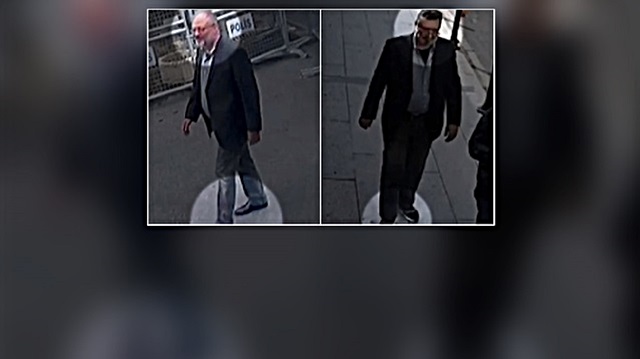
Jamal Khashoggi entering the Saudi consulate (L) and one of the 15 Saudis sent to confront Khashoggi dressed in his clothes (R).
Surveillance footage of the Saudi national who wore Jamal Khashoggi's clothes to make it seem like the journalist left the Istanbul consuate has emerged. The man seen in the footage was a member of the 15 Saudis who killed Jamal Khashoggi when he entered the consulate in Istanbul.
"The same man was seen in Khashoggi's clothing at the city's world-famous Blue Mosque just hours after the journalist was last seen alive entering the consulate on October 2," CNN reported, citing a senior Turkish official.
"The man in the video, identified by the official as Mustafa al-Madani, was allegedly part of what investigators have said was a hit squad, sent to kill the journalist at the Saudi consulate during a scheduled appointment to get papers for his upcoming wedding."
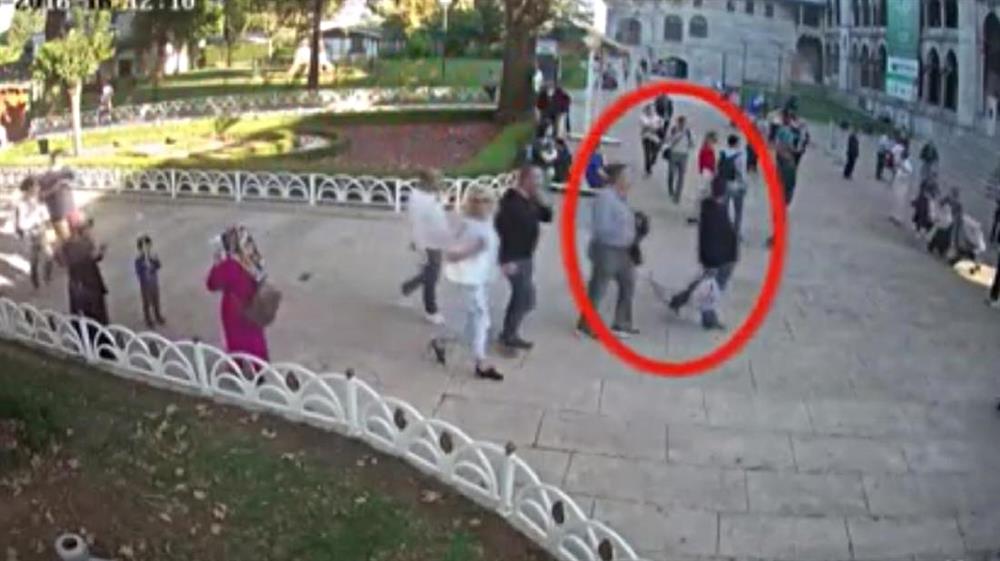
Khashoggi vanished after entering the consulate to obtain documents for his upcoming marriage.
After two weeks denying any involvement in Jamal Khashoggi's disappearance, Saudi Arabia on Saturday said the journalist, a critic of the crown prince, died during a fight in the building. An hour later, another Saudi official attributed the death to a chokehold.
Reflecting international scepticism over its account, a senior Saudi government official laid out a new version that contradicts previous explanations.
The latest account includes details on how 15 Saudis sent to confront Khashoggi had threatened him with being drugged and kidnapped and killed him in a chokehold when he resisted. A member of the team dressed in Khashoggi's clothes to make it appear as if he had left the consulate.
After almost three weeks of denials and blame deflection, the Saudi authorities finally backtracked on Oct. 19, 2018, announcing that Khashoggi died during a “brawl” inside the consulate on Oct. 2 and that 18 Saudis have been arrested in connection with this case. Moreover, two top aides of Crown Prince Mohammed bin Salman (MBS), as well as three other intelligence agents, have been sacked.Regardless of the Saudi version’s dubious veracity, the gruesome murder and likely dismemberment of Saudi journalist Jamal Khashoggi, which took place on Oct. 2 inside the Saudi consulate in Istanbul, convey not only a sinister picture of the Saudi regime but also an extraordinarily poor impression of their media.It should be noted that the Saudi regime has a long history of kidnapping opponents. Luring dissidents to meetings and kidnapping them appears to be a regularly used tactic. For instance, Naser al-Sa'id, one of the first opposition leaders against the Saudi royal family, disappeared in Beirut in 1979. Similarly, Prince Sultan bin Turki was abducted in Geneva and put on a plane destined to Saudi Arabia in 2003 after calling for reforms in Saudi Arabia. Likewise, Prince Turki bin Bandar Al-Saud, a former police chief, was also snatched overseas in 2015 and rendered against his will to Saudi Arabia.Prince Salman backed into a tight corner as links to Khashoggi murder become clearerThe tendency to use heavy-handed repressive manoeuvres against Saudi intellectuals and journalists seems to have accelerated since Mohamed Bin Salman (MBS) became Crown Prince. According to The Independent, Saudi authorities planned a similar kidnapping plot against Khaled bin Farhan al-Saud, a Saudi prince living in exile in Germany, just ten days before Khashoggi went missing.The aforementioned vicious campaign was accompanied by an upsurge in propaganda levels to promote the Saudi regime’s totalitarian line, smear the forces of change, and denigrate their narratives. Ranging from Saudi-owned Al Arabiya news channel to the Rotana Group conglomerate and the Middle East Broadcasting Corporation (MBC), to transnational newspapers, such as the dailies Al Hayat and Asharq Al-Awsat, and the online news portal Elaph, the Saudis have put their media empire at the service of this strategy.However, despite having built such a massive transnational media empire, media values, journalistic ethics, and press professionalism are not on offer in Saudi Arabia. Suffice to say that Al Arabiya News Channel, which is supposed to be the Saudi flagship media outlet, lost in February 2018 its broadcasting licence with regulator Ofcom in the United Kingdom (UK) after receiving complains that the broadcaster was “violating impartiality code and accuracy in news sourcing”. This is particularly telling, as Ofcom enjoys international respectability for its high standards in maintaining broadcasting codes for programming, with which all broadcasters in the UK must comply.Turkish employees of Saudi consulate give statements in Khashoggi probeThe Jamal Khashoggi affair is a case in point. The mountain of evidence linking Riyadh to the murder of Jamal Khashoggi was so big that the Saudi media’s fact-free denials for almost three weeks not only turned these media into a laughing stock but also became indictments, as it were, for the Saudi regime in and of themselves.Instead of providing meaningful information about the disappearance of Khashoggi or even offering substantial counter-evidence that challenges the facts surrounding this affair, the Saudi media’s reaction ranged from total denial and obfuscation to the construction of baseless conspiracy theories.For example, Jamil Al-Dhiabi, the editor of Saudi newspaper Okaz, stated in an article published on Oct. 9, 2018 that “all those circulating the information about the killing of Saudi journalist Jamal Khashoggi are tweeting in unison almost identical slogans, which indicate that they are involved and accomplices in this crime.” Another columnist for Okaz, Hammoud Abu Talib, tried in the same edition (9 October) to deflect the blame to foreign entities, affirming that the Jamal Khashoggi case “strongly indicates an intelligence operation prepared by intelligence operatives and journalists handled by the Muslim Brotherhood.” In a similar vein, Al-Arabiya.net quoted the chargé d'affaires of the Saudi Embassy in Lebanon as saying that “the Khashoggi theatrical show is a conspiracy and a plot from an intelligence agency that was designed to undermine Saudi Arabia's reputation.”Germany urges other EU states to also stop arms exports to Saudi ArabiaIn parallel, the Saudi media also attacked American and international press for their reporting on Khashoggi. For example, Al-Arabiya website downplayed the reporting from Reuters as “full of contradictions”. Similarly, in an editorial entitled “Black propaganda” and published on Oct. 8, state-owned newspaper Al-Riyadh attacked the Washington Post, lamenting that “the latter turned overnight into a platform for vilifying the Saudi kingdom and denigrating its leadership”. According to this editorial, this media flak indicates “the collapse of the credibility of this media institution and its transformation into a paid space to attack the Kingdom”. For this Saudi newspaper, the only explanation for singling out Riyadh in this affair is “the rising hostility between the Washington Post and U.S. President Donald Trump”.The bizarre editorial line adopted by the Saudi media vis-à-vis the Khashoggi case has brought ridicule to some of the most passionate advocates of MBS, like Thomas Friedman, the columnist of the New York Times. Hosted by CNN journalist Christiane Amanpour on her show on Oct. 18, 2018, Friedman could not but hide his face in disbelief after hearing some of the ridiculous comments by Saudi media outlets.When Riyadh began admitting at last some part of responsibility in an agonizingly slow process, the Saudi media, despite having blatantly lied to their public and vehemently accused virtually anybody ranging from the Washington Post and Turkey to Qatar and the Muslim Brotherhood, barefacedly made a 180-degree turn and offered no apology to their audience or acknowledgement about their pathetic coverage.Saudi king, prince condole with Khashoggi familyAll things considered, after spending millions of dollars over lobbying firms and public relations companies, the grisly murder of Khashoggi has tarnished the image of MBS and the Saudi regime for a long time to come. In short, Riyadh has plunged into an international crisis. However, in the battle to shape the international public opinion, the Saudi media, which had little journalistic reputation -- if any -- before the Khashoggi affair, has been at best a worthless fig leaf, and at worst an additional source of embarrassment for Riyadh in this case.By Tarek Cherkaoui, the manager of the TRT World Research Centre and the author of “The News Media at War: The Clash of Western and Arab Networks in the Middle East.” Cherkaoui is an expert in the field of strategic communications.Khashoggi's fiancee receives police protectionErdoğan to make statement on Khashoggi killing TuesdayBin Salman wasn't aware of Khashoggi killing: Saudi FM
Some lie and some die: Saudi media and Khashoggi affair
Maher Abdulaziz Mutreb, who allegedly headed the 15 Saudis who were inside the Saudi consulate in Istanbul when Jamal Khashoggi was killed, called Badr Al Asaker, the director of the private office of Crown Prince Mohammed bin Salman, four times after the “fistfight” that resulted in the journalist’s death.After denying any involvement in the disappearance of Khashoggi, 59, for two weeks, Saudi Arabia on Saturday morning said he had died in a fistfight at the consulate. An hour later, another Saudi official attributed the death to a chokehold, which a senior official reiterated.Information obtained by Yeni Şafak indicates that Mutreb used his cellphone to call Asaker at least four times after the murder took place.Germany urges other EU states to also stop arms exports to Saudi ArabiaMutreb was a diplomat in the Saudi embassy in London and has travelled frequently with the crown prince.It was found that Mutreb also contacted a U.S. number thought to be the Saudi envoy in Washington, Khaled bin Salman.Khaled is the younger brother of Salman, who was appointed as Saudi Arabia’s ambassador to the U.S. in 2017. He left Washington for Riyadh once the murder of Khashoggi was exposed.Asaker quelled rumors in May that Salman was killed in an attempted coup attempt by tweeting a picture of the crown prince with Abu Dhabi Crown Prince Sheikh Mohammed bin Zayed Al Nahyan, King of Bahrain bin Isa and Egyptian President Abdel Fattah al-Sisi.Saudi king, prince condole with Khashoggi familyHe also shared various video footage to confirm that Salman was very much alive and well.Khashoggi vanished after entering the consulate on Oct. 2 to obtain documents for his upcoming marriage.He was a U.S. resident who wrote columns for the Washington Post and a critic of the Saudi government, calling for reforms.Saudi Arabia on Sunday called the killing of journalist Jamal Khashoggi at its Istanbul consulate a "huge and grave mistake," but sought to shield its powerful crown prince from the widening crisis, saying Mohammed bin Salman had not been aware.Erdoğan to make statement on Khashoggi killing TuesdayPrince Salman is currently in a chokehold as top U.S. lawmakers also turned on him and said they believed he ordered the killing of Khashoggi.“Do I think he did it? Yes, I think he did it,” said Republican Senator Bob Corker, the influential chairman of the Senate Foreign Relations Committee.Saudi stocks also tumbled as foreigners sold a net 4.01 billion riyals ($1.07 billion) in Saudi stocks in the week ending Oct. 18.Turkish President Recep Tayyip Erdoğan in his turn said that he would make all the necessary statements about the killing of the Saudi journalist on Tuesday.Bin Salman wasn't aware of Khashoggi killing: Saudi FM
Prince Salman backed into tight corner as links to Khashoggi murder become clearer
A number of employees of the Saudi Consulate in Istanbul testified as part of an ongoing probe into the killing of Saudi journalist Jamal Khashoggi, a judicial source said on Monday.Five Turkish employees of the Saudi Consulate said in their testimonies that they weren't given a day off on Oct. 2 and left the consulate when their shift ended at 3.30 p.m. local time (1230GMT).Khashoggi was last seen at 1.14 p.m. (1014GMT) on Oct. 2, when he entered the Saudi Consulate in Istanbul.Among those who testified to the prosecutors assigned by the terror and organized crimes unit of Istanbul’s Chief Public Prosecutor’s Office, a consulate staff -- employed as a driver -- spoke to the reporters after his testimony at Istanbul Court House in Caglayan district.Indonesia hopes for 'transparent and thorough' probe of Khashoggi killingThe employee said the prosecutors asked them whether there was an extraordinary thing happened on Oct. 2 in the consulate or they saw Khashoggi and 15 other Saudis, how long they were employed in the consulate, where they are from and the working hours of the staff.As for the answers, the driver said they did not sense extraordinary situation on the day when Khashoggi entered the consulate, the testifier was not sent to anywhere out of the consulate, and the working hours began at 9 a.m. (0600GMT) and ended 3.30 p.m. (1230GMT) local time.The driver added that the employees left the building as usual when their shift ended on Oct. 2.Upon the questions of journalists, he said that he knew Saudi Consul General Mohammad al-Otaibi, who left Turkey for Riyadh last week.Germany urges other EU states to also stop arms exports to Saudi ArabiaLater, the witnesses left the courthouse.The remaining 17 personnel -- both Turkish and foreign nationals -- are expected to appear at the courthouse for submitting their testimony as part of Istanbul Chief Public Prosecutor's Office's probe, the sources added.Last week, a total of 23 consulate employees had also spoken to the prosecutors.Khashoggi, a columnist for The Washington Post, had gone missing since entering the Saudi Consulate in Istanbul on Oct. 2.Saudi king, prince condole with Khashoggi familyAfter days of denying to know his whereabouts, Saudi Arabia on Saturday claimed Khashoggi died during a fight inside the consulate.On the day of Khashoggi’s disappearance, 15 other Saudis, including several officials, arrived in Istanbul on two planes and visited the consulate while he was still inside, according to Turkish police sources. All of the identified individuals have since left Turkey.A joint Turkish-Saudi team completed an investigation into the case on Thursday after searching the residence of the consul general as well as the Saudi Consulate in Istanbul.On Sunday, Turkish President Recep Tayyip Erdogan said he will make a statement on Khashoggi’s killing on Tuesday during his party's group meeting at the parliament.Khashoggi's fiancee receives police protectionErdoğan to make statement on Khashoggi killing TuesdayBin Salman wasn't aware of Khashoggi killing: Saudi FM
Saudi Consulate employees testify on Khashoggi killing
Germany wants other European Union member states to follow its example in stopping arms exports to Saudi Arabia as long as uncertainty remains over the killing of journalist Jamal Khashoggi, Economy Minister Peter Altmaier said on Monday.Riyadh has given multiple and conflicting accounts on what led to Khashoggi's death on Oct. 2 at its consulate in Istanbul. On Sunday, Foreign Minister Adel al-Jubeir called the killing a "huge and grave mistake" but sought to shield Saudi Arabia's powerful crown prince.Chancellor Angela Merkel said on Sunday that Germany would stop arms exports to Saudi Arabia as long as the uncertainty around Khashoggi's death persisted.Saudi king, prince condole with Khashoggi familyAltmaier, a close ally of Merkel, said Riyadh's explanations on the case so far had not been satisfactory."The government is in agreement that we will not approve further arms exports for the moment because we want to know what happened," Altmaier told ZDF broadcaster.So far this year the German government had approved weapons exports worth more than 400 million euros ($462 million) to Saudi Arabia, making it the second-biggest recipient of German arms after Algeria.Asked whether Germany would roll back previously agreed arms deals with Saudi, he said a decision would be made "very soon".Khashoggi's fiancee receives police protectionAltmaier said other EU states should stop arms exports to Saudi Arabia in order to increase pressure on Riyadh over the Khashoggi case."For me it would be important that we come to a joint European stance," Altmaier said."Because only if all European countries are in agreement, it will make an impression on the government in Riyadh. It will not have any positive consequences if we halt arms exports but other countries at the same time fill the gap."Senior German politicians have also urged Siemens CEO Joe Kaeser over the weekend to pull out of an investment conference in Saudi Arabia later this week.Pakistan welcomes Turkish-Saudi contacts on KhashoggiGermany stops arms exports to Saudi ArabiaErdoğan to make statement on Khashoggi killing TuesdayBin Salman wasn't aware of Khashoggi killing: Saudi FM
Germany urges other EU states to also stop arms exports to Saudi Arabia