

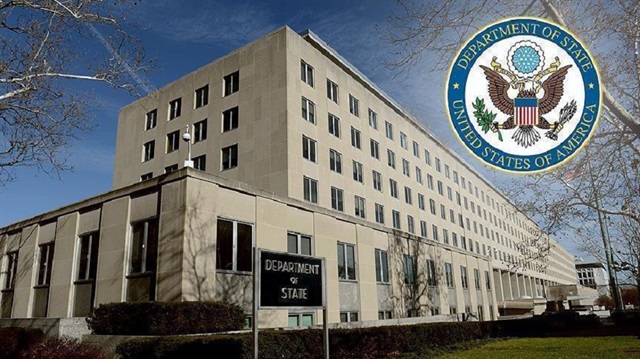
File photo
The U.S. on Sunday welcomed the Saudi Arabia-led coalition's admission that it had made "mistakes" in a deadly airstrike on a bus in Yemen that left scores of children dead.
"The United States regards the Saudi-led Coalition's announcement that it will review their rules of engagement, hold those at fault accountable, and compensate victims following the Joint Incident Assessment Team's finding that last month's Sa'ada air strikes lacked justification as an important first step toward full transparency and accountability," State Department spokeswoman Heather Nauert said in a statement.
She said Washington continues to call on all sides to abide by the Law of Armed Conflict, to mitigate harm to civilians and civilian infrastructure, and thoroughly investigate and ensure accountability for any violations.
The Saudi-led coalition on Saturday expressed regret over "mistakes" in a deadly airstrike on a bus in Yemen that left scores of children dead.The Saudi Press Agency (SPA) said, "the Joint Forces Command of the Coalition expresses regret over the mistakes, extends its sympathies, condolences and solidarity to the families of the victims."On Aug. 9, a Saudi-led airstrike targeted a bus carrying children in Yemen’s northwestern Saada province. At least 50 people, mostly children, were killed and dozens of others injured.The coalition said it would undertake legal proceedings "to hold the ones who committed mistakes accountable."It also pledged voluntary assistance to those affected in the attack.Lt. Gen. Mansour al-Mansour, the head of the Joint Incidents Assessment Team (JIAT), said in a press conference in Riyadh that the videos of the aircraft that launched the strike were being investigated."The authorities were informed that there were Houthi leaders in the bus. The order to hit the bus in an area away from the civilians was given when the bus was moving. As there was no nearby warplane in the area, the target could not be hit at that moment. After the bus stopped at a place where there were civilians around, another order not to target the bus was given but the order arrived late." The airstrike was the latest in a series of attacks by the U.S.-backed Saudi-led coalition in the country. The forces entered Yemen three years prior in order to fight Houthi rebels who had taken over the Yemeni government in the capital, Sanaa.Yemen has been wracked by war since 2014, when Shia Houthi rebels overran much of the country, including Sanaa.The loss of the capital forced President Abdrabbuh Mansur Hadi and his government to take up temporary residence in Yemen’s coastal city of Aden.The conflict escalated in 2015 when Saudi Arabia and its Sunni-Arab allies -- accusing the Houthis of serving as Iranian proxies -- launched a massive air campaign in Yemen aimed at rolling back Houthi gains and shoring up Hadi’s pro-Saudi government.UN-sponsored peace talks held in Kuwait the following year failed to end the destructive conflict.The violence has devastated Yemen’s infrastructure, including water and sanitation systems, prompting the UN to describe the situation as “one of the worst humanitarian disasters of modern times”.
Saudi-led coalition admits mistakes in Yemen bus strike
"It is imperative that all parties work toward a comprehensive political solution to avoid further harm to the Yemeni people," read the statement.
The statement came a day after the Saudi Press Agency (SPA) said : "The Joint Forces Command of the Coalition expresses regret over the mistakes, extends its sympathies, condolences and solidarity to the families of the victims."
On Aug. 9, a Saudi-led airstrike targeted a bus carrying children in Yemen’s northwestern Saada province. At least 50 people, mostly children, were killed and dozens of others injured.
The coalition said it would undertake legal proceedings "to hold the ones who committed mistakes accountable". It also pledged voluntary assistance to those affected in the attack.
A senior Saudi official on Friday appeared to confirm local media reports that the kingdom is considering digging a canal to separate the Qatari peninsula from the mainland and turn it into an island, amid a year-long dispute between the neighbours."As a citizen, I am impatiently waiting for the details of the implementation of the East Salwa island project, this great historic project that will change the region's geography," Saud al-Qahtani, a senior adviser to Saudi Crown Prince Mohammed bin Salman, wrote on Twitter.Qatari authorities did not immediately respond to a request for comment.Qahtani has mentioned the project on Twitter over the past few months, but Friday's tweet was the clearest reference yet to an initiative which critics dismiss as a public relations tactic aimed at intimidating Qatar rather than a serious plan.US aiding Saudi war crimes in Yemen: NY TimesSaudi Arabia, the United Arab Emirates, Bahrain and Egypt cut diplomatic, trade and transport ties with Qatar in June 2017, accusing it of supporting terrorism. Doha denies that charge and says the boycott is an attempt to impinge on its sovereignty.The dispute has eluded mediation efforts by the United States and Kuwait, with both sides trying to secure the support of Western allies through diplomacy, media and business deals.Reports about the canal first emerged on Sabq, a news website close to the government in April. Unnamed sources described Saudi plans to build a military base and a nuclear waste dump beside a 60 kilometre (37 mile) channel measuring 200 metres wide and 20 metres deep and stretching across the entire border with Qatar.The cost was estimated at 2.8 billion riyals ($747 million).Further reports in the newspaper Makkah in June said Riyadh was moving ahead with the plans, with five unnamed companies invited to bid on the project and a winner to be announced in September.US goes to WTO to challenge Russian response to Trump's steel tariffs
Saudi official hints at plan to dig canal on Qatar border
U.S. assistance to the Saudi-led coalition’s war in Yemen has amounted to killing innocent Yemeni civilians, the New York Times argued in its newspaper.The op-ed piece cited reports by the UN and international watchdog Human Rights Watch, which said the Saudi coalition is responsible of war crimes in Yemen.The report also emphasized the role of the U.S. in not only selling weapons to the coalition but also providing military assistance."It’s time for the United States and its Western allies to stop selling arms or giving any military assistance to Saudi Arabia and its coalition partners," the newspaper wrote Tuesday.Saudi-led coalition to respond to UN Yemen reportThe majority of U.S. aid to coalition forces in Yemen have been in aerial combat, which received criticism when a U.S. made bomb was used to target a school bus, killing dozens of Yemeni children.According to CNN, the weapon was a 500 pound laser guided MK-82 bomb made by Lockheed Martin, one of the top defense contractors in the U.S. The bomb was sold to Saudi Arabia in a State Department approved arms deal.The violence in Yemen has devastated the country's infrastructure, including its health and sanitation systems, prompting the UN to describe the situation as “one of the worst humanitarian disasters of modern times”.About 6,660 civilians have been killed and 10,563 injured in the Yemeni conflict since March 2015, according to the UN Human Rights Office.Saudi-led coalition air strikes in Yemen may amount to war crimes: UNInternational organizations are not the only ones who have become irritated by the record of the coalition forces.“Clearly, we’re concerned about civilian casualties, and they know about our concern,” Lt. Gen. Jeffrey Harrigian told the New York Times.The Times said the next step for the U.S. should be to cut off aid to Saudi Arabia, a move that is not likely to happen.Secretary of Defense James Mattis said Tuesday that while U.S. support to Saudi Arabia is not unconditional, it will continue to provide assistance to coalition forces fighting in Yemen.
US aiding Saudi war crimes in Yemen: NY Times