

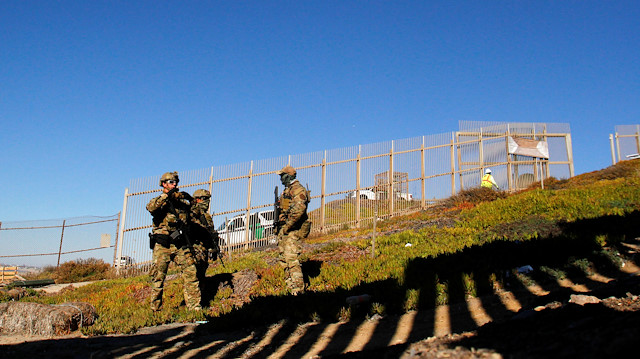
Agents with the U.S. Border Patrol Tactical Unit (BORTAC) stand guard behind the border fence between Mexico and the United States, as seen from Tijuana, Mexico November 14, 2018.
The number of U.S. troops at the border with Mexico may have peaked at about 5,800, the U.S. commander of the mission told Reuters, noting he would start looking next week at whether to begin sending forces home or perhaps shifting some to new border positions.
The outlook by Lieutenant General Jeffrey Buchanan, while not definitive, suggests that the high-profile military mission could soon achieve its goal of helping harden the border ahead of the expected arrival of caravans of Central American migrants in the coming weeks.
The deployment, which critics have called a pre-election political stunt by President Donald Trump, was initially expected to reach more than 7,000 forces, acting in support of U.S. Customs and Border Protection (CBP).
U.S. Defense Secretary Jim Mattis authorized the mission through Dec. 15 and while Buchanan did not rule out an extension, he did not think one appeared likely at this point, based on the current set of tasks assigned to the military.
Authorities continued to search for victim’s remains as the most destructive wildfire in California history continued to blaze Wednesday with the death toll soaring to at least 56.The Camp Fire in northern California has burned more than 9,000 structures, threatening in excess of 15,500 others as thousands of firefighters struggle to contain the 216-square-mile (350-square-mile) inferno. It is just 35 percent contained as it roars northeast of San Francisco.At least 130 people remain missing, according to reports.The fire has already laid waste to the town of Paradise where Federal Emergency Management Agency (FEMA) administrator Brock Long and Interior Secretary Ryan Zinke toured the devastation earlier in the day.Zinke said the fire is the worst he has ever seen, adding “the level of devastation” is devastating to the community.“Now is really not the time to point fingers,” Zinke said. “There’s a lot of reasons why these catastrophic fires are happening, but certainly we’re very clever as Americans and we need to pull together and do everything within our power to make sure that these communities, like Whiskeytown, like Yosemite, like Paradise, don’t get devastated because it really is a devastating tragedy.”Zinke’s comments follow his boss' Twitter screed last weekend against what U.S. President Donald Trump called California’s forest mismanagement, claiming “There is no reason for these massive, deadly and costly forest fires in California except that forest management is so poor.“Remedy now, or no more Fed payments!” he threatened.Following backlash from firefighters, the president made a dramatic about-face saying in subsequent tweets that he spoke to California Gov. Jerry Brown “to let him know that we are with him, and the people of California, all the way!”Officials and local residents in Paradise are now seeking to determine whether it is worth rebuilding, faced with the daunting task of a near-complete rebuild of the town.The cause of the Camp Fire continues to be under investigation.
Death toll from California wildfire reaches 56
"It is a hard date. And we have no indications that CBP is going to need us to do our work for longer than that," Buchanan said on Wednesday at Base Camp Donna in Texas, as Mattis toured the site near the Mexico border.
He acknowledged that there could be new requests, saying: "If we get an extension, we get an extension. But I’ve got no indications of that so far."
Asked whether he thought the troop levels had peaked, Buchanan said: "I do. We might increase by a hundred here or there, but probably not."
Trump's politically charged decision to send U.S. troops to the border with Mexico came ahead of U.S. congressional elections last week, as Trump sought to strengthen border security as part of a crackdown on illegal immigration.
Migrants, part of a caravan traveling from Central America en route to the United States walk by the road that links Ciudad Hidalgo with Tapachula, Mexico, November 2, 2018.Migrant caravan traveling to US walks by road that links Ciudad Hidalgo with Tapachula

Show All
But critics have said it was designed to drive Republican voters to the polls. They have scoffed at Trump's comparison of caravans of Central American migrants, including women and children, fleeing poverty and violence, to an "invasion."
Mattis defended the deployment on Wednesday, saying the mission was "absolutely legal," justified and was improving military readiness.
'RIGHTSIZING'
Buchanan also said his mission guidelines were clear - to support CBP personnel. He said his work was apolitical.
"I'm not being directed to do anything unnatural from above me," said Buchanan, who is commander of U.S. Army North.
The Pentagon says there are no plans for U.S. forces to interact with migrants and instead have been carrying out support tasks for CBP, like stringing up concertina wire and building temporary housing for themselves and CBP personnel.
In recent days, up to 1,000 migrants linked to the caravans have arrived in the Mexican border city of Tijuana, with a similar number expected to arrive in the next day or so. Thousands more could arrive in border towns over the coming days as the bulk of the caravans arrive.
Buchanan estimated that about 5,800 troops were deployed in total, with about 1,500 in California, 1,500 in Arizona and 2,800 in Texas. Buchanan acknowledged he might shift forces east or west along the border if needed.
Mattis told reporters earlier on Wednesday that U.S. soldiers were making rapid progress erecting barriers along the border and estimated the first, construction phase of the U.S. military effort could be completed within 10 days.
Buchanan suggested troops would go home once they had fulfilled requests by CBP.
"At some point in time, I'm not going to keep troops here just to keep them here. When the work is done, we’re going to start downsizing some capability," Buchanan said.
Buchanan would need to make any recommendations on redeployment of troops to General Terrence O'Shaughnessy, the head of U.S. Northern Command. O'Shaughnessy would then report to Mattis.
He suggested a recommendation could be made in the near future.
"I'm looking as early as next week to start thinking through rightsizing, if we need to change. Or do I need to shift (troops elsewhere on the border)," Buchanan said, without predicting when changes might occur.