

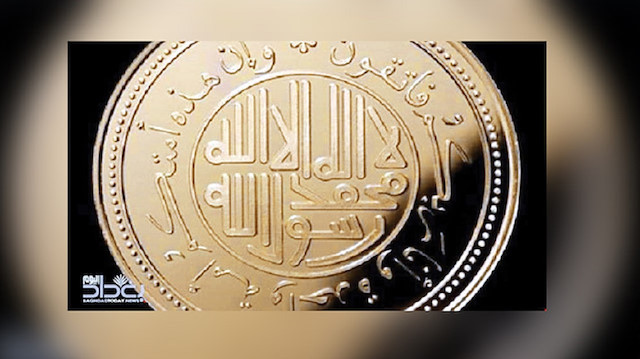
File photo
The U.S. and the Kurdistan Workers’ Party (PKK) are after Daesh’s seven-ton gold reserves in Syria as they prepare to seize the terror group’s stronghold in eastern Syria, according to a former senior Daesh member.
Speaking exclusively to Yeni Şafak daily, former Daesh finance responsible Abu Zeid al-Ambari revealed the true intentions of the U.S. and PKK as they prepare to attack the final Daesh stronghold in Syria.
Abu Zeid also pointed that Daesh has 17 tons of silver in the besieged city of Hajin in Deir Ezzor, noting that Daesh had 13 tons of gold in its coffers in mid-2016.
“Only seven people knew where the gold was hidden; two were killed, one went missing; and now the U.S. and PKK are trying to seize the gold,” said Abu Zeid.
Policies of forced displacement and razing homes carried out by the U.S.-backed Kurdistan Workers’ Party (PKK) terror group in eastern Syria resembles those practiced by Israel in Palestine, according to a Syrian opposition official.Raqqa’s former Deputy Governor Abdullatif al-Qashal spoke exclusively to Yeni Şafak daily about the recent developments near the border with Turkey.Bloodiest occupation in historyHundreds of tunnels were dug so close to the border in the towns and cities of Tal Abyad, Ras al-Ayn, Ayn al-Arab, Derbasiyeh and Malikiyyeh. “Six houses that belonged to me and my relatives in the Tal Abyad town of Mounbatah were seized by PKK terrorists.” “700 square kilometers were forcibly taken from us. Fields where we grew cotton and cereals are now being cultivated with drugs. Raqqa, Hasakah, Deir Ez-zor and Manbij are witnessing the bloodiest occupation and looting in history,” continued al Qashal.Over 750,000 Palestinians were expelled from Palestine when West Jerusalem was occupied by Israel in the Arab-Israeli war of 1948. This is referred to as the Nakba, or catastrophe, when Israel was officially founded. Eastern Jerusalem was occupied by Israel in 1967, although this annexation has never been recognized internationally. A UN vote in December 2016 declared that Palestinian territories were under hostile occupation.“A couple of cities could’ve been built”In addition to transporting weapons and munitions to the border, the U.S. has been moving large quantities of cement and iron.Tons of iron and cement were transported by the U.S. to the border from Assad-controlled regions, Egypt and Iraq. Despite the fact that most of eastern Syria is still in ruins, these resources are being spent on building a terror tunnel near the border. The terror organization is trying to relocate most of its headquarters underground and establish a line of resistance due to the region being on level ground. Work on building these tunnels started a year ago but only now began “in earnest.”250,000 Syrian refugees could return home next year: UNHCROver 70 houses destroyedOver 70 houses were destroyed due to these tunnels, and many other residences along the 10- 15 kilometer border are at a risk of collapse.The PKK continues with its policy of forced displacement as no homeowners whose houses were destroyed received any sort of payment.”Thousands of homes across several towns and villages remain at risk due to the construction of the underground tunnels.Israel has razed thousands of Palestinian homes, building Jewish settlements instead, in its attempt to drive Palestinians out.Israel’s settlements have repeatedly been described as having “no legal validity, constituting a flagrant violation under international law and a major obstacle to the vision of two states living side-by-side in peace and security, within internationally recognized borders,” as stated by a UN Security Council Meeting in December 2016.Syrian regime prisons are a ‘real hell’ and inmates prefer death, say survivors“Disaster of massive proportions”Syria faces a “disaster of massive proportions,” warned al-Qashal, calling on Turkey to intervene in the region.“The honor of the region’s people is being tarnished by the terror group and its supporters. If Turkey’s intervention is delayed, the scope of the disaster will only grow. We’re looking forward to the day the region will be liberated with the help of it residents and the Turkish Army.”A possible mission east of the Euphrates, which Turkey’s leadership has been suggesting for months, would follow two successful cross-border Turkish operations into Syria, Euphrates Shield and Olive Branch, both meant to eradicate the presence of YPG/PKK and Daesh terrorists near Turkey’s borders.Turkey has objected to the U.S. arming the YPG/PKK, in what the U.S. calls anti-Daesh efforts, telling Washington that fighting one terrorist group with another will come to nothing.The PKK is listed as a terrorist organization by Turkey, the European Union and the United States. The PKK has been conducting armed violence in the southeastern part of Turkey since 1984. More than 40,000 people, mostly civilians, have been killed in the three-decade long conflict.US-led coalition defends strike on hospital in Syria
‘PKK follows the same policy in east Syria as Israel does in Palestine’
Daesh coinage
“Upon seizing Mosul and Raqqa, the terror group’s so-called finance ministry created a ‘gold pool.’ Abu Bakir [al-Baghdadi] and Abu Ali gave the orders. They laid the infrastructure to funnel all the gold from Daesh-occupied cities to this pool. A special delegation was created for this purpose, and in 2015 they began to press gold and silver coins and put them into circulation,” revealed Abu Zeid.
“The terror group secured a large income from oil, cereal and trade activities, turning it into gold. Large amounts of gold were brought from Mosul, Talafar, Deir Ezzor, Aleppo and Raqqa to this ‘gold pool.’ Between mid-2015 and 2016, Daesh had 2.5 tons of gold in its coffers, which enabled it to press its own money,” he continued.
The Kurdistan Workers’ Party (PKK) terror group knows it cannot hold the regions under its occupation in Syria, relying only on the U.S.’s political and diplomatic prowess to “block a possible operation” by Turkey, according to a prominent defector from the terror group. Speaking exclusively to Yeni Şafak daily, Talal Sillo, who served for two years as the terror group’s spokesman, said that a Turkish operation in the east of the Euphrates River is the PKK’s “worst nightmare.” Sillo, a former high-ranking commander and spokesperson of the U.S.-backed Syrian Democratic Forces (SDF) who defected from the terrorist group last month, is currently in Turkey.He divulged details of the U.S. arming terrorist groups in the region and what some U.S. officials thought about the PKK/PYD's presence in northern Syria.Over Turkey’s objections, the U.S. has provided the PKK/PYD with arms, calling it an ally in the fight against Daesh, ignoring its status as a terrorist group, he stated.He also explained how the PKK-terrorist dominated force was formed and how the U.S. made a controversial deal to allow Daesh terrorists to leave the city of Raqqah before it was liberated.The old structure will be liquidated Sillo said that the U.S.’s true intentions behind placing a $12-million bounty over the heads of so-called PKK commanders Murat Karayılan, Duran Kalkan and Cemil Bayık are very clear. “It was to send a message inside the terror group to move Shahin Cilo into the spotlight. Abdullah Öcalan sent the U.S. a message through his lawyers, saying ‘Shahin Cilo is my successor. If you want to maintain presence in the region for the long term, your task is to protect him.’ Thus, the PKK’s center will be Syria from now on and the old structure will be liquidated by the U.S.”PKK continues to recruit children in Iraq’s SinjarU.S. trained 50,000 PKK terrorists The U.S. trained 50,000 terrorists in areas occupied by the PKK in Syria, pointed Silo. “However, this patchwork army can be dispersed through a small intervention. The SDF is only the banner and the 35,000 of those trained by the U.S are Arabs. They won’t show any resistance. Because Arabs know they’re being used. They trust neither the U.S. nor the PKK. In the same vein, the U.S. and PKK do not trust them. Terrorists who will show resistance are between 10,000 and 12,000.”Commanders killed, money burnt The operation carried out by Turkey in Karaçok came as a shock for the PKK terror group, said Tala Silo. “Everyone in the organization realized ‘everything has come to an end. Turkey launched its operation and the Syrian Kurdistan dream is over.’ News of a possible aerial operation resulted in headquarters being evacuated. In the following 10 days, we slept in camouflaged positions in the desert.” Silo said that 75 terrorists were killed in the Karaçok bombings. “Those are mostly key names. Nalin, the Syria responsible for the PKK’s so-called women unit, the YPJ, was also killed in the attack. Hundreds of millions of dollars in PKK money were burned in the attack. That operation dealt a large blow to the organization in every respect.”Turkey 'neutralizes' 26 terrorists over past week“He’s personally in charge of money and weapons”The U.S. is controlling the Kurdistan Workers’ Party (PKK) in Syria with the help of a terrorist on Turkey’s most-wanted list, said Sillo. Shahin Cilo, who’s known as terror ringleader Abdullah Öcalan’s foster son and whose real name is Ferhat Abdi Shahin, was tasked along with Bahoz Erdal of managing the PKK’s Syria arm since the beginning of the Syrian war. Wıth the start of the American intervention in Syria in 2015, Shahin answered directly to U.S. Special Envoy Brett Mcgurk and military officials as the PKK’s leading commander in charge of running operations from behind the scenes. Shahin, who’s on Turkey’s most-wanted list, was personally in charge of receiving money, weapons, munitions and other aid. He was spotted in 2017 with U.S. Special Operations soldiers in Syria’s Mount Karaçok. After protests by Tukey, the Pentagon finally acknowledged dealing with Shahin, who they called “General Mazlum,” and claimed he was a commander of the SDF in a scandalous statement.
‘Turkish op in the east of the Euphrates is PKK’s worst nightmare’
A bribe of three tons of gold
“Some of the terror group’s henchmen, who fled the cities of Mosul and Raqqa after they fell, bribed the Peshmerga, U.S. soldiers and intelligence services in exchange for allowing them to be smuggled out of the region. The wheels of this cycle of bribery are still running to this day. In 2017, the Peshmerga received gold from senior Daesh terrorist Abdulsamad Sejeri, who they promised they’d give an ID and passport so he can be smuggled out of Iraq. Instead, they ended up executing him after seizing large amounts of gold from the man who had been tasked with overseeing the finances of Daesh.”
Daesh has lost almost all the territory in Iraq and Syria where it once declared a caliphate, including its two main cities of Mosul and Raqqa last year.
The U.S. seeks to keep a close watch on Turkish territory and protect Kurdistan Workers’ Party (PKK) terrorists with its observation posts that are being established along the northern Syrian border under the pretext of helping the country “stave off terror threats.”Pentagon has established its first observation post in Syria’s Tal Abyad about 2 kilometers away from the Turkish border on a hill, which has a clear view of Turkish soil.On the opposite side of the border, the Turkish Armed Forces (TAF) have an observation post in the Turkish village of Öncül, which is just 2-2.5 kilometers away from Washington’s new observation post. Not an observation post but a “surveillance tower” to spy on Turkish territoryU.S. Defense Secretary Jim Mattis said on Nov. 21 that the United States was setting up the posts to help keep the focus on clearing the final strongholds of Daesh terrorists in Syria and avert terror threats.“We want to be the people to call the Turks and warn them if we see something coming out of an area that we’re operating in,” Mattis said. “We are going to track any threat that we can spot going up into Turkey. That means we will be talking to Turkey’s military across the border,” he stressed.Evaluating the designated observation posts, a military expert spoke exclusively to Yeni Şafak daily and said, “If their purpose was eliminating potential terror threats targeting Turkey, they would have established those posts at least 15 to 20 kilometers south of the border. This is the system that Turkey proposed to the states as well. No threat warning can be made just 2 kilometers from the border.”“Installing an observation post just 2 kilometers away from the border is has no significance other than observing Turkey. It is meant to be a surveillance point, not an observation post. It is a protective shield for Democratic Union Party (PYD) terrorists in the east of Euphrates River in Syria,” the source continued.“The U.S. is overtly planning to make Turkey’s intervention in the east of the Euphrates difficult.”Turkish Defense Minister Hulusi Akar in his turn expressed Turkey’s concerns and warned Washington by saying the posts would have "a very negative impact" on bilateral relations in November.The Kurdistan Workers’ Party (PKK) terrorists have accelerated efforts to transfer weapons received from the U.S. under the pretext of fighting Daesh to Syria’s northeastern town of Tal Abyad. The shipments particularly escalated after Turkey started to shell PKK/YPG terror positions in the city and the east of the Euphrates River.The PYD and its military YPG wing are Syrian branches of the PKK, which has waged war against Turkey for more than 30 years.Dahlan launches tirade after Turkish media exposes his dirty gameEU showcases PKK terror group in parliament
US seeks to spy on Turkey from observation posts along Syrian border
Buried in the desert
Former Daesh terrorist Abu Zeid revealed the fate of the gold amassed by the terror group.
“After the fall of Raqqa, Daesh transferred the gold in its procession to the city of al-Mayadeen. Later, after the latter also fell, they moved their reserves in Syria to the Badiyat al-Sham desert. The same was also done in Iraq where the gold was hidden in the desert region of Tikrit where no force was able to enter. For now the U.S. and PKK hope to find the gold reserves in the Hajeen region of Deir Ezzor, however, the terror group had taken all the gold and silver from urban centers under its control,” concluded Abu Zeid.
The U.S.-led coalition is supporting the Syrian Democratic Forces (SDF), which is predominantly made up of PKK/YPG terrorists, in assaulting the last Daesh territory in eastern Syria near the Iraqi border.
The PKK is listed as a terrorist organization by Turkey, the European Union and the United States. The PKK has been conducting armed violence in the southeastern part of Turkey since 1984. More than 40,000 people, mostly civilians, have been killed in the three-decade long conflict.