

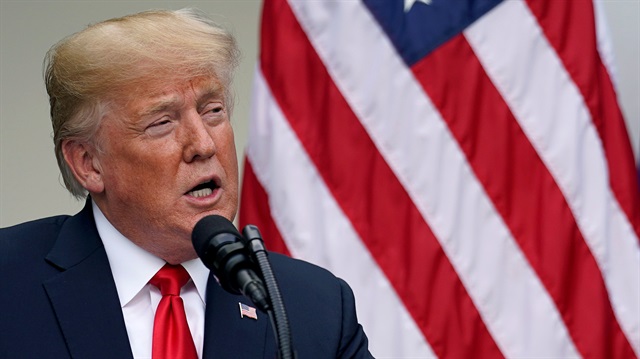
U.S. President Donald Trump
The United States has opened a path for India to avoid sanctions for buying arms from Russia, business leaders and experts said, almost a year after U.S. President Donald Trump signed a law penalising such trade.
India uses a large amount of Russian military equipment, from combat planes to ships and submarines, and is in the final stages of negotiating a $6 billion deal to buy S-400 long range surface to air missile systems from Russia.
Under the Countering America's Adversaries Through Sanctions Act (CAATSA) that Trump signed in August, any country trading with Russia’s defence and intelligence sectors faces secondary sanctions.
The law is designed to punish Russian President Vladimir Putin for the 2014 annexation of Crimea from Ukraine, involvement in the Syrian civil war and meddling in the 2016 U.S. presidential election.
German ministers welcomed an initiative agreed between U.S. President Donald Trump and European Commission President Jean-Claude Juncker to ease the threat of a trade war, with one describing it as a breakthrough and another saying it had won the EU time.After a meeting with Juncker at the White House on Wednesday, Trump agreed to refrain from imposing car tariffs while they start talks on cutting other trade barriers.The two also said talks would seek to "resolve" U.S. tariffs on steel and aluminum and Europe's retaliatory duties, a step back from Trump's import protections for U.S. metal producers."This is not yet the result we are aiming for but it has made a positive result in the whole discussion...on free trade or protectionism more likely than before," Maas told a news conference in Seoul, extracts of which were broadcast on German radio.US, EU reach trade pact after retaliatory tariffs"America and Europe are not opponents...We are partners and allies with common values and interests," Maas said, adding it was good that the two would also work on unfair trade practices and on a reform of the World Trade Organisation."The answer to America First can only be: Europe United," he said.German Economy Minister Peter Altmaier was even more enthusiastic, hailing the talks as a "breakthrough" that could avoid a trade war and save millions of jobs. "Great for global economy," he tweeted late on Wednesday.U.S. import tariffs of 25 percent on steel and 10 percent on aluminum imposed in March will stay in place during the talks and Trump said Europe had agreed to raise purchases of liquefied natural gas and lower trade barriers to American soybeans.The DIHK chambers of Commerce gave a cautious welcome to what was agreed, saying however, that U.S. auto tariffs were not totally off the table.Germany's car industry, including BMW, Daimler and Volkswagen, accounts for some 800,000 jobs."The proposed solutions move in the right direction but a significant proportion of scepticism remains," the DIHK said. 
Germany hails US-EU trade reprieve
But the U.S. Congress reached an agreement this week laying out conditions under which Trump can seek a waiver for allies. The administration has to certify that a country is reducing arms imports from Russia and is expanding defence cooperation with the United States.
India meets both those conditions, analysts and business leaders in New Delhi and Washington said.
India's government declined immediate comment, and a defence official said the U.S. Congress had still to vote on the modifications to the legislation which would then be signed by Trump into law.
Nisha Biswal, president of the U.S.-India Business Council (USIBC), said the U.S. move would help protect its strategic relationship with India.
The U.S. and the European Union have reached a new pact on trade, U.S. President Donald Trump and European Commission President Jean-Claude Juncker announced Wednesday.Addressing reporters at the White House, Trump said the pair agreed to work towards "zero tariffs, zero non-tariff barriers and zero subsidies on non-auto industrial goods."EU preparing counter-tariffs on $20 billion of US goodsEU's Juncker will not bring offer to Trump trade talksThe trading partners will also work to reduce trade barriers on services, chemicals, pharmaceuticals, medical products and soy beans. Services will also be addressed, Trump said.The U.S. and EU trade relationship is valued at roughly $1 trillion dollars.
US, EU reach trade pact after retaliatory tariffs
"At a time when India is focusing on growing defence ties with the U.S., we applaud Congress for also focusing on protecting this strategic partnership," Biswal said.
Jeff Smith, a south Asia expert at The Heritage Foundation, said the changes were a "meaningful and positive step forward".
"It reduces the possibility an Indian arms purchase from Russia will trigger CAATSA sanctions, a situation both the administration and most of Capitol Hill are keen to avoid," he said.
India has in recent years diversified its arms purchases, turning to the United States and Israel for modern equipment. It has ordered $15 billion of weapons from the U.S. over the past ten years and U.S. companies are bidding for contracts for fighter planes and helicopters worth billions of dollars.