

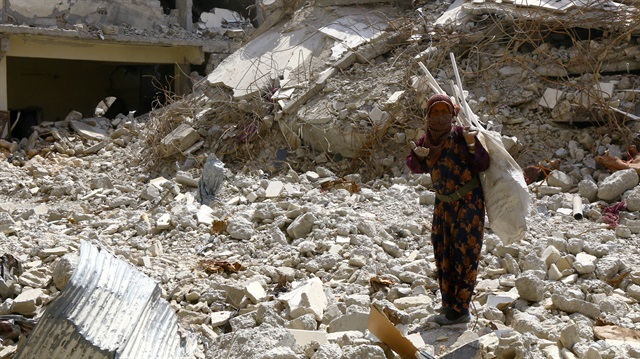
File photo
U.S.-led air strikes destroyed much of Syria's Raqqa while crushing Daesh last year, but the coalition has done little to help it recover, rights group Amnesty International said on Friday.
Nearly a year after the battle, 80 percent of the city is in ruins and thousands of bodies lie in the rubble, with funding to recover them poised to run out, said Anya Neistat, Amnesty's senior director of global research.
"It's absolutely shocking in Raqqa how little over this last year has actually been done to bring life back to the city," she said at a news conference in Beirut after visiting Raqqa.
"The coalition, given that they have the money to carry out this very, very expensive military campaign, should have enough money to work with its consequences," she added.
Daesh made it hard to take the city without killing civilians, blending in with the local population and using car bombs as they retreated from street to street.
Jamal Khashoggi, the Saudi dissident who went missing last week after entering the Saudi consulate in Istanbul, tweeted about a range of critical regional issues in the days leading up to his (as-yet-unexplained) disappearance.Along with the Palestine-Israel issue, the crisis in Syria, and Iranian intervention in the Arab world, Khashoggi also alluded to U.S. President Donald Trump’s recent suggestion that Saudi Arabia pay the U.S. for the protection it provides.أغادر لندن وفلسطين في البال، حضرت مؤتمرا وتعرفت على باحثين وناشطين مؤمنين بعدالة قضيتها من أطراف الارض.—رغم قوة اللوبي الاسرائيلي الذي حاصر اَي تعاطف معها الا ان صوتها لا يزال عاليا هنا.—في عالمنا يحاولون تغييب فلسطين لكسر الغضب فينا ولكنها حاضرة في ضمير كل مواطن … وان صمت. pic.twitter.com/qnOF5ZyUgu— جمال خاشقجي (@JKhashoggi) 1 Ekim 2018 After taking part in a pro-Palestine seminar in London, Khashoggi tweeted on Oct. 1 (only one day before his disappearance): “I am leaving London and Palestine is still on my mind. I attended a conference where I met [pro-Palestinian] researchers and activists from all over the world who believe in the justice of their cause”.He added: "Despite the power of the Israeli lobby [in the U.K.] … the voice of Palestine is still loud here. They are trying to marginalize the Palestinian cause … but it remains ever-present in the popular conscience."Khashoggi also tweeted several times about the arrest of his friend Essam al-Zamel, a prominent Saudi businessman and economy expert, by the Saudi authorities."Essam doesn't deserve such treatment,” Khashoggi asserted. “The accusations leveled against him don’t convince anyone!"قبل اعتقاله بيومين، كان عصام ضمن وفدا من #مركز_أداء بواشنطن يساعدهم بخبرته ويجول معهم على مؤسسات أمريكية للاستفادة من خبراتها @essamz لا يستحق هكذا معاملة وهكذا اتهامات لم تقنع أحداً ! pic.twitter.com/vQubNDEoOG— جمال خاشقجي (@JKhashoggi) 1 Ekim 2018 The Saudi authorities accuse al-Zamel -- an outspoken critic of Crown Prince Mohamed bin Salman’s “reform” initiative -- of maintaining covert affiliations with the Qatari government (with which Riyadh severed relations last year) and of having links to the Muslim Brotherhood (which Riyadh considers a “terrorist group”).Late last year, the Saudi authorities detained dozens of people -- including a number of princes and cabinet ministers (both former and current) -- in a massive "anti-corruption" sweep.Saudi billionaire investor Prince Alwaleed bin Talal and Prince Miteb bin Abdullah, minister for the Saudi National Guard, were among those rounded up.Only two months earlier, the Saudi authorities had launched a campaign targeting several Saudi intellectuals and Muslim scholars, including Salman al-Awda, Safar al-Hawali and Ali Al-Omari.In the days leading up to his disappearance, Khashoggi had also tweeted about his country’s dwindling role in Syria and alleged plans by the Saudi leadership to normalize ties with the Assad regime."Those who want to restore the Arab role in Syria should not do so through an Iranian ally [i.e., the Assad regime], which has forfeited its legitimacy and relinquished [the country’s] sovereignty...," Khashoggi tweeted on Sept. 30.Saudi Arabia had been one of the main supporters of the Syrian uprising that began in 2011 and which later erupted into full-blown conflict -- involving numerous regional and international actors -- after the Assad regime cracked down on protesters with unexpected ferocity.In a Sept. 27 tweet, Khashoggi urged the Saudi leadership to review its Syria policy, saying that “the only way to get Iran out of our [Arab] world is to support the Syrian revolution and a pluralistic system in Yemen”.For the past three years, Saudi Arabia -- at the head of an Arab military coalition -- has been fighting a destructive war with Shia rebels in Yemen who Riyadh accuses of serving as Iranian proxies.Khashoggi also urged the Saudi leadership to support the "the Arab people’s desire for freedom”. "The [Arab] people dislike the Iranian regime… as much as the regimes they rose up against in 2011 [in the so-called ‘Arab Spring’ uprisings]," Khashoggi declared.As for Trump's recent suggestion that the Saudi regime pay for the protection the U.S. provides, Khashoggi tweeted: "Trump himself is the biggest threat."In another tweet, Khashoggi voiced his belief that the “biggest threat” facing the Gulf States and their oil “is a president like Trump, who sees us merely as a source of oil”.Since Khashoggi went missing on Oct. 2, speculation has mounted that he was killed by the Saudi authorities, who have yet to provide a convincing explanation for his disappearance.Meanwhile, several countries -- including Turkey, the U.S. and the U.K. -- have continued to press Riyadh for clarification.According to Khashoggi’s Turkish fiancée, Hatice Cengiz, he first visited the Saudi consulate in Istanbul on Sept. 28.After being told his documents would be ready after one week, Khashoggi briefly visited London before returning to Istanbul on Oct. 1.The following day, he entered the consulate and has not been seen since.On the same day as his disappearance, 15 Saudi officials arrived in Istanbul, where they went to the consulate while Khashoggi was still presumably inside, according to Turkish police sources.France raises pressure on Saudi over Khashoggi disappearanceSaudi delegation arrives in Ankara for Khashoggi probeTurkey has recordings proving Khashoggi was killed inside Saudi consulate: Washington PostTrump: Khashoggi disappearance no reason to stop Saudi investments
In final tweets, Khashoggi alluded to Palestine, Syria
By the time the campaign ended, entire districts lay in ruins, Reuters reporters covering the battle said.
"30,000 houses in Raqqa have been completely destroyed and 25,000 are partially destroyed," said Neistat.
So far about 2,500 bodies have been dug from the rubble.
"To the extent that they are able to identify the bodies, they believe that the majority of them are civilians. And the majority of these civilians have died as a result of coalition air strikes," she said.
The People’s Protection Units (YPG), which is the armed wing of the Democratic Union Party (PYD), which is the Syrian offshoot of the Kurdistan Workers' Party (PKK) has not left Syria's Manbij, and Turkey will do what is necessary, President Recep Tayyip Erdoğan said on Friday.The terrorist group has completed the construction of trenches and embankments in areas surrounding the entire city center as if it has no intention of leaving. "They are now digging trenches in Manbij. What does this mean? It means 'we've prepared the graves, come and bury us'," Erdoğan said at a rally in southern Turkey.US sends 500 trucks of arms to PKK/YPG terrorists in a week"They said they would abandon the area in 90 days, but they haven't. We will do what is necessary."The Manbij deal between Turkey and the U.S. was inked in June this year on the withdrawal of YPG/PKK terrorists from the city to stabilize the region, which is in the northeast of the Aleppo province in northern Syria."There is no room for terrorists in Turkey's future," Erdoğan said.Turkish security forces "cause great distress" to terrorist organizations, Erdoğan added.Turkey pledges to launch a military operation against YPG/PKK in the strategically important city on Manbij that lies west of the Euphrates River in northern Syria, as part of Operation Olive Branch. Manbij lies northeast of Aleppo but just south of the Turkish border.Washington has claimed the YPG is a “reliable ally” in the fight against Daesh, while Ankara has pointed to its status as an offshoot of the PKK, a recognized terrorist group which has taken some 40,000 lives in Turkey.The YPG/PKK terror group is also in the midst of a military buildup along Manbij's border with areas liberated by Turkey’s Operation Euphrates Shield in 2016-2017.Turkish army 'neutralizes' 38 terrorists over past week
Turkey to 'do whatever is necessary' regarding Syria's Manbij: Erdoğan
"Nobody knows what's going to happen to the 3,000 bodies that still lie in the ground come 31 October when the funding for this team runs out," she said.
The coalition says it works on stabilisation in Raqqa, not reconstruction.
"The number's around 3 million people liberated, which is a good thing. There was a lot of damage. I don't think the problem lies with coalition countries not wanting to help," said Colonel Sean Ryan, the coalition spokesman.
He pointed to coalition countries not being able to work with the Damascus government, which opposes their presence, as an obstacle to channelling help.
The U.S. administration has supplied terrorists of the Kurdistan Workers’ Party (PKK)’s Syrian affiliate, the YPG, with a total of 500 trucks of arms in Syria’s Manbij in the past week alone, despite a deal between Ankara and Washington for the withdrawal of the terror group from the city.The Manbij roadmap between Turkey and the U.S. was agreed upon in June this year on the withdrawal of YPG/PKK terrorists from the city to stabilize the region, which is in the northeast of the Aleppo province in northern Syria.On Tuesday, Turkish Defense Minister Hulusi Akar said that the joint training of U.S. and Turkish soldiers for patrols in Manbij had begun.US supplies construction vehicles to YPG/PKK in ManbijTurkey will soon destroy terror nests in eastern Euphrates, says ErdoğanTerrorists dig trenches with American construction vehiclesThe trucks, carrying four construction vehicles which were transported to Manbij, escorted by the U.S soldiers, allows the terrorists to continue digging up trenches and build embankments around the city center.The U.S. also had reportedly shipped M984A4 Recovery Trucks (wrecker), produced by the Oshkosh Defense, to YPG/PKK terrorists.Defense experts predict that these vehicles will be used for fortifications.The PKK is listed as a terrorist organization by Turkey, the European Union and the United States.Turkish army 'neutralizes' 38 terrorists over past weekPentagon provides Lenco BearCat armored vehicles to terroristsThe U.S.-led international coalition on Thursday also approved that more than 300 truckloads of arms and military materials have been delivered to Syria’s Qamishli for the Syrian Democratic Forces (SDF), which is made up of YPG terrorists.The U.S. has additionally transferred at least two Lenco BearCat armored vehicles to the SDF as part of coalition aid.The SDF will allegedly use these vehicles for patrolling in rural areas and city centers.Lenco tactical response and rescue vehicles, manufactured by the Massachusetts-based Lenco Industries, are capable of carrying 12 military personnel.
US sends 500 trucks of arms to PKK/YPG terrorists in a week
Amnesty in June said coalition strikes may have broken international law, which it denied. The coalition says it worked hard to avoid deaths and is transparent in its efforts to investigate.
People in Raqqa said their main priority was education after suffering years of Daesh rule, but the few schools that had reopened were heavily overcrowded and riddled with war damage, Neistat said.