

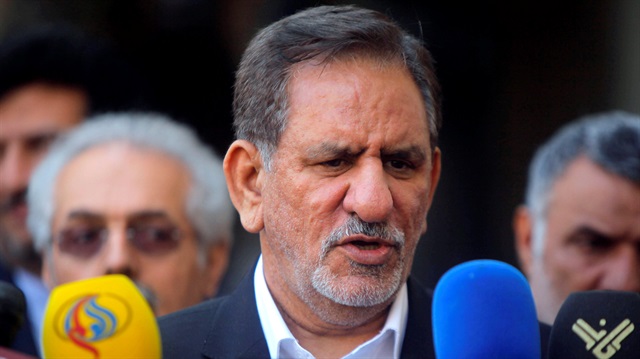
Iranian Vice President Eshaq Jahangiri
The United States is trying to make Iran surrender through the imposition of sanctions, Iranian vice president Eshaq Jahangiri said on Wednesday.
New U.S. sanctions against Iran took effect last week, and President Donald Trump said companies doing business with the country will be barred from the United States.
“The first priority for all of us under a sanctions situation is to work toward managing the country in a way that brings the least amount of damage to people’s lives,” Fars News quoted Jahangiri as saying. “America is trying by applying various pressures on our society to force us to retreat and surrender.”
The new sanctions targeted Iranian purchases of U.S. dollars, metals trading, coal, industrial software and its auto sector, though the toughest measures targeting oil exports do not take effect for four more months.
President Donald Trump has made no secret of his disdain for the international order, pledging before entering office to upend multilateral accords and recalibrate U.S. participation in the UN.He has made good on one of his most central vows: to scrap the nuclear accord world powers struck with Iran in 2015, roiling close transatlantic allies in the process.Trump’s actions, emboldened by close aide John Bolton, have inched the U.S. closer to confrontation with Tehran while at the same time increasing the likelihood of Washington sanctioning European allies who are working to salvage the deal and its curbs on Iran’s nuclear program.Economically, Trump has unilaterally removed Washington from one of the world’s largest free trade pacts and vowed to scrap another if it cannot be renegotiated.Tariffs on Turkish imports ‘pose serious risks’ for USThe president has further slashed U.S. funding for the UN by $285 million following a vote that condemned his unilateral recognition of Jerusalem as Israel’s capital and has removed the U.S. from two major UN bodies and is working to undermine another.Here is a list of major international agreements the American president has nixed or threatened to remove Washington from, the countries that were affected, and key UN bodies the U.S. has taken umbrage with.The Trans Pacific Partnership – The now defunct free trade agreement among Pacific Rim countries that was abandoned after the U.S. withdrew; 11 remaining countries formed a new trade agreement after the U.S. decision.Turkey raises tariffs on US-origin productsCountries affected: Japan, Malaysia, Vietnam, Singapore, Brunei, Australia, New Zealand, Canada, Mexico, Chile and Peru.Shortly after Trump signed off on the order, leading Republican Senator John McCain slammed the decision as “a troubling signal of American disengagement in the Asia-Pacific region at a time we can least afford it".“President Trump’s decision to formally withdraw from the Trans-Pacific Partnership (TPP) is a serious mistake that will have lasting consequences for America’s economy and our strategic position in the Asia-Pacific region," McCain said.Paris Climate Agreement – Historic effort to combat climate change; U.S. cannot exit until November 2020 under the terms of the pact despite Trump's efforts.Countries affected: the rest of the world.Former President Barack Obama, who spearheaded the Paris effort, slammed his successor's decision, saying the countries still within the agreement will "reap the benefits in jobs and industries created."Even in the absence of American leadership, even as this Administration joins a small handful of nations that reject the future, I’m confident that our states, cities and businesses will step up and do even more to lead the way and help protect for future generations the one planet we’ve got," he said.North American Free Trade Agreement – Free trade agreement between the U.S., Canada and Mexico that has been in effect since 1994. Trump has threatened to scrap it if it cannot be renegotiated; talks ongoing as Canada and Mexico reject separate individual pacts with U.S.Countries affected: Canada and Mexico.“Canada very much believes in NAFTA as a trilateral agreement,” Canadian Foreign Affairs Minister Chrystia Freeland said. “It has been in place for near a quarter century.”The agreement has allowed the three countries to integrate trading and supply chains that have benefited all involved, she said.Joint Comprehensive Plan of Action - Nuclear deal brokered by P5 1 group of world powers and Iran in 2015 giving Tehran billions of dollars in sanctions relief in exchange for intensive inspection regime.Countries affected (directly): Iran, Germany, Russia, China, France, the UK and the EU; global trade also impacted.Following re-imposition of first round of pre-deal nuclear sanctions, the EU vowed to protect Europeans doing business with Iran."We are determined to protect European economic operators engaged in legitimate business with Iran, in accordance with EU law and with UN Security Council Resolution 2231," the bloc saidCuba detente – Effort to restore relations between Cold War rivals begun under President Barack Obama; Trump has curbed travel to island nation, as well as commerce.Countries affected: U.S., Cuba.The tighter U.S. regulations were met with criticism by Senator Patrick Leahy, who said they are "what one would expect of a paranoid totalitarian government, not a democracy like ours”.“The hypocrisy of the White House ideologues is glaring. It is stunning," the Democratic senator said in a statement. “Far from promoting human rights in Cuba, these new regulations will hurt fledgling entrepreneurs and the rest of the Cuban people by discouraging Americans from traveling there.”US participation in UNHRC – Trump pulled the U.S. out of the UN’s Geneva-based human rights body in June, in part because of the council's criticism of Israel.Following the U.S. exit, UN Secretary General Antonio Guterres and Russian Foreign Minister Sergey Lavrov urged the U.S. to return to the Human Rights Council."We of course would much prefer the U.S. to remain in the Human Rights Council. And I believe that the human rights architecture is a key tool at the present moment in order to promote and protect human rights around the world," Guterres said.US participation in UNESCO – The U.S. announced it was exiting the UN’s world heritage organization in October 2017, citing alleged Israel bias.UNESCO Director-General Irina Bokova expressed "profound regret" about Washington's action, saying despite the decision to withhold funding, the U.S.-UNESCO relationship has continued to strengthen."At the time when the fight against violent extremism calls for renewed investment in education, in dialogue among cultures to prevent hatred, it is deeply regrettable that the United States should withdraw from the United Nations agency leading these issues," Bokova said.US funding for UNRWA – The Trump administration halved an installment payment to the UN’s Palestine refugee agency in January, giving only $60 million of a planned $125 million. Senior Trump officials are working to dismantle the agency altogether as legislation winds its way through Congress.A senior western official warned that one of two pieces of legislation seeking to shift UNRWA’s activities to the UN’s main refugee agency (UNHCR) could undermine Washington’s objectives.“Be very careful what you wish for, because for UNHCR, the preferred priority or choice would be for refugees to go back home, which is not something I suppose these American congresspeople would want,” the diplomat told Anadolu Agency, referring to the right of return, which Israel and its allies in Washington reject outright.
Trump’s global policy a string of abandoned commitments
Few U.S. companies do much business in Iran so the impact of sanctions mainly stems from Washington’s ability to block European and Asian firms from trading there.
President Hassan Rouhani made similar comments to Jahangiri, although he did not specifically refer to the United States.
"We will not let the enemy bring us to our knees," Rouhani said, according to state TV. "If the enemy thinks they will defeat us they will take this hope to the grave with them."
Iran's Supreme Leader Ayatollah Ali Khamenei on Monday ruled out the possibility of any military confrontation with the United States, Iranian state TV reported."Recently, American officials have been talking blatantly about Iran ... they are talking about war and negotiations ... They are exaggerating about possibility of a war with Iran. There will be no war ... We have never started a war and they will not confront Iran militarily," Iran's top authority said in a televised speech. Iran will not change regional policies under US threats: FMIran's Khamenei says mismanagement hurts economy more than US sanctions
Khamenei rules out any military confrontation with US
Washington had said Iran’s only chance of avoiding the sanctions would be to accept an offer by Trump to negotiate a tougher nuclear deal than the international accord struck in 2015.
Iranian officials already rejected the offer and on Monday Supreme Leader Ayatollah Ali Khamenei, the highest authority in the country, also ruled out the possibility of talks.
The Iranian economy is beset by high unemployment and a rial currency which has lost half its value since April. The reimposition of sanctions could also make the economic situation worse.
Iran will not rein in its influence in the Middle East despite mounting U.S. pressure on Tehran to curb its regional activities, Foreign Minister Mohammad Javad Zarif told Qatar's al Jazeera TV. "Iran will not change its policies in the region because of U.S. sanctions and threats," al Jazeera on Monday quoted Zarif as saying.In May, President Donald Trump exited Iran's 2015 nuclear deal with major powers, saying it failed to address Iran's ballistic missile program, its nuclear activities beyond 2025 or its role in conflicts in Yemen and Syria. Iran's Khamenei says mismanagement hurts economy more than US sanctions
Iran will not change regional policies under US threats: FM
Rouhani said on Wednesday that the economy is the biggest problem facing the country.
Khamenei accused the Iranian government of economic mismanagement on Monday in the face of reimposed sanctions.
Thousands of Iranians have protested in recent weeks against sharp price rises of some food items, a lack of jobs and state corruption. The protests over the cost of living have often turned into anti-government rallies.