

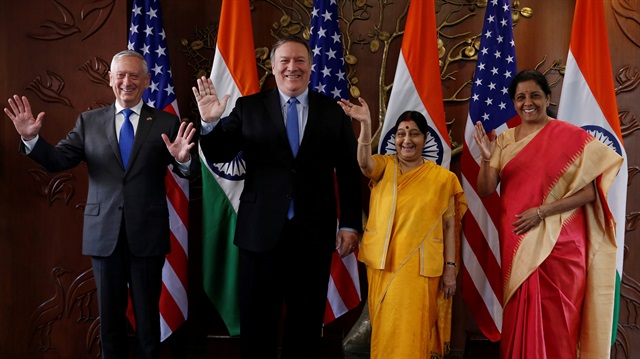
U.S. Secretary of State Mike Pompeo and Secretary of Defence James Mattis pose beside India’s Foreign Minister Sushma Swaraj and Defence Minister Nirmala Sitharaman before the start of their meeting in New Delhi, India, September 6, 2018.
The United States and India began talks in New Delhi to deepen political and security ties on Thursday, with officials hoping for an accord on military communications that could lead to increased U.S. arms sales to the South Asian giant.
U.S. Defense Secretary Jim Mattis and Secretary of State Mike Pompeo met with India's Foreign Minister Sushma Swaraj and Defence Minister Nirmala Sitharaman in a two-plus-two setting.
The world's two largest democracies have drawn closer in recent years, seeking ways to counter-balance China's spreading influence across Asia, notably in Pakistan, Southeast Asia and the Indian Ocean.
"My visit is a firm indicator of what we see as India's place among our most strategic, and I would even call them 'consequential' emerging partners," Mattis told reporters traveling with him to New Delhi.
Pakistan reassured the U.S. on Wednesday that it would use its influence to bring Taliban to the negotiating table in war-struck Afghanistan.“The U.S wants Pakistan to play its role for negotiations and reconciliation in Afghanistan. This is what our policy and desire is. We want peace and stability in Afghanistan, and I have fully assured them in this regard,” Foreign Minister Shah Mahmood Qureshi said at a news conference after a meeting with U.S Secretary of State Mike Pompeo in capital Islamabad.Pompeo arrived in the capital for a one-day visit, shortly after the U.S. announced a military aid cut of $300 million to Pakistan. On Thursday, he will set out to India.“America will lead peace talks with the Taliban,” Qureshi added, pointing to a thawing of ties between the two allies on the war on terror.Video: Pompeo meets with Pakistan foreign minister in IslamabadThe two sides agreed that the present conditions in Afghanistan were conducive to intensifying efforts for a political settlement, said a statement from the Foreign Ministry after the meeting. Pompeo conveyed the U.S desire to work with Pakistan in furthering the shared objectives of peace and stability in Afghanistan, the statement added.In a tweet after the meeting Pompeo said: "In #Pakistan with my colleague friend CJCS Gen Joe Dunford. Today we met with PM @ImranKhanPTI FM Shah Mehmood Qureshi to discuss our diplomatic military to military relationship. @StateDept."U.S. army chief Gen. Joseph Dunford also accompanied the U.S. secretary of state.The Pakistani foreign minister observed that a lingering diplomatic deadlock between Pakistan and the U.S had been broken by Pompeo’s visit.“There had been a long deadlock in relations between the two sides. But the situation has totally changed in this meeting,” he said.Responding to a question regarding the aid cut, Qureshi said: "We do not have a give and take relation with the U.S. We are a sovereign nation, and we do not want to talk about money but about principles."He added that Pompeo had extended him an invitation to visit Washington, which he accepted.Advisor to newly-elected Pakistani premier resignsOther visitsEarlier on Wednesday, Pompeo met newly-elected Prime Minister Imran Khan and army chief Gen. Qamar Javed Bajwa.Khan said that his government's agenda was focused on human development and poverty alleviation for which peace and stability in the region was a pre-requisite. He underscored his commitment to peace with all neighbors, according to a statement released from the prime minister house.Pompeo conveyed the desire of the U.S. administration to work with Pakistan to achieve the common objectives of peace and stability in Afghanistan and the region, the statement added.
Pakistan to help US bring Taliban to negotiating table
Before coming to India, Pompeo held talks in Islamabad with Pakistan's new government and senior most generals.
The presence of U.S. troops in Afghanistan has heightened U.S. sensitivity to the rivalry between nuclear-armed India and Pakistan. And, Washington and New Delhi share concerns over Pakistan-based anti-Western and anti-Indian Islamist militant groups.
Both the Indian and U.S. governments are keen to sign the Communications Compatibility and Security Agreement (COMCASA), which could open up the way for sales of more sensitive U.S. military equipment to India.
"We have been discussing how we can more openly communicate back and forth because of the sensitivity of some of the technology... we have to know that when we share this with another like-minded nation, that we can keep it secure," Mattis said.
The U.S. wants to expand its presence in Greece by increasing the use of military bases and ports in the country, chairman of the U.S. Joint Chiefs of Staff said.“If you look at geography, and you look at current operations in Libya, and you look at current operations in Syria, you look at potential other operations in the eastern Mediterranean, the geography of Greece and the opportunities here are pretty significant,” Gen. Joseph Dunford was quoted as saying by the Military Times, a U.S.-based online magazine.Dunford was in the Greek capital Athens on Tuesday to meet Greek Chief of Defense, Adm. Evangelos Apostolakis.Turkish, Greek FMs open renovated consulate in IzmirAccording to the report, no specific bases have been identified but several options are being evaluated by the Gen. Curtis Scaparrotti, head of U.S. European Command and NATO’s supreme allied commander.“Those are discussions that Gen. Scap and others are having right now, as they look around the region in terms of where they want to put forces within the next five to 10 years,” the newspaper quoted an unnamed official.Dunford said that the U.S. will continue using Incirlik Air Base in southern Turkey. The U.S. interest in Greek bases was not related to the U.S.-Turkey standoff, he added.Greek ships remain docked at ports after seamen extend strikeTurkey could start drilling in Eastern Mediterranean: FM
US seeks to expand its military presence in Greece
"I think that we're pretty much there already, on the American side," Mattis added.
The United States has emerged as India's second largest arms supplier, closing $15 billion worth of deals in the past decade,
Once the communications accord is in place it could lead to the sale of an armed version of Guardian drones, as Washington has so far only authorized the sale of unarmed, surveillance versions of the aircraft.
Experts believe the signing of the agreement could also reduce the chances of the United States imposing sanctions on India for looking to buy Russian S-400 surface-to-air missile systems.
The United States has imposed sweeping sanctions on Russia, under which any country engaged with its defence and intelligence sectors could face secondary U.S. sanctions.
However, a new defence bill proposes giving the U.S. president authority to grant waivers when national security interests are at stake.
The United States is also pushing countries to halt oil imports from Iran after U.S President Donald Trump withdrew from a 2015 deal between Iran and six world powers that was intended to stall Tehran's developing nuclear capabilities.
India is Iran's top oil buyer after China, and it is seeking a waiver from the United States.
Ahead of the talks in New Delhi, a senior U.S. State Department official said the United States was engaged in "very detailed conversations" with India over Washington's request to completely stop India's oil imports from Iran.
"We’re asking all of our partners, not just India, to reduce to zero oil imports from Iran and so I’m confident that will be part of our conversation with India," the official told reporters accompanying Pompeo.