

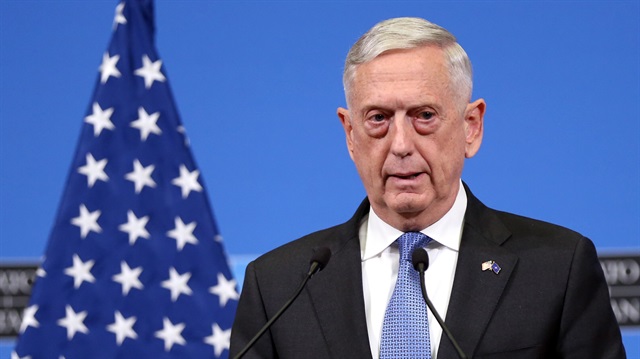
US Secretary of Defense Jim Mattis
The Trump administration has included Britain, Washington's most loyal battlefield ally in the wars in Iraq and Afghanistan, among countries being sent letters rebuking them for spending too little on their militaries.
Secretary of Defense Jim Mattis threatened to replace Britain with France as its main military ally unless London ramps up its defence spending, in a letter sent on June 12 and reviewed by Reuters on Tuesday.
The strongly-worded letter from Mattis to Britain's Defence Secretary Gavin Williamson noted that Britain was one of the few NATO allies that already meets the alliance's target of spending 2 percent of economic output on the military.
A new public opinion poll in Israel suggests that most Israelis believe a backchannel U.S. Middle East peace plan -- dubbed the “Deal of the Century” -- will fail.The same poll found that most Israelis believe that U.S. President Donald Trump is working in Israel’s best interest.The survey, conducted by the Israel Democracy Institute and Tel Aviv University, found that 74 percent of Israelis believe Trump’s peace plan -- details of which remain vague -- will fail to gain any traction.Slightly more -- 77 percent -- believe Trump is working in Israel’s best interest, according to the poll.Meanwhile, 74 percent of Israelis surveyed believe Israel’s interests are “moderately important” or “very important” to the U.S. president, while 94.5 percent of Israel’s Arab citizens believe the same.Only 30 percent of Israeli Jews surveyed -- and a mere 3.5 percent of Israeli Arabs -- believe Palestinian interests are important to Trump.Last week, Trump’s senior adviser and son-in-law Jared Kushner said the controversial plan’s details would soon be unveiled.Kushner, along with U.S. peace envoy Jason Greenblatt, recently visited the region, where the pair held talks with senior officials in Egypt, Saudi Arabia, Jordan, Qatar and Israel with a view to promoting the plan.The Palestinian leadership in Ramallah, however, has rejected any talk of U.S. mediation since last December, when Trump formally announced his decision to recognize Jerusalem as Israel’s capital.
Most Israelis think Trump peace plan will fail: Survey
But it said that was not good enough. Britain's global role "will require a level of defence spending beyond what we would expect from allies with only regional interests," Mattis wrote.
"I am concerned that your ability to continue to provide this critical military foundation ... is at risk of erosion," he wrote. He asked for a "clear and fully funded, forward defence blueprint" from Britain, and said he hoped for an update at a NATO summit next week.
The letter shows U.S. President Donald Trump's determination to pressure NATO allies to significantly increase military expenditure, ahead of the summit in Brussels.
Since Prime Minister Tony Blair vowed to stand "shoulder to shoulder" with the United States after the Sept. 11, 2001 attacks, Britain served as the main U.S. ally in both Iraq and Afghanistan, losing more than 600 service members killed. The Afghanistan war was commanded by a British general during one of its most violent phases while U.S. forces were tied up in Iraq.
"It is in the best interest of both our nations for the UK to remain the U.S. partner of choice," Mattis wrote, noting that France was increasing its spending. "As global actors, France and the U.S. have concluded that now is the time to significantly increase our investment in defence."
Reuters has seen letters from the Trump administration to Belgium and Norway, written ahead of next week's NATO summit, demanding those countries increase defence spending in line with the Western alliance's 2 percent target. The New York Times has reported that Trump also wrote such letters to Germany and Canada.
Britain has cut defence spending over the past decade in line with an austerity programme that has also seen cuts to domestic spending. London and Paris still field far and away the most powerful militaries in Europe.
Some British lawmakers have called for spending to increase to 2.5 or 3 percent of national output from 2 percent. However, the British government is also under pressure to find more money for health, education and the police, at a time when plans to withdraw from the European Union have slowed growth.