

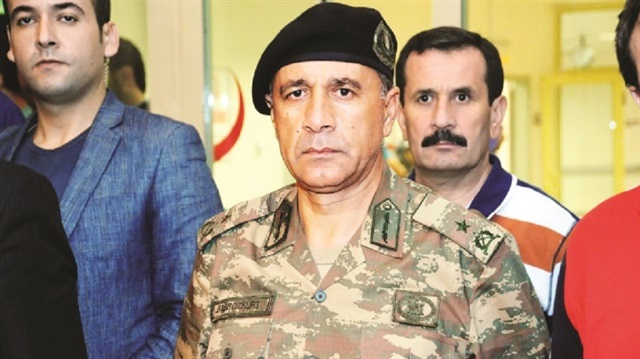
Retired Brigadier İhsan Başbozkurt (C)
The United States, which delivered a 24,000-square-kilometer area to the Kurdistan Workers’ Party (PKK) by dividing Syria, has once again resorted to using the Daesh terror group. Despite the Pentagon’s statement saying that Daesh had been defeated in 2017, the terrorists in Hasakah and Deir Ezzor have entered the field once more.
Daesh captured al-Didye village on the Hasakah-Shaddadi line as well as the Baguz village in the Deir Ezzor countryside. Retired Brigadier İhsan Başbozkurt evaluated field developments in an exclusive interview with Yeni Şafak.
Daesh terrorists are employed by the U.S.
“To bring Daesh back on the scene is a sly and dirty move by the U.S. in response to Turkey’s resolute stance on Qandil and Manbij. The mission assigned to Daesh between 2013 and 2017 was to form the pretext for occupation; now it is to legitimize the terror map which is shaping in the occupied areas,” Başbozkurt said.
The U.S. presence in the Syrian city of Manbij is now subject to "political discussion and policy determination", an anti-Daesh coalition spokesperson said on Tuesday while referring to a roadmap drawn up by Ankara and Washington to stabilize the city.Speaking through video conference, CJTF-Operation Inherent Resolve Public Affairs Director Col. Thomas Veale said: "Coalition troops have been there for quite some time and they are conducting security operations."They are not forward presence. This is not like the Korean Demilitarized Zone...Future of that mission, again, that's subject to political discussion and policy determination."Noting that there there has not been any operational changes in Manbij, Veale said the coalition is a conditions-based organization which accords with conditions on the ground.Many U.S. officials, including head of CJTF-Operation Inherent Resolve Paul E. Funk, have repeatedly said the U.S. will not withdraw from Manbij.However, Veale's remark came a day after Turkish Foreign Minister Mevlut Cavusoglu and his American counterpart Mike Pompeo met and affirmed that a joint Manbij-focused roadmap shows a drastic shift over its policy on Manbij.Stating that the results of the roadmap drawn up by the two countries have yet to be understood, Veale noted that the U.S. acknowledges the valid security concern of Turkey, which is a coalition member and a valued NATO partner."So working closely with them through these discussions is exactly the right approach to this issue," he added.Emphasizing that the purpose of the roadmap is to clear Manbij from terrorists and ensure the security and stability of the city, Cavusoglu said the roadmap would be implemented in three stages, which would focus on the removal of YPG/PKK forces from Manbij, the removal of YPG/PKK affiliated individuals from local governing organizations, and establishing joint U.S.-Turkish patrols and a new local governing administration based on the local population.It is important that much of the Manbij Military Council is made up of local Arabs and it will remain as it is and cooperate with Turks so that Turks will be more comfortable in the process of making long-term adjustments, the officials added.Clash erupts between PKK, Hashd al-Shaabi in IraqErdoğan vows to eradicate terrorism 'completely'If the Manbij issue gets resolved, it would address part of a major issue dividing Ankara and Washington. Turkey has for long objected to U.S. support for the terrorist PYD/PKK, the target of Turkey’s recent Operation Olive Branch in Afrin, Syria.About claims the U.S. has also deployed troops near Sinjar in northern Iraq, Veale refuted the claims, saying that the military convoy just passed through the region on its way to Syria.About his response to Turkey's military operations against the PKK terrorist organization in northern Iraq, Veale noted the operations have been conducted in a close cooperation with Iraqi government.The YPG/PKK and PYD/PKK are Syrian offshoots of the PKK terror group, which has taken some 40,000 lives in its 30-year terrorist campaign against the Turkish state, including those of women and children.
US presence in Manbij 'subject to political discussion'
Officials have hinted at a possible Turkish operation in Iraq’s Qandil, which is considered as the main base of the PKK terror group.
“Daesh terrorists who are gathered from almost every region of Syria are employed by U.S. military and intelligence agencies. How could Daesh suddenly emerge and take control of areas controlled by U.S. troops and the PKK? What we have seen very clearly in the Syrian process is that terrorist organizations are the only element that the U.S. has embraced in order to actualize the occupation map designed for the region,” the retired brigadier added.
Daesh attacks used as sabotage
“Turkey has overcome the majority of the terror line in northern Iraq. The logistical connection between their [PKK] headquarters in Qandil and Turkey has been severed. The period that started with Afrin has advanced to Manbij and both the Syrian people and Turkey are working to eliminate the PKK. These factors have pushed the U.S. to take action,” Başbozkurt said.
Weapons that were supplied to terrorists from the PKK/YPG will be taken back as they withdraw from the city within the scope of the Manbij roadmap agreement between the U.S. and Turkey, Turkish Foreign Minister Mevlüt Çavuşoğlu said on Tuesday.
As terrorists from the Kurdistan Workers’ Party (PKK)’s Syrian affiliate, the YPG, begin withdrawing from the northern city of Manbij, the details of the roadmap brokered between Turkey and the U.S. continue to unfold. According to military sources, the agreement must be extended to include regions east of the Euphrates River, such as Horozköy, the Karakozak bridge area of Sirrin and the Tishreen Dam, a crucial source of water and electricity, all of which must be placed under Turkey’s control. In order to ensure security in Manbij and the Euphrates Shield region, the safe zone is expected to encapsulate the city’s geographical borders.Weapons that were supplied to terrorists from the PKK/YPG will be taken back as they withdraw from the city within the scope of the Manbij roadmap agreement between the U.S. and Turkey, Turkish Foreign Minister Mevlüt Çavuşoğlu said on Tuesday.Erdoğan vows to eradicate terrorism 'completely'Invaders to be withdrawnAccording to the approved roadmap, all attempts by the PKK/PYD to alter the demographic make-up in the city will be foiled. In the context of the agreement reached between the U.S. and Turkey, families that were brought to Manbij will return to their own regions following the withdrawal of the PKK from the city. The status quo in Manbij, which was predominantly Arab, is set to return to what it was prior to the arrival of PKK terrorists in the city, thanks to a Turkey- U.S. agreement similar to the one that was previously brokered between Turkey, Iran and Russia to ensure security in the northwestern city of Idlib. Observation points will also be established in Manbij and its vicinity as part of the approved roadmap, which includes the withdrawal of 3rd parties, in addition to PKK terrorists, including French soldiers that are also present in the city. With the establishment of observation points, security will be ensured together with the local administration and the to-be-formed police force. While Turkey will never accept the presence of PKK or any similar groups in Manbij, the U.S. does not look too kindly on the Free Syrian Army (FSA) either. The U.S. wants to form a police force in Manbij that is formed of Arabs within the ranks of the Syrian Democratic Forces (SDF), which is a front for the PKK, however, Turkey wants to make sure that the to-be-established force will be completely made up of local elements.The PKK is listed as a terrorist organization by Turkey, the European Union and the United States. The PKK has been conducting armed violence in the southeastern part of Turkey since 1984. More than 40,000 people, mostly civilians, have been killed in the three-decade long conflict.Joint roadmap for Manbij is for stabilization: USUS presence in Manbij 'subject to political discussion'
Manbij roadmap must include regions east of Euphrates in Syria
“The pawns they [U.S.] train at various bases are released on the field when they see it as appropriate. Daesh attacks were designed to sabotage the Ayn Issa, Manbij, Raqqa, Tell Abayd and Qandil period and give the PKK a break. The U.S.-Israel-Europe-Gulf alliance, which has made extraordinary efforts to keep Raqqa controlled by the PKK, is trying everything for this purpose. This is why the Arab Force project is being formed. We must give extraordinary importance to Raqqa and pay attention to it,” he added.
Same game to be actualized in Iraq
Brigadier Başbozkurt said the U.S. was openly protecting Daesh in Iraq and Syria, adding that the group was active across various points in these countries. There is a risk that Daesh may also take the stage in Iraq, he added.
“Nobody should doubt that if Iraq does not elect a government that serves the Israel-U.S. plan, many Iraqi cities – including Mosul and Kirkuk – will again be plagued by Daesh,” Başbozkurt said.
In 2016, U.S. President Donald Trump had stated that former U.S. leader Barack Obama founded Daesh. “He's the founder of ISIS [Daesh]. I would say the co-founder would be crooked Hillary Clinton,” said Trump.
Senior officials from the U.S. State Department on Tuesday said the aim of a roadmap drawn up by Ankara and Washington is to stabilize the Syrian city of Manbij. The officials gave details via a teleconference call to reporters in Washington of the meeting between Turkish Foreign Minister Mevlut Cavusoglu and his American counterpart Mike Pompeo held on Monday.Avoiding a clear response on the specifics of the roadmap timeframe, the officials noted it would proceed step by step and hoped that necessary steps would be taken as soon as possible as the NATO ally Turkey also desires it.Emphasizing that the purpose of the roadmap is to clear Manbij from the terrorists and to ensure the security and stability of the city, Cavusoglu on Monday said the roadmap would be implemented in three stages, which would focus on the removal of YPG/PKK forces from Manbij, the removal of YPG/PKK affiliated individuals from local governing organizations, and the establishment of joint U.S.-Turkish patrols and a new local governing administration based on the local population.Following a visit by former U.S. Secretary of State Rex Tillerson to Ankara in February, Turkey and the U.S. established a mechanism to address separate issues in working groups, including the stabilization of Manbij and to prevent any undesirable clashes.The first meeting of the working group on Syria was held on March 8-9 in Washington.Officials during the conference call also said the YPG/PKK would withdraw to the eastern side of the Euphrates river.About the outcome of the PKK-affiliated YPG withdrawing from Manbij, officials said everyone would benefit from this process because the goal is to defuse tension and stabilize the region.US presence in Manbij 'subject to political discussion'"The idea behind this is not for the U.S. or Turkey to take over Manbij," they added. "The idea is for the people of Manbij to reassert their leadership over both governance and security structures there."In addition, officials also said the purpose of the deal is to not hand over the city to Turkey or the U.S., it is for the local people to be able to establish their own leadership and ensure their security.It is important that much of the Manbij Military Council is made up of local Arabs and it will remain as it is and cooperate with Turks so that Turks will be more comfortable in the process of making long-term adjustments, the officials added.If the Manbij issue was resolved, it would address part of a major issue dividing Ankara and Washington. Turkey has long objected to U.S. support for the terrorist PYD/PKK, the target of Turkey’s recent Operation Olive Branch in Afrin, Syria.The YPG/PKK and PYD/PKK are Syrian offshoots of the PKK terror group, which has taken some 40,000 lives in its 30-year terrorist campaign against the Turkish state, including those of women and children.
Joint roadmap for Manbij is for stabilization: US
A brief clash occurred late Tuesday between the PKK terrorist group and Hashd al-Shaabi militia in northern Iraq, according to a Peshmerga commander in the region.Qasim Shesho, an Ezidi Peshmerga commander, told Anadolu Agency that the situation was complicated in Mosul city’s Sinjar district and such clashes would occur again between units of PKK terrorists and the Hashd al-Shaabi, a Shia contingent of the Iraqi army that also maintains a presence in Sinjar.“The tensions are ongoing,” he added.According to information obtained from eye witnesses, a group consisting of PKK-linked terrorists and supporters gathered in central Sinjar. The Iraqi army tried to disperse them.No casualties have been reported, while two terrorist commanders were taken into custody by the Iraqi army.It was also reported that the Hashd al-Shaabi wanted Ezidi Peshmerga forces in the region to leave the area, but it was rejected by the group.Erdoğan vows to eradicate terrorism 'completely'Claim of U.S. troop deployment in the regionOn Saturday, Sinjar District Governor Mahma Khalil confirmed that U.S. soldiers had been recently deployed to Mount Sinjar, hoping to establish a military base there.Also, on Friday, Colonel Ahmed al-Jubouri, head of the army’s Nineveh operations command, said an Iraqi force accompanied by U.S. “advisers” has assumed control over the border zone between Syria and Iraq.In mid-2014, the YPG/PKK moved into Sinjar on the pretext of “protecting” the local Ezidi community from the Daesh terrorist group.Earlier this year, after Turkey hinted at a possible military operation in Sinjar, the YPG/PKK announced plans to withdraw from the region. The PKK is listed as a terrorist group by Turkey, the U.S. and the EU. Its three-decade terror campaign against Turkey has cost more than 40,000 lives, including women and children.
Clash erupts between PKK, Hashd al-Shaabi in Iraq