

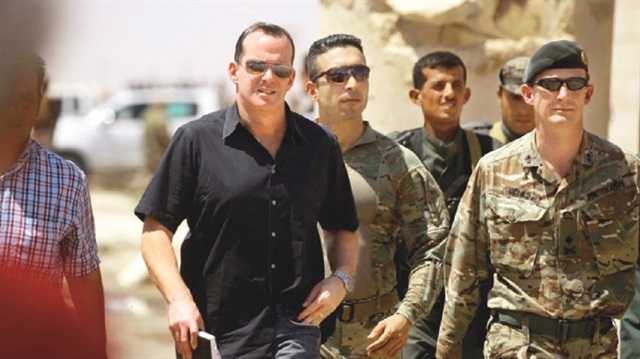
Special Presidential Envoy for the Global Coalition to Defeat Daesh Brett McGurk
As the Washington administration warns the Assad regime to stop its vicious bombardments in the last opposition-held stronghold of Syria’s Idlib, it simultaneously dispatches Kurdistan Workers’ Party (PKK) terrorists to the region, further escalating tensions which could lead to a grave massacre.
Special Presidential Envoy for the Global Coalition to Defeat Daesh Brett McGurk has appointed so-called Manbij Military Council (MMC) spokesman Servan Darwish as a quasi-commander of PKK terrorists to conduct attacks against the Syrian opposition in Idlib.
The Syrian regime has recently announced plans to launch a major military offensive in Idlib, which has long been controlled by various armed opposition groups, and is under heavy bombardment by Russia and Assad. The last such provocation triggered joint airstrikes by the U.S., UK and France against the Syrian regime.
Servan Darwish is from the terror organization’s Qandil cadre, which is considered as the main base of the PKK, and a prominent figure for the U.S, notably for McGurk.
Darwish recently arrived in Syria’s Aleppo with 250 PKK terrorists following a meeting with McGurk in Hasakah.
Top White House envoys and commanders such as U.S. Central Command General Joseph Votel, American Special Operations Commander in Syria and Iraq Jamie Jarrard, and Commander of the U.S.-led Coalition Task Force Lieutenant-General Paul Funk previously awarded Darwish with a distinguished service medal during their visits to Syria’s Manbij.
Syrian government forces fired chlorine, a banned chemical weapon, on an opposition-held Damascus suburb and on Idlib province this year, in attacks that constitute war crimes, United Nations human rights investigators said on Wednesday.The three incidents bring to 39 the number of chemical attacks which the Commission of Inquiry on Syria has documented since 2013, including 33 attributed to the government, a U.N. official told Reuters. The perpetrators of the remaining six have not been sufficiently identified.Weaponising chlorine is prohibited under the Chemical Weapons Convention, ratified by Syria, and under customary international humanitarian law, the investigators said in their latest report.Germany can't look away if Syria uses chemical weapons: Merkel"To recapture eastern Ghouta in April, government forces launched numerous indiscriminate attacks in densely populated civilian areas, which included the use of chemical weapons," it said, referring to incidents on Jan. 22 and Feb. 1 in a residential area of Douma, eastern Ghouta, outside the capital.Women and children were injured in the attacks, suffering respiratory distress and requiring oxygen, it added.UK 'strongly' agrees with Turkey's Erdoğan on Idlib"INDISCRIMINATE ATTACKS""The Commission concludes that, on these two occasions, government forces and or affiliated militias committed the war crimes of using prohibited weapons and launching indiscriminate attacks in civilian-populated areas in eastern Ghouta," it said.A surface-to-surface, improvised rocket-assisted munition had been used in the two Douma incidents, it said. "Specifically the munitions documented were built around industrially-produced Iranian artillery rockets known to have been supplied to forces commanded by the (Syrian) government," the report added.In the northwest province of Idlib - where the United Nations fears a major imminent assault by Syrian and Russian forces against the last opposition-held stronghold - chlorine was also used on February 4, the U.N. report said.UN chief says 'essential' to avoid Idlib 'bloodbath'"Government helicopters dropped at least two barrels carrying chlorine payloads in the Taleel area of Saraqeb," it said, adding that at least 11 men were injured."Documentary and material evidence analysed by the Commission confirmed the presence of helicopters in the area and the use of two yellow gas cylinders".The report, based on 400 interviews, also examined aerial and ground attacks by Turkey's 'Operation Olive Branch', conducted with allied Syrian opposition, which wrestled the northwest Afrin region from Syrian Kurdish forces this spring.Afrin's main hospital, a market and homes were hit, it said.'Attack on Idlib to sabotage ongoing political process’"In conducting airstrikes beginning on 20 January, the Turkish air force may have failed to take all feasible precautions prior to launching certain attacks, in violation of international humanitarian law," the report said.Fighters of the Free Syrian Army were "notorious for their arbitrary arrests and detention" in Afrin, it added.More than a million civilians were displaced in six major battles across Syria during the first six months of the year, many marked by war crimes, the report said.Thousands of displaced civilians still live in dire conditions in severely overcrowded centres, "where many are still being unlawfully interned by Government forces", it said. Turkey's UN envoy demands immediate cease-fire in Idlib
UN war crimes team documents further Syrian regime use of banned chlorine
The U.S. on Tuesday blasted Russia, Iran and the Syrian regime amid a growing military offensive in northwestern Syria's Idlib province.“Russia, Iran and Assad are demolishing Idlib and asking us to call it peace,” Nikki Haley, the U.S.'s UN envoy said in remarks before the Security Council.Since the beginning of September, at least 30 civilians have been killed in Idlib and Hama, and dozens injured, by airstrikes and attacks by the regime and Russian warplanes, according to the White Helmets civil defense agency.Turkey, Russia, Iran, UN discuss SyriaThe UN warned Monday at least 30,000 residents in Idlib have been displaced in the first nine days of this month amid a Russian and regime air campaign there.Haley blamed Russia and the regime for allegedly carrying out more than 100 airstrikes, some of which she said were "ruthless double tap" strikes targeting first responders.“It is a disgusting tactic of terrorists, not professional soldiers,” she said.'Attack on Idlib to sabotage ongoing political process’She alleged Moscow, Tehran and Damascus are not interested in pursuing a political solution to the Syrian crisis, saying “Turkey learned this lesson last week” during trilateral talks in the Iranian capital.“The United States is long past taking Russia and Iran at their word that they are interested in protecting civilians in Idlib from further violence," she said. "If Assad, Russia, and Iran continue down the path they are on, the consequences will be dire. The world will hold them responsible. And no number of Security Council meetings will ever change that.”Vasily Nebenzia, Russia's UN ambassador, defended the deteriorating security situation in Idlib, which is an established "de-escalation zone" as part of the trilateral talks.Turkey's UN envoy demands immediate cease-fire in idlib"Sooner or later," Nebenzia said, such areas "were to be replaced first by local truces, and in cases where that did not take place, a counter-terrorist operation.”“The Astana process is ongoing, and with the help of the process we will have tangible results,” he said, referring to the trilateral process with Iran and Turkey.Last week, the UN warned an offensive on Idlib would likely lead to the “worst humanitarian catastrophe of the 21st century”.
US rips Russia, Iran, Assad regime amid Idlib offensive
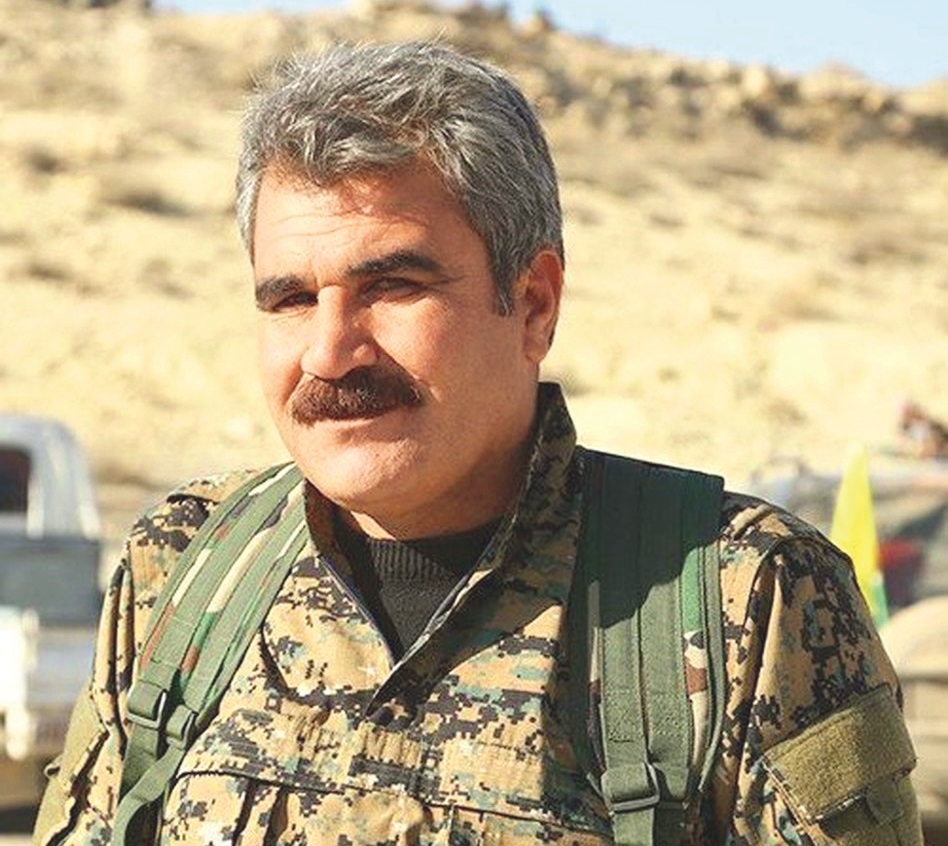
So-called Manbij Military Council (MMC) spokesman, PKK terrorist Servan Darwish
Distributing lines
PKK terrorists are being deployed to the frontlines within the context of a meeting conducted in August between Ilham Ahmad, one of the PKK’s so-called political representatives and Bashar al-Assad’s Special Security Adviser Ali Mamlouk at the Four Seasons Hotel in Damascus.
Following the U.S.-backed PKK and Assad regime negotiations, 6000 terrorists have been deployed to two separated points in the Idlib region.
The PKK is listed as a terrorist organization by Turkey, the European Union and the United States. The PKK has been conducting armed violence in the southeastern part of Turkey since 1984. More than 40,000 people, mostly civilians, have been killed in the three-decade long conflict.
A total of 760 PKK terrorists, including senior representatives targeting civilians, in their bid to disrupt peace in Turkey have been "neutralized" as part of anti-terror operations across the country and abroad over the last three months.Turkish authorities often use the word "neutralized" in statements to imply the terrorists in question either surrendered, were killed or captured.Turkish Armed Forces, Security General Directorate, General Command of Gendarmerie and National Intelligence Service resolutely continue to chase terrorist organizations that try to disturb the peace and brotherhood in the country.According to information compiled by Anadolu Agency, 35 security officers were martyred during the attacks of YPG/PKK between June 1 and Aug. 31.Seven Daesh suspects arrested in IstanbulDuring the attacks, six civilians, including an 11-month-old baby were killed, while 52 security officers were injured.A total of 180 people, including officials from Peoples' Democratic Party’s (HDP) and Democratic Regions Party (DBP), were remanded in custody as part of operations across Turkey.Security forces also destroyed shelters and depots of terrorists, mainly in Turkey's eastern and southeastern provinces.Turkish army ‘neutralizes’ two PKK terrorists in N. IraqTerrorists neutralizedKaniar Muslim, codenamed "Kurtay Rojova", was neutralized on June 2 in the rural of eastern Tunceli province. During the same operation, Ramazan Yasugev and Erkan Ordu, who were in the grey category of the interior ministry's wanted list, were among the neutralized terrorists.The wanted list is divided into five color-coded categories, with red as the most wanted, followed by blue, green, orange and grey.On June 13, Turkish security forces neutralized Ertan Erol, who had the codename Ferhat Dersim and was mentioned in the grey category.Turkey neutralizes 35 PKK terrorists in past weekOn June 14, Fatih Kirtay, codenamed "Dilovan Bahtiyat", and Rojbin Akyol, codenamed "Dicle Hevirdar", were neutralized during a clash between security forces and terrorists in Lice district of southeastern Diyarbakir province.On June 28, Sefer Acar was neutralized during an operation in eastern Bitlis province.Acar, who was in the red category, was the perpetrator of a terrorist attack against Turkish gendarmes during an operation in 1998 in the north of Iraq. Turkish gendarmes' Sikorsky helicopter was shot down during the attack in which 15 soldiers were martyred.Turkey neutralizes 68 wanted PKK terrorists this yearHasan Cakmak, codenamed Delil Karakocan, was among the three terrorists killed in the airstrikes in northern Iraq on July 13. Cakmak was "the logistics coordinator" of the PKK.A suspect identified by the initials C.D., the terrorist PKK’s so-called top representative in Scandinavia and wanted under Interpol red notices, was captured in Denmark.Mehmet Yakisir, codenamed "Zeynel", PKK's so-called top member in the Black Sea region, was also neutralized on July 15.Yakisir, who was in the red category of Turkey’s wanted list, had killed 15-year-old Eren Bulbul last year in the Macka district of Trabzon province. Osman Gulen, codenamed Aram Civan, who was neutralized on July 23 in Diyarbakir -- was in the grey category of the most wanted list.During an operation on Aug. 6, Ilker Tezer, codenamed "Yusuf", the so-called representative of the far-left TKP/ML terror group, was neutralized in Tunceli.In the same operation, Cumhur Sinan Oktulmus -- codenamed "Deniz Dogan" -- on the orange list, was also neutralized.Terrorists to pay price Ibrahim Coban, codenamed "Atakan Mahir", was in the Turkish Interior Ministry’s red category of wanted terrorists list; he had been the so-called Dersim region head of the terror group for the past 25 years. He was killed on Aug. 11 in Tunceli.PKK's so-called representative in eastern Erzurum province Mahmut Lacin was also neutralized.Omer Duran and Pinar Yildirim were among those neutralized in August.On Aug. 15, a senior PKK/KCK figure in Iraq's northern Sinjar province, Ismail Ozden, codenamed "Mam Zeki Sengali", was neutralized in a joint operation of the Turkish Armed Forces and the National Intelligence Organization (MIT) in Sinjar.On Aug. 20, the so-called PKK representatives in southeastern Sirnak province, Yusuf Sungur and Serbest Gun were also neutralized.Codenamed "Turk Tarik", Baris Oner, another PKK terrorist who was wanted in the red category, was neutralized on Aug. 19.Operations continue in northern IraqTurkish Air Forces continue with air operations in northern Iraq's Hakurk, Gara, Zap, Qandil and Avasin-Basyan regions to purge terrorists.At least 400 terrorists were neutralized during the operations in northern Iraq. Turkish forces also destroyed the positions and shelters of the terrorists.
Turkey neutralizes 760 PKK terrorists in 3 months
YPG/PKK terrorist group has imposed a curfew in Syria’s northeastern Raqqah province in an effort to silence protests against the group, according to local sources.“The terrorist group prevents the movement of civilians to and from the city’s center and through the two banks of the Euphrates river,” a local source said on condition of anonymity due to security concerns.According to the source, the curfew was imposed on Friday in an effort to prevent protests against its practices and assassinations of YPG/PKK members.Over the past three days, YPG/PKK terrorists raided homes of civilians, arrested more than 150 civilians and killed two other people.It remains unclear when the curfew will be lifted.The sources said the terrorist group allows civilians to move to the city’s center at certain times, and permit them to leave their homes for only two hours a day.The terrorist group has also banned civilians to go to the mosques over the past three days.YPG/PKK terrorists are using Raqqah as their main headquarters and a base for controlling other occupied areas.Raqqah, a former Daesh stronghold, was captured by the YPG/PKK last October with air support from the U.S.The YPG is the Syrian branch of the PKK terrorist network.In its more than 30-year terror campaign against Turkey, the PKK -- listed as a terrorist organization by Turkey, the U.S. and the EU -- has been responsible for the deaths of 40,000 people, including women and children.
YPG/PKK terrorists impose curfew in Syria’s Raqqah
A female suspect who allegedly works for the PKK/KCK terrorist organization in Austria was held in western Turkey on Wednesday, according to security sources.Turkey’s National Intelligence Organization’s regional directorate in Izmir province learned the suspect was linked with the PKK/KCK's associations in Austria as a senior representative, said the source, who asked not to be named due to restrictions on speaking to the media.She was held near Izmir Adnan Menderes Airport by the provincial security directorate’s anti-terror branch teams before flying back to Austria.The investigation into the issue is ongoing, the source added.In its more than 30-year terror campaign against Turkey, the PKK -- listed as a terrorist organization by Turkey, the U.S. and the EU -- has been responsible for the deaths of nearly 40,000 people, including women and children.Video: Turkey arrests PKK/KCK suspect near Izmir airportTurkey captures key plotter of Reyhanlı attack in Syria's Latakia
Turkey arrests PKK/KCK suspect near Izmir airport