

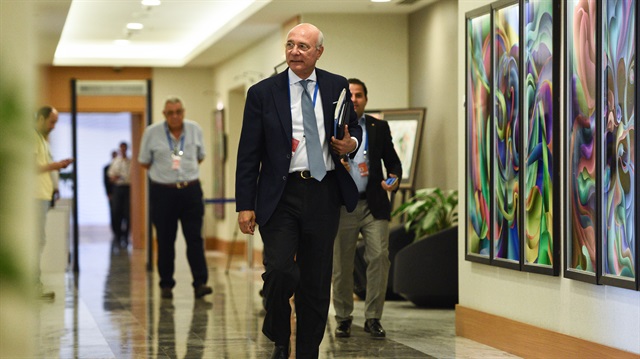
10th high-level Astana-format international meeting on Syria in Sochi
The United Nations Special Envoy for Syria plans talks with Iran, Russia and Turkey in September to start finalising the composition of the body intended to draft a new Syrian constitution, a statement said on Tuesday.
Staffan de Mistura, attending two-day talks with the three powers in Russia, has received lists from the Assad government and opposition on proposed candidates for the Constitutional Committee.
"The Special Envoy looks forward to holding formal consultations (with the three countries) ... very early in September in Geneva, in order to begin to finalise the constitutional committee," the statement said.
It was 38 years ago today when Turkish diplomat Galip Özmen and his 14-year-old daughter Neslihan were martyred by a notorious Armenian terror group in Greece.His wife, Sevil Özmen, and his 16-year-old son, Kaan Özmen, were also seriously injured but managed to survived. The Armenian Secret Army for the Liberation of Armenia (ASALA) claimed responsibility for the 1980 terrorist attack.Decades later, the hurt still fresh, the wound still open, Turkey is still mourning for Özmen and his daughter, who were among over 30 Turkish diplomats and their family members martyred by ASALA and similar terror attacks between 1973 and 1984.Founded in 1975 in Beirut, Lebanon during the Lebanese Civil War, ASALA is responsible for hundreds of bloody terror acts.According to Armenian Terror -- a 2006 study by Omer Engin Lutem, a former Turkish diplomat -- the killings spanned the continents, taking place in the U.S., Austria, France, Italy, Spain, Lebanon, Greece, Switzerland, the Netherlands, Canada, Portugal, Iran, and the U.K.The study said that the assimilation of Armenians who migrated to other countries was seen as a threat to Armenian churches and political parties, which then decided to revive extremist national emotions to hinder assimilation and protect their concept of identity.First killing in 1973Though the group formed in 1975, the first killing of a diplomat and his deputy came on Jan. 27, 1973 when Gürgen Yanıkyan, an Armenian, martyred Turkey's consul general in Los Angeles Mehmet Baydar and his aide Bahadır Demir.A total of three diplomats were martyred between 1973 and 1978, after which Turkish public servants abroad became targets for Armenian terrorist organizations like ASALA and the so-called Justice Commandoes for Armenian Genocide.From 1975 to 1984, Turkish ambassadors and diplomats were targeted around the world by ASALA and its affiliates.These Armenian terrorist attacks intensified from 1980 to 1983, when 580 of the 699 attacks -- over 80 percent -- occurred. The terrorist attacks ended in 1986, according to the Armenian Terror study.In order to compel the Turkish government "to acknowledge publicly its responsibility for the so-called Armenian genocide in 1915, pay reparations, and cede territory for an ‘Armenian homeland’,” ASALA martyred Turkish diplomats in numerous bloody attacks in that decade.In 1915, the Ottoman Empire relocated Armenians in eastern Anatolia following revolts when some sided with invading Russians, and there were Armenian casualties during the relocation process.Armenia has demanded an apology and compensation, while Turkey has officially refuted Armenian allegations over the incidents saying that, although Armenians died during the relocations, many Turks also lost their lives in attacks carried out by Armenian gangs in Anatolia.The Turkish government has repeatedly called on historians to study Ottoman archives pertaining to the era in order to uncover what actually happened between the Ottoman government and its Armenian citizens.The debate on so-called “genocide” and the differing opinions between the present-day Turkish government and the Armenian diaspora, along with the current administration in Yerevan, still generates political tension between Turks and Armenians.Rebuffing the “genocide” allegations, Turkey has officially acknowledged past experiences as a great tragedy in which both parties suffered heavy casualties, including hundreds of Muslim Turks.Terror acts in ParisThe attack at Esenboga airport on August 7, 1982, was one of the most notorious attacks of ASALA, as the group targeted non-diplomat civilians for the first time.Nine people died and over 80 were injured when two terrorists opened fire in a crowded passenger waiting area of the airport in the Turkish capital Ankara.The 1981 and 1983 Paris attacks are among the group's other notable acts. ASALA terrorists held 56 people hostage for 15 hours during Turkish Consulate attack in 1981, while a suitcase bomb killed eight people -- most of them non-Turks -- in 1983 at a Turkish Airlines check-in desk at Paris’ Orly Airport.According to some Turkish officials, it was the Orly attack when the group lost much of its support and financial backing from the Armenian diaspora and had to dissolve.Here is a list of Turkish diplomats and public servants martyred by Armenian terrorist attacks: Date Place Position Name Jan. 27, 1973 Santa Barbara Consul General Mehmet BaydarJan. 27, 1973 Santa Barbara Consul Bahadır DemirOct. 22, 1975 Vienna Ambassador Danis TunaligilOct. 24, 1975 Paris Ambassador İsmail ErezOct. 24, 1975 Paris Driver Talip YenerJan. 16, 1976 Beirut Head Clerk Oktar CiritJune 9, 1977 Vatican Ambassador Taha CarımJune 2, 1978 Madrid Ambassador's Wife Necla KuneralpJune 2, 1978 Madrid Retired Ambassador Beşir BalcıoğluOct. 12, 1979 The Hague Ambassador's Son Ahmet BenlerDec. 22, 1979 Paris Tourism Counselor Yılmaz ColpanJuly 31, 1980 Athens Administrative Attache Galip ÖzmenJuly 31, 1980 Athens Attache's Daughter Neslihan ÖzmenDec.17, 1980 Sydney Consul General Sarik AriyakDec.17, 1980 Sydney Security Attache Engin SeverMarch 4, 1981 Paris Working Attache Resat MoraliMarch 4, 1981 Paris Religious Officer Tecelli AriJune 09, 1981 Geneva Contracted Secretary M. Savaş YergüzSep. 24, 1981 Paris Security Attache Cemal OzenJan. 28, 1982 Los Angeles Consul General Kemal ArikanMay 05, 1982 Boston Honorary Consul General Orhan GunduzJune 07, 1982 Lisbon Administrative Attache Erkut AkbayJune 07, 1982 Lisbon Administrative Attache's Wife Nadide AkbayAug. 27, 1982 Ottawa Military Attache Colonel Attila AltıkatSep. 9, 1982 Burgas Administrative Attache Bora SuelkanMarch 9, 1983 Belgrade Ambassador Galip BalkarJuly 14, 1983 Brussels Administrative Attache Dursun AksoyJuly 27, 1983 Lisbon Undersecretary's Wife CahideMıhçıoğluApril 28, 1984 Tehran Contracted Secretary's Wife Işık YönderJune 20, 1984 Vienna Working Attache Erdogan OzenNov. 19, 1984 Vienna International Servant Enver Ergun
Turkey remembers victims of ASALA terror attacks
Officials from Turkey, Russian and Iran on Monday agreed to the mutual release of some Syrian detainees from both the regime and opposition sides. According to participants attending the pre-meeting in the Russian city of Sochi ahead of a 10th round of Syria peace talks in Astana, Kazakhstan, as part of confidence-building measures, the sides will mutually release a limited number of detainees that they held. No further details were provided by the participants -- who asked not to be named due to restrictions on speaking to the media -- on how many detainees will be released or from what region. The 10th round of Syria peace talks will start in Astana, Kazakhstan on Tuesday, which will address the latest situation in de-escalation zones in Idlib, Syria, the return of refugees, the release of prisoners, and the formation of a committee that will rewrite Syria's Constitution. During the 9th Astana meeting held on May 14-15, all parties agreed to maintain the de-escalation zones and the cease-fire regime. However, the Assad forces and their allies took control of the de-escalation zones in the Homs region, Daraa, and Quintieri following a heavy offensive. Last week, the regime began a military buildup in southwestern Idlib in a bid to attack Syria’s northwestern Turkmen Mountain region, which is located within the de-escalation zones. Idlib is set to be a top issue during the Astana meeting, as the Turkish delegation is expected to stress the importance of maintaining the cease-fire regime in the region. Separately, Russia during the meeting is expected for the first time to bring up the issue of the return of refugees and displaced persons. Russian officials have recently visited Turkey, Jordan, and Lebanon, which host the majority of Syria's refugees. UN Special Envoy for Syria Staffan de Mistura is also expected to meet with the Turkish, Russian and Iranian officials on the formation of a constitutional committee. The regime and opposition had each submitted to de Mistura a list of 50 candidates to represent them on the committee.
Turkey, Russia, Iran set to free some Syrian detainees