

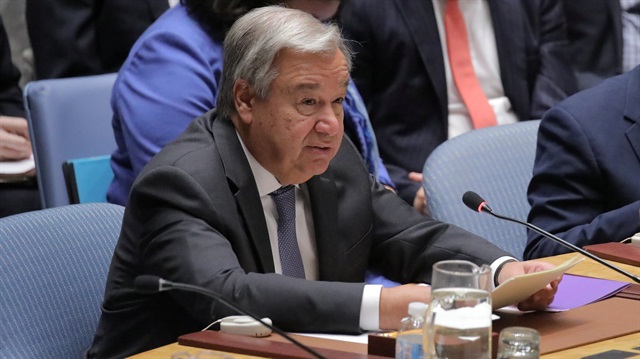
Secretary General of the United Nations Antonio Guterres
UN Secretary General Antonio Guterres voiced deep concern Wednesday for the "growing risk" of a full-scale Syrian regime offensive in northwest province of Idlib.
"The Secretary-General urgently appeals to the Government of Syria and all parties to exercise restraint and to prioritize the protection of civilians," Guterres spokesman Stephane Dujarric said in a statement.
Guterres maintained "any use of chemical weapons is totally unacceptable."
He called on Turkey, Russia and Iran to "find a peaceful solution to the situation in Idlib, the last remaining de-escalation zone."
Russian and Turkish militaries are discussing "practical actions" against terrorists in Syria's Idlib, Foreign Minister Sergey Lavrov said on Wednesday.Speaking at a news conference in Moscow following his meeting with his Saudi counterpart Adel al-Jubeir, Lavrov said the issue had been discussed a dozen of times between Moscow and Ankara over the last couple of months.Idlib was the main point in talks between Russian and Turkish ministers of foreign affairs and defense, and representatives of special forces several days ago in Moscow, he said.Russia's Lavrov says contacts with US on Syria's Idlib ongoing"The political understanding fully exists between Moscow and Ankara; it is urgent to separate normal armed opposition from the bandits of Al-Nusra Front and at the same time to prepare an operation against these terrorists, doing everything to minimize the risks to the civilian population," Lavrov said while referring to Idlib as "the last major hotbed of terrorists".Russian and Turkish militaries are talking to each other, he said."How to translate this political agreement into the language of practical actions -- it has been discussed by the militaries of Russia and Turkey, who handle the situation on the ground," he said.Active phase of Russia's SCO’s anti-terror drills startLavrov also said he expects the West to not obstruct the planned military operation against Al-Nusra Front in Idlib.Saudi Foreign Minister Adel al-Jubeir said he had exchanged views with Lavrov on Idlib and the two ministers agreed on the necessity to fight terrorists in this region.Al-Jubeir added that Riyadh fully supports the political process in Syria. He recalled that the first ever conference of Syrian opposition had been organized with Saudi support and in the country's capital.Putin tells Russians he is softening unpopular pension reform'No bargain on security'About U.S. criticism concerning the possible purchase of Russian defense systems S-400 by Saudi Arabia, al-Jubeir said the country does not bargain over its security."There are two things in Saudi Arabia that we do not bargain on, security and faith. Our leadership is always striving to buy the most modern weapons for its army, to protect its sovereignty," he said.Al-Jubeir said the country's militaries consult, negotiate and sign contracts on the purchase of weapons, including those from Russia.Syrian foreign minister to visit Moscow on Thursday"Now talks are being held between the Russian and Saudi concerned persons in the defense domain on buying certain defense systems. And I would not like to interfere in the process and to anticipate their results," he said.Commenting on the U.S. withdrawal from the Iran nuclear deal, Lavrov said the move was damaging to regional security.Meanwhile, his Saudi counterpart said the agreement was "weak" and called for strengthening the sanctions on Iran.US warns Syria, Russia on possible Idlib offensive"The [international agreement with Iran called] JCPOA is a weak agreement and does not provide for the adoption of active measures that would not allow Iran to continue its nuclear program as soon as possible. This agreement would end in 2025, and until then there was a danger that Tehran could build a nuclear bomb," al-Jubeir said.Lavrov said Russian President Vladimir Putin had not forgotten about Saudi king's invitation to visit the country.The exact dates and other details of the visit will be agreed via diplomatic channels later, he added.
Ankara, Moscow mull 'practical actions' in Idlib
The countries are known as the "Astana guarantors" due to their role in peace talks the Kazakh capital to at end Syria's over seven-year conflict.
Located near the Turkish border, Idlib in May was designated a de-escalation zone where acts of aggression are expressly forbidden as part of the ongoing Astana process.
Guterres called "on all parties to take all necessary measures to safeguard civilian lives, allow freedom of movement, and protect civilian infrastructure, including medical and educational facilities, in accordance with international humanitarian law and human rights law."
Russian Foreign Minister Sergei Lavrov said on Wednesday that Moscow remained in contact with the United States on the situation in Syria's opposition-held Idlib province.Russia said earlier on Wednesday it was discussing the situation there and in Syria's Afrin region with Iran and Turkey, as well as the Syrian government and opposition, the RIA news agency reported. Syrian foreign minister to visit Moscow on ThursdayUS warns Syria, Russia on possible Idlib offensiveUN chief warns against military escalation in Syria
Russia's Lavrov says contacts with US on Syria's Idlib ongoing
Amid the UN chief's urgent plea, Russian Foreign Minister Sergey Lavrov said Wednesday the Russian and Turkish militaries are discussing "practical actions" against terrorists in Syria's Idlib.
"The political understanding fully exists between Moscow and Ankara; it is urgent to separate normal armed opposition from the bandits of al-Nusra Front and at the same time to prepare an operation against these terrorists, doing everything to minimize the risks to the civilian population," Lavrov said while referring to Idlib as "the last major hotbed of terrorists".
"How to translate this political agreement into the language of practical actions -- it has been discussed by the militaries of Russia and Turkey, who handle the situation on the ground," he said.
The U.S. on Tuesday warned Russia and the Syrian regime against any potential offensive on the northwestern Syrian city of Idlib."We would hold them responsible and we would hold them accountable for that, most especially for the use of chemical weapons,” State Department spokeswoman Heather Nauert said.“We would encourage Russia to make this point very clear to Damascus, that that will not be tolerated," she added.Russia reinforces naval forces in Mediterranean off Syrian coastTurkish Foreign Minister Mevlüt Çavuşoğlu warned Friday that a possible military offensive on Idlib would be a "disaster".“Preserving the de-escalation zone in Idlib, Syria is important in both humanitarian respects and the fight against terrorism," Çavuşoğlu said.“Separating the civilians from the combatants in Idlib is important for everyone, but a solution through force would lead to a new wave of refugees and a humanitarian catastrophe.”Iran says to maintain military presence in Syria despite US pressureLocated near the Turkish border, Idlib in May was designated a “de-escalation zone” where acts of aggression are expressly forbidden.Syria has only just begun to emerge from a devastating conflict that began in early 2011, when the Bashar al-Assad regime cracked down on protesters with unexpected ferocity.UN officials estimate that hundreds of thousands of people have been killed in the conflict.
US warns Syria, Russia on possible Idlib offensive
Lavrov said he expects the West to not obstruct the planned military operation against al-Nusra Front, which has been renamed to Hayat Tahrir al-Sham, in Idlib.
Syria has only just begun to emerge from a devastating conflict that began in early 2011, when the Bashar al-Assad regime cracked down on protesters with unexpected ferocity.
UN officials estimate hundreds of thousands of civilians have been killed in the conflict.