

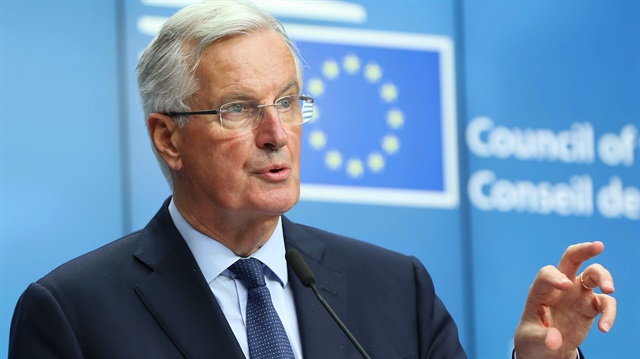
Michel Barnier
Britain's proposals on its future relationship with the European Union contain constructive elements, but many questions remain, EU chief Brexit negotiator Michel Barnier said on Friday.
Barnier, who met new UK Brexit minister Dominic Raab on Thursday, also reminded Britain there could be no progress on future relations until all elements of its exit were tied up - notably ensuring no hard border between Ireland and Northern Ireland.
"As I told the ministers, there are several elements in this white paper that open the way to a constructive discussion regarding the political declaration on our future relationship", Barnier told a news conference in Brussels following a meeting of EU ministers.
Ireland's foreign minister said on Friday reaction from EU capitals to British Prime minister Theresa May's Brexit white paper was lukewarm but said there was agreement it formed the basis for negotiations."There has been a response that has been lukewarm to the British white paper coming from Brussels but also other member states. They are anxious to get the British negotiating team into serious and detailed negotiation," Simon Coveney told Ireland's RTE radio following a meeting with chief Brexit negotiator cand EU foreign ministers.British PM calls on EU to evolve its position on Brexit
EU reaction to UK Brexit white paper lukewarm: Irish Minister
Barnier said Britain shared the EU's desire for an ambitious trading relationship, a level playing field and a security partnership.
However, he added that he had put many questions to Britain, asking whether the proposals were workable and if they would create more red tape.
"I would simply say that Brexit cannot be and will not be a justification for creating more bureaucracy," he said.
Barnier noted that there were only 13 weeks until EU leaders meet for a summit, by when the European Union and Britain should have finalised a withdrawal agreement.
British Prime Minister Theresa May called on the European Union to evolve its position in response to her new plan which has outlined a blueprint for the UK's post-Brexit relationship with the bloc."It is now for the EU to respond, not simply to fall back on previous positions which have already been proven unworkable but to evolve their position in kind," May said in a speech in Belfast on Friday.UK to warn public every week over 'no-deal Brexit'May says her chief whip made honest mistakeBritish Prime Minister Theresa May said on Friday that her chief enforcer in parliament had made an honest mistake by breaking a so called pairing agreement at a crucial vote and that he and the party's chairman had apologised.Julian Smith, known as the government's chief whip, told some Conservative lawmakers to break a pairing arrangement with rival parties that ensures genuine absences do not skew votes in parliament.Conservative Chairman Brandon Lewis followed the advice and voted with the government at a key Brexit vote on Tuesday even though his "pair", Liberal Democrat lawmaker Jo Swinson, was away as she had just given birth.When asked by a reporter if she could be trusted, May said: "There was an honest mistake made for which the chief whip and indeed Brandon Lewis have both apologised to the member concerned." 
British PM calls on EU to evolve its position on Brexit
Barnier said that 80 percent of that agreement was already in place, but that there was still no agreement on how to avoid a hard Irish border after Britain leaves the bloc.
"This requires a legally operative backstop, an all weather insurance policy, to address the issues of Ireland and Northern Ireland. All 27 member states insist on this," he said.
British Prime Minister Theresa May said in a speech on Friday she accepted that a hard Irish border was "almost inconceivable", but dismissed the EU's current plan as "unworkable".
Barnier said he had invited British negotiators to work on the backstop issue next week.
May also called on Brussels to respond quickly to her white paper plan to avoid a damaging no-deal Brexit.
EU leaders have avoided going public with criticism, aware of the fragility of May's government, but many have major reservations, notably about how Britain's plans could disrupt Europe's single market.
The EU's internal market assures the free movement of goods, services, capital and persons. May's white paper indicates Britain is seeking single market privileges for industrial and agricultural goods alone.
"When you make a proposal limited to agricultural products and goods, you have to ask what about services, what about capital, what about the free movement of people. Those questions will have to be answered in the coming days and weeks," said German Europe Minister Michael Roth.