

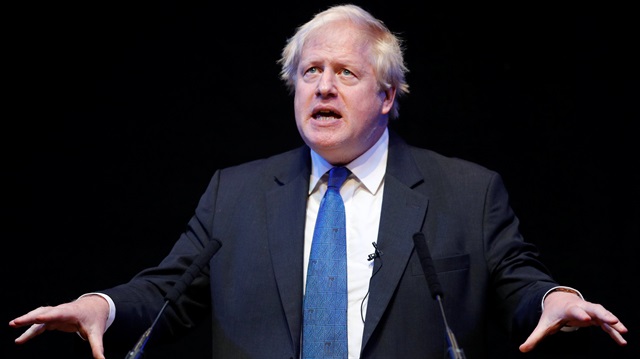
Boris Johnson
Boris Johnson, Prime Minister Theresa May's former foreign secretary, said her Brexit plans were a constitutional outrage that would humiliate the United Kingdom by leaving it under the European Union's sway for generations to come.
"It would mean that UK business and industry, our entire economy, would be exposed perpetually to regulations that might have been expressly designed at the behest of foreign competitors to do them down," Johnson told the Conservative Party conference in the English city of Birmingham.
"It would mean that whatever the EU came up with in future ... all this nonsense we would have to implement with no ability to change or resist," he said. "That is not pragmatic, that is not a compromise - it is dangerous and unstable, politically and economically.
"My fellow Conservatives, this is not democracy. That is not what we voted for," he said.
Johnson called on the Conservative Party to chuck out Prime Minister Theresa May's "Chequers" Brexit proposals which he said were an attempt to mislead British voters.
"This is the moment to chuck Chequers," Johnson said to applause and shouts of "bravo" at the Conservative Party conference.
"If we cheat the electorate, and Chequers is a cheat, we will escalate that sense of mistrust," he said. "If we get it wrong, if we bottle Brexit now, believe me, the people of this country will find it hard to forgive."
Britain cannot leave the European house but keep the key and the right to swing by anytime, a top European Union official told London as Brexit negotiations are entering their final stretch.Speaking at the European Parliament's plenary session in Strasbourg, deputy head of the EU's executive, Frans Timmermans said: "We are all under the obligation to do as little harm as possible. That is in the interest of all Europeans, whether they are in the United Kingdom or on continent.""But let me be clear... if somebody says 'I want to leave your house, but I'll take the key and I will come back whenever I like and take whatever I like from that house.", that doesn't work," Timmermans told the sitting.Timmermans said the issue of avoiding border infrastructure and checks between EU member state Ireland and Britain's province of Northern Ireland was "central to our responsibility to do as little harm as possible in these negotiations."Britain is due to become next March the first country to ever leave the EU - but the two have yet to agree on divorce terms or future rules on cooperating on everything from security and trade to air traffic. 'No-deal Brexit would cost European firms up to $18 billion''Don't bully us', Britain takes new combative tone to Brexit talksSterling rises despite fears of Tory Brexit conflictBritain's Hammond says UK can cope with no-deal Brexit
You can't leave our house and keep the key: EU official to Britain
"Unworkable", "unacceptable", "impasse" - the words used to describe Brexit talks between Britain and the European Union do little to temper concerns that the two are heading for a chaotic divorce.But behind the scenes, both sides are preparing concessions as part of what one British official called "a constructive dialogue" that could yet lead to a deal.Officials and sources on both sides say there is clear will to try to overcome the obstacles to winning a withdrawal deal and agreeing a framework for future ties - a Northern Ireland border and EU-UK trade deal.Details are scarce, but the EU is planning to start putting in writing its offer for future trade ties, a demand Britain has pressed after officials felt Prime Minister Theresa May was snubbed at talks in Austria last month.Brexit must not mean deregulation for banks: UK watchdogBritain has also promised to bring a new proposal to unlock a standoff over preventing the return to a hard border between the British province of Northern Ireland and EU-member Ireland, possibly by compromising about regulatory controls on goods in exchange for Brussels embracing the use of technological fixes for customs checks.With only six months to go before Britain leaves the bloc, the lack of clarity over the divorce has spooked markets by increasing the possibility of a no-deal Brexit, which both sides say they are working to avoid.On Wednesday, May gives a speech to end a fractious annual conference of her Conservative Party, where Brexit rebels did much to undermine her stance of maintaining close ties with the EU.On Thursday, Ireland's Prime Minister Leo Varadkar will be in Brussels for talks with the EU's Brexit negotiator Michel Barnier.After Soviet comparison, UK PM May says the EU is not the USSRSenior diplomats in Brussels have been summoned to a Brexit meeting on Friday and Barnier is due to present to them an initial draft of the bloc's trade proposal soon after, which the EU hopes would woo Britain into more compromises.While no new dates have been confirmed for the next round of negotiations between Barnier and British Brexit minister Dominic Raab, several EU diplomats said they expected them to take place in Brussels next week."It must be next week or it's too late to get anything done within our six week schedule," one person said, referring to a plan of having a preliminary Brexit deal at the next EU leaders' summit on Oct.18.The remaining 27 EU states are due to host a summit on Nov. 17-18 to sign off on any agreement with Britain. Otherwise, they would switch to contingency mode and focus on preparing for a no-deal Brexit in which Britain leaves next March with no agreements in place to mitigate the economic shock.'No-deal Brexit would cost European firms up to $18 billion'CUSTOMS VS. REGULATORY CHECKSBritish officials have signalled new ideas will come. A focus will be attempts to come to agreement over customs arrangements on the island of Ireland to prevent a return to a hard border that inflamed sectarian differences in the past.Raab welcomed Barnier's suggestion that technology could be used to help resolve the issue after London said it could not accept the bloc's proposal for Northern Ireland to effectively stay in the EU's customs union.He also said Britain was looking at how regulatory checks on some goods could be used as part of a solution to move Brexit talks, notably on a "backstop deal" for the Irish border, forward.London has indicated that it may consider options on regulations on the island of Ireland, noting there are already some different rules for agriculture and food products between Northern Ireland and the rest of the United Kingdom.'Don't bully us', Britain takes new combative tone to Brexit talksBut it was not clear whether the government would tolerate such a difference for manufactured goods."We said we would need to retain a UK-wide customs backstop and on the regulatory side of things, we have been clear that we will, as long as we can carry the communities of Northern Ireland with us, we will be open to looking at some of the options on regulatory checks," Raab said on the sidelines of May's Conservative Party annual conference.The EU hopes a more developed promise of seeking close ties with Britain after Brexit could help May build a majority behind a divorce deal that the bloc insists must include an emergency fix for the Irish border.The bloc has decided to flesh out the declaration on post-Brexit ties with Britain a bit more to make the case for Britons more compelling.
Beyond the rhetoric, Britain, EU preparing to move forward on Brexit
Britain's departure from the European Union next year should not be seen as triggering a "race to the bottom" in regulatory standards, a top UK regulator said on Monday.Backers of Brexit say Britain should ditch some EU financial rules, such as caps on banker bonuses, in order to keep the City of London competitive as a global financial centre."The FCA does not see the UK's withdrawal from the European Union as an opportunity to join a race to the bottom in regulatory standards – quite the contrary," Charles Randell, chair of the Financial Conduct Authority, told an industry event.Britain's Hammond says UK can cope with no-deal BrexitBrexit has cost Britain 500 million pounds a week, study saysSome UK lawmakers have said the FCA and its sister regulator, the Prudential Regulation Authority at the Bank of England, should have a formal objective of maintaining competitiveness, meaning new financial rules must not be overly burdensome.Randell said this could imply some very difficult trade-offs with its existing objectives."How much loss of competition should we tolerate to ensure that a sector is competitive? How much loss of consumer protection? How much loss of market integrity?""I believe that if we deliver our existing statutory objectives of making our markets work well, consumer protection, competition and market integrity, then there should be nothing to stop the firms we regulate from making money and growing in global markets."'No-deal Brexit would cost European firms up to $18 billion''Don't bully us', Britain takes new combative tone to Brexit talksBritain's FTSE treads water, eyes on Tory conferenceSterling rises despite fears of Tory Brexit conflict
Brexit must not mean deregulation for banks: UK watchdog