

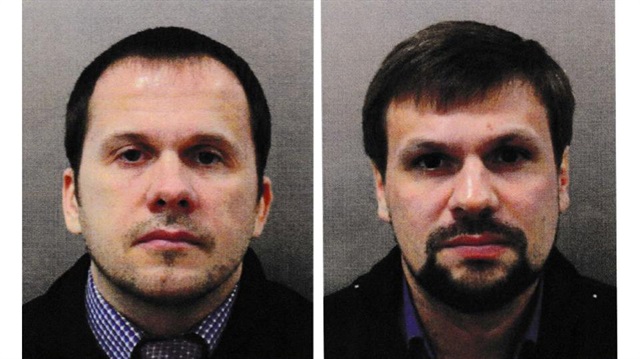
Alexander Petrov and Ruslan Boshirov, who were formally accused of attempting to murder former Russian intelligence officer Sergei Skripal and his daughter Yulia in Salisbury, are seen in an image handed out by the Metropolitan Police in London, Britain September 5, 2018.
British prosecutors on Wednesday identified two Russians who they accused of trying to murder former Russian spy Sergei Skripal and his daughter Yulia with a military-grade nerve agent in England.
Skripal, a former colonel in Russian military intelligence who betrayed dozens of agents to Britain's MI6 foreign spy service, and his daughter Yulia, were found unconscious on a public bench in the southern city of Salisbury on March 4.
Britain has blamed Russia for the poisonings and identified the poison as Novichok, a deadly group of nerve agents developed by the Soviet military in the 1970s and 1980s. Russia has repeatedly denied any involvement in the attack.
British prosecutors named the two suspects as Alexander Petrov and Ruslan Boshirov, who police said arrived in Britain from Moscow on March 2 at London's Gatwick airport on an Aeroflot flight and left on March 4. Police released images of the two men.
Moscow on Thursday called new U.S. sanctions against Russia over the Salisbury poisoning incident "unacceptable".Kremlin spokesman Dmitry Peskov told reporters that both these sanctions and those imposed before by Washington were "illegal and against the international law".Peskov's remarks came a day after the U.S. State Department announced the intention to impose new sanctions on Russia over the poisoning of Russian agent Sergei Skripal and his daughter Yulia Skripal in March in the southern English city of Salisbury."Of course, such decisions made by the American side are absolutely unfriendly. And it is unlikely that they can be somehow associated with the difficult but constructive atmosphere that was at the last meeting of the two presidents," Peskov said.However, Russia still hopes for the possibility of restoring constructive relations with the U.S., he said, adding that "it is too early to talk about retaliatory measures".US to impose sanctions on Russia over Skripal poisoningThe sanctions are expected to take effect on or around Aug. 22 following a congressional notification period.The British government has blamed the incident on Russia, linking the nerve agent to a series of Russia-developed chemical weapons collectively known as Novichok. The Kremlin has denied responsibility.The Skripals have recovered from the alleged assassination attempt following intensive care at the hospital.'West acting as judge and executioner in Skripal case': RussiaRussia calls new US sanctions draconian, rejects poisoning allegations
Russia condemns US sanctions over Salisbury poisoning
Neil Basu, Head of UK Counter Terrorism policing, said the two suspects were travelling under aliases but were around 40 years old and had genuine Russian passports.
"We would like to hear from anyone who knows them," Basu said. Russia's foreign ministry said the names given by Britain did not mean anything to them.
Basu said Novichok was sprayed on the front door of Skripal's house in Salisbury, where the two men were sighted on CCTV nearby. Basu said traces of Novichok contamination were found in the London hotel room where the two men had stayed.
"Tests were carried out in the hotel room where the suspects had stayed. Two swabs showed contamination of Novichok of levels below that which would cause concern for public health," Basu said.
Russia's delegation to the international chemical weapons watchdog said on Thursday that the West was acting as a prosecutor, judge and executioner in the case of the poisoning of a former Russian double agent Sergei Skripal.US to impose sanctions on Russia over Skripal poisoning"Collective West in the so-called #Novichok drama acts as a prosecutor, judge and hangman at the same time. Why should (Russia) prove its innocence and not the other way round?" the delegation to the Organisation for the Prohibition of Chemical Weapons wrote on its official Twitter account. Russia calls new US sanctions draconian, rejects poisoning allegations
'West acting as judge and executioner in Skripal case': Russia
NOVICHOK PERFUME
A European arrest warrant has been issued for the two Russians, the prosecutors said.
The Russians are charged with conspiracy to murder Sergei Skripal and the attempted murder of Skripal, his daughter and Nick Bailey, a police officer who was taken ill while attending to the Skripals.
They are also charged with use and possession of Novichok, contrary to the Chemical Weapons Act.
“We will not be applying to Russia for the extradition of these men as the Russian constitution does not permit extradition of its own nationals," said Sue Hemming, director of Legal Services at the Crown Prosecution Service.
A British woman, Dawn Sturgess, died in July after coming across a small bottle containing Novichok near Salisbury where the Skripals were struck down. Her partner, Charlie Rowley, was also stricken.
Police said Rowley and Sturgess had found a counterfeit Nina Ricci Premier Jour perfume bottle which tests later showed had contained Novichok.