

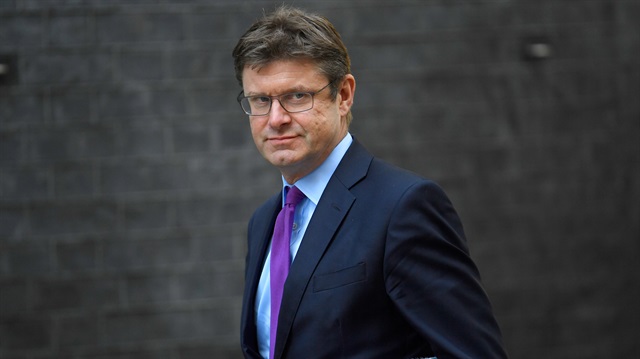
Britain's Secretary of State for Business Greg Clark
British Business Secretary Greg Clark said on Saturday there were grounds for optimism that Britain would strike a Brexit deal with the European Union, after Japanese carmaker Toyota warned that leaving without an agreement would hit its output.
Just six months before Britain is due to leave the EU on March 29, 2019, Prime Minister Theresa May has said talks to clinch a divorce deal are at an impasse.
She has said her "Chequers" proposals are the only viable option, but EU leaders have said key parts of them are unacceptable and many lawmakers in her own Conservative Party have threatened to vote down a deal based on May's blueprint.
The uncertainty has led to concerns that Britain will leave without a deal which businesses, particularly carmakers, have said would be hugely damaging.
"Of course we want a deal," Business Secretary Greg Clark told BBC radio. "No one should be under any illusion that the prime minister and our negotiating team are absolutely determined...
"There are grounds for optimism that we can reach an agreement on this," he said.
Clark was responding to comments from the boss of Toyota's plant in central England, who told the BBC a no-deal Brexit would hit production.
It is the latest in a series of warnings from carmakers that any delays at borders could slow the movement of components and finished models, adding costs and crippling output.
British Prime Minister called for businesses on Wednesday to invest in a post-Britain U.K., by praising free trade, innovation and cooperation between trading partners.With uncertainty surrounding the U.K. leaving the European Union, May said Britain’s relationship with the EU will change, but the two will continue to be close trade partners."We are looking for a frictionless trade," May said in her speech at Bloomberg Global Business Forum 2018 held in New York.Looking beyond the EU, she said the U.K. wants to engage in the "most ambitious" trade relations with other countries and businesses around the world."Whatever is your business, if you invest in post-Brexit Britain, we will give you the lowest tax rate in [the] G20," May said."We are seeing more investment in [the] U.K. in [the] past three years, compared to [the] rest of the EU combined," she said, adding "Post-Brexit Britain will be a trusted partner and will face the challenges of global economy."May also called for a change in the World Trade Organization (WTO), saying it should adapt to changes in global economy."We need to give the WTO a broad ambitious mandate reform to maintain trust in the system," she said, highlighting some of the issues such as legitimacy and transparency.EU negotiator seeks orderly Brexit, new partnership respecting UK sovereignty
May calls for businesses to invest in post-Brexit UK
"If we crash out of the EU at the end of March the supply chain will be impacted and we will see production stops in our factory," said Marvin Cooke, managing director of Toyota's Burnaston plant, which produced 144,000 models last year.
Earlier this week other carmakers in Britain including BMW, McLaren and Honda said they had triggered some Brexit contingency plans, such as certifying models in the EU, and were working on redrawing production schedules and stockpiling more parts.
The moves aim to ensuring plants, which rely on the just-in-time delivery of tens of thousands of components, can keep operating after Brexit, but will add costs and bureaucracy which could risk their long-term viability.
Jaguar Land Rover, Britain's biggest carmaker, has warned it does not know whether its plants will be able to operate in six months' time and that the wrong Brexit deal could cost thousands of car jobs.
Europe, after the devastating results of World War II, understood the necessity of peace across the continent. Six neighboring countries took the first step in 1951 with the Treaty of Paris that established the European Coal and Steel Community (ECSC). The founding countries of the ECSC were Belgium, France, West Germany, Italy, Luxembourg and the Netherlands. European integration moved another significant step further when the Treaty on European Union, known as the Maastricht Treaty, was signed on 7th February 1992. This is the day of establishment of the European Union (EU) as we know it today.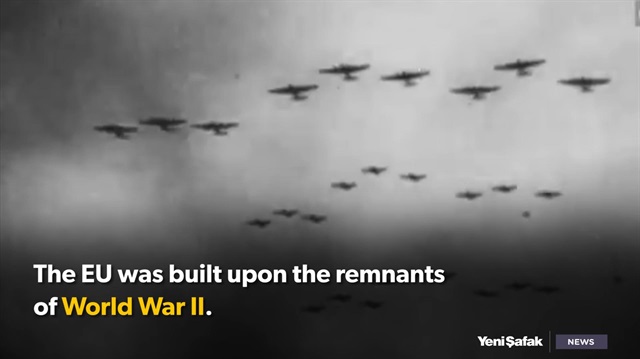
How the EU was formed