

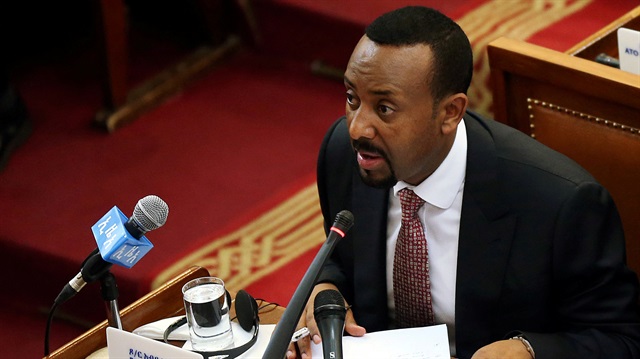
Ethiopia's newly elected Prime Minister Abiy Ahmed
The United Arab Emirates plans to build an oil pipeline connecting Eritrea and Ethiopia, the latest sign of the Gulf state's increasing involvement in the Horn of Africa.
The pipeline will run from Eritrea's port city of Assab to Ethiopia's capital Addis Ababa, an Ethiopian official said.
Landlocked Ethiopia began extracting crude oil on a test basis from reserves in the country's southeast in June and will need access through Eritrea in order to export it.
Ethiopian soldiers traded fire with members of local government security forces on Saturday in the country's eastern Somali region after central authorities sought to arrest regional officials, witnesses said.Residents told Reuters soldiers were deployed in the province's capital Jijiga on Friday evening, bringing them into conflict with the region's paramilitary forces."We can still hear shots being fired. They have been taking place since the morning," one resident said.Eritrean plane lands in Ethiopia after 25-year hiatusAnother resident told Reuters an Ethiopian Orthodox church had been burned down by a mob, while shops, hotels and banks remained closed.A third witness said government soldiers had been deployed in the region's administration offices with the intention of arresting officials.It was not immediately clear why the government in Addis Ababa sought to apprehend them. Officials in the capital and Jijiga were not immediately available for comment.Ethiopia's PM Abiy sets up team to advise on privatisationEthiopia's Somali region has been plagued by violence for the last two decades. The government has fought the rebel Ogaden National Liberation Front (ONLF) since 1984 after the group launched its bid for secession of the region, also known as Ogaden.Since 2017, clashes along the province's border with the Oromiya region have displaced tens of thousands of people.The region's officials have recently been accused by the government in Addis Ababa of perpetrating rights abuses. Last month, Ethiopia fired senior prison officials there after details emerged of torture and other abuses in one notorious prison.
Ethiopian army clashes with local government paramilitaries
Ethiopian broadcaster Fana first reported the pipeline plan earlier on Friday following a meeting in Addis Ababa between Ethiopia Prime Minister Abiy Ahmed and Reem Al Hashimy, the UAE's minister of state for international cooperation.
The UAE played a behind-the-scenes role in helping Ethiopia and Eritrea end a two-decade state of war last month, Reuters reported this week.
Hashimy, who last month publicly referred to herself as the UAE's policy lead on sub-Saharan Africa, said after meeting Abiy that the UAE is keen to exploit investment opportunities in Ethiopia, a country of 100 million people with the fastest growing economy in Africa, Fana reported.
For the first time in 25 years, an Eritrean commercial plane landed at the Addis Ababa Bole International Airport.Ethiopian officials were at the airport to welcome the Eritrean businesspeople, artists and clerics upon arrival to the capital.Over the past two months, former rivals Ethiopia and Eritrea have forged a new friendly rapprochement with reciprocal visits of their leaders to each other’s country.Eritrea and Ethiopia have been in a no-war-no-peace situation after the end of their bloody war fought from 1998 to 2000.Last month, Ethiopian Airlines commenced a twice weekly flight to Asmara, capital of Ethiopia’s northern neighbor, Eritrea.As per their July agreement, the two countries fast tracked the opening of embassies in each other’s country and naming their ambassadors. The agreement also gave Ethiopia an opportunity to use the Port of Assab and Massawa in Eritrea at cheaper rates.Eritrea seceded from Ethiopia in 1993.
Eritrean plane lands in Ethiopia after 25-year hiatus
Abiy's chief of staff, Fitsum Arega, told Reuters that the talks were largely on investment in "industries, agriculture, real estate, (the) oil pipeline, (and) resorts".
"Most are under study," Fitsum said in a text message.
REGIONAL RIVALRY
The UAE is also driven by a fear that rivals such as Iran or Qatar could gain a foothold. Earlier this year ties frayed between Mogadishu and Abu Dhabi and the two countries ended a UAE military training programme in Somalia.
Ethiopia's prime minister has appointed a team to advise his government on the privatisation of state-owned enterprises, his chief of staff said, as part of reforms the new leader has instituted since taking office four months ago.Since becoming prime minister in April, 41-year-old Abiy Ahmed has turned Africa's most populous after Nigeria on its head with his plans to reshape politics and the economy."PM Abiy Ahmed has set up an Advisory Council on the privatisation of large state-owned enterprises," Fitsum Arega, Abiy's chief of staff said on Twitter late on Friday."The Council will ensure the process is managed with utmost transparency and accountability."Abiy's government has said that it is open to selling off a host of state-owned firms, either partially or entirely, as part of economic reforms designed to “unleash the potential of the private sector”.The government was tendering for advice from global business consultancies including McKinsey and PwC, the country's information minister told Reuters in July.Ethiopia has achieved one of Africa’s fastest growth rates over the past decade, averaging up to 10 percent a year.But investors complain about its stifling and antiquated socialist bureaucracy, where the default answer from fearful civil servants is “no” and importing something as mundane as cotton can take six or 12 months.Besides his stated desire to attract foreign capital into one of Africa’s most closed states, Abiy has brokered peace with Eritrea, with whom Ethiopia fought a border war two decades ago. 
Ethiopia's PM Abiy sets up team to advise on privatisation
Abu Dhabi has a military base in Assab which it uses in its military campaign in the war in Yemen, located just across the Red Sea.
Saudi Arabia's Foreign Minister Adel al-Jubeir arrived in Addis Ababa on Thursday and met with Abiy, although there were no detailed announcements from the meeting.
Last month, Reuters reported that Ethiopia had asked Saudi Arabia for a year's supply of fuel with payment delayed for 12 months to ease severe foreign currency shortages.
The Foreign Ministry on Friday appeared to backtrack from the position taken by its premier on the U.A.E. trying to teach Islam to Ethiopia, saying the remarks attributed to him in a viral video did not target any specific country.In the video, Prime Minister Abiy Ahmed was heard telling a gathering of Ethiopian Muslims in the U.S. last week that he had told Abu Dhabi Emir Mohammed Bin Zayed: “You can’t teach us Islam, because you lost direction to Islam”.Video: You’ve lost Islam, says Ethiopian PM to UAE's ZayedAhmed said he made the remarks when he asked the gulf sheikh whether he would like to help Ethiopia open an Islamic center. But “when the emir offered to teach Islam, I told him no you cannot teach us Islam, you lost faith”, adding that he said that because gulf states remain divided among themselves.“There are sects of Islam that do not help build Islam in the Middle East; there are sects of Islam that destroy Islam amongst you,” he said. Clarifying the premier's remarks, Ethiopian Foreign Affairs spokesperson Meles Alem told a press briefing the remarks seen in a viral video “utterly distorted the true word and spirit of Prime Minister Abiy Ahmed’s remarks”.Ethiopian PM calls for unity in Washington diasporaAccording to Alem, the premeir was not targeting any particular country but the whole Islamic world about how the teachings on peace, which is a pillar of Islam, was lost.It remains unclear if the viral video would end up hurting ties between Ethiopia and the U.A.E.Alem said: “Relations between the two countries are well grounded and deep that no such social media message can spoil it.”Since May, Ahmed has visited the U.A.E. twice. The gulf state has also given Ethiopia $3 billion to help withstand its foreign currency shortages and expand investment.
Ethiopia clarifies remarks of premier on UAE shiekh
Eritrea's foreign minister and a close adviser to President Isaias Afkwerki arrived in Ethiopia on Friday to discuss progress on implementing the agreement they signed last month.
The rapprochement ended Africa's longest major military stalemate and holds great potential for both economies, which were held back by the "no war, no peace" status quo.
Though the two countries have re-opened embassies in each other's capital and resumed flights, details ranging from border demarcation to war reparations have not been worked out.
Authorities have cut off Internet access in eastern Ethiopia amid an outbreak of violence in the region, two local residents said on Wednesday.The residents, one speaking from Oromia region and the other from the city of Harar, said the connection had been down for three days.Ethiopian government spokesman Ahmed Shide did not immediately respond to a phone call and a text message seeking comment on the shutdown, which was reported on Tuesday by digital rights group Access Now.Violence broke out on Saturday in Jijiga, the capital of Ethiopia's Somali region, with mobs looting properties owned by ethnic minorities. Security officials shot dead four people, a witness told Reuters.Ethiopian army clashes with local government paramilitariesThe government said unrest had been stoked by regional officials.The residents in Oromia and Harar said they were concerned the violence could spread from the Somali region into other parts of eastern Ethiopia, in part because tit-for-tat ethnic reprisals were one facet of the unrest that roiled the country for three years until the resignation of Prime Minister Hailemariam Desalegn in February.Since replacing Desalegn in April, Abiy Ahmed has turned politics and the economy on its head in the country of 100 million people but continuing ethnic violence poses a challenge to his reforms.
Internet in eastern Ethiopia shut down after regional violence