

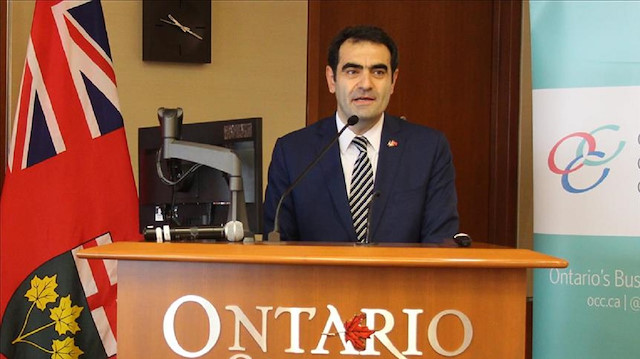
Selcuk Unal
Turkey’s ambassador to Ottawa praised Canada’s role in hosting Syrian refugees while saying many other countries have failed to respond to take similar steps.
In his article he wrote for the Canadian newspaper The Hill Times, Selcuk Unal said Turkey’s open-door policy would continue for refugees fleeing their homes for various reasons including violence.
Unal emphasized that the Turkish people had welcomed migrants, refugees and asylum seekers with "tolerance and hospitality" throughout history, including Crimean Tatars, Poles, Swedes, Hungarians, Russians, Jews escaping from Inquisition or Nazi Germany, Afghans, Bosnians, Kosovars, Macedonians, Iraqis and Syrians.
“Those people belonged to many different ethnic and religious backgrounds; yet one thing they all shared was the trust they had for Turkey: a safe harbor,” he added.
U.S.-led coalition warplanes struck a mosque in Syria's Deir ez-Zor province, killing at least seven people, according to local sources."At least seven civilians were killed by the bombing," one source told Anadolu Agency on Thursday.On Wednesday evening, coalition warplanes targeted the Al-Zawiyya Mosque in Deir ez-Zor’s Daesh-held Hajin district.According to local sources, the mosque was severely damaged by the bombardment.Kremlin alarmed by report that US led drone attack on Russian base in SyriaLast week, at least 30 civilians were killed, including two children, when a coalition airstrike destroyed the Ammar bin Yasser Mosque in the town of Al-Sousa on Deir ez-Zor’s outskirts.Another 16 were killed in a similar attack on the Uthman ibn Affan Mosque -- in the same town -- last Friday.Along with the Hajin district, Daesh remains in control of Deir ez-Zor’s towns of Al-Shaafah and Al-Sousa, in addition to the villages of Muhsin and Bukhater.On Sept. 11, the PKK/YPG terrorist group, with U.S. and French support, launched an offensive aimed at capturing Deir ez-Zor from Daesh.
US-led coalition strikes mosque, kills 7 in east Syria
Having accepted more than 50,000 refugees from Syria while other countries were “sitting on the fences”, Unal said Canada is one of the few countries who should be thanked in this regard.
“In that respect, like Canada, Turkey has become home to many peoples from different cultures living in harmony,” he said.
Underlining Turkey’s role as the largest refugee-hosting country in the world with nearly 4 million refugees from Syria and Iraq, Unal said Turkey was “shouldering more than its fair share” of responsibilities with almost $32 billion of expenditures so far.
The Kremlin said on Thursday that it was very alarmed by a report from the Russian Defence Ministry alleging that a U.S. spy plane coordinated a drone attack on Russia's Hmeymim air base in Syria in January.Russian Deputy Defence Minister Alexander Fomin said earlier on Thursday that a U.S. Poseidon-8 spy plane had helped coordinate an attack by 13 drones on the base, the TASS news agency reported.Kremlin spokesman Dmitry Peskov said he could not rule out that President Vladimir Putin would raise the alleged drone attack with U.S. President Donald Trump. The two leaders are expected to meet in Paris on Nov. 11. 
Kremlin alarmed by report that US led drone attack on Russian base in Syria
“The two NATO Allies could have more avenues not only to meet needs, but to effectively reduce risks and vulnerabilities over time as well as to work on the humanitarian crises the humanity will be facing,” he added.
Turkey hosts 3.5 million Syrian refugees, more than any other country in the world. The country has spent more than $32 billion from its own national resources for helping and sheltering refugees since the beginning of the Syrian civil war.
Syria has only just begun to emerge from a devastating conflict that began in 2011 when the Assad regime cracked down on demonstrators with unexpected ferocity.
A 44-year-old Japanese freelance journalist arrives home on Thursday to an uncertain welcome more than three years after militants in Syria captured and held him in what he described as a physical and mental “hell”.Jumpei Yasuda, who quit his job as a reporter on a Japanese newspaper to cover the Iraq war in 2003, is due in Tokyo on Thursday on a flight from Turkey, rekindling debate in Japan about reporting from war zones that some see as reckless adventurism and others as courageous journalism.“I am happy that I can return to Japan. At the same time, I don’t know what will happen from here or what I should do,” a gaunt and tired-looking Yasuda told Reuters as he traveled to Ankara from southern Turkey where he had crossed from Syria after 40 months in captivity.He was, he added, struggling to speak Japanese.Japanese PM thanks Erdoğan for saving reporter in SyriaJapanese government officials had earlier traveled to southern Turkey to confirm his identity. Prime Minister Shinzo Abe thanked authorities in Turkey and elsewhere for their help in freeing Yasuda.His capture in Syria was not the first time he has been held by militants in the region.Yasuda traveled to Iraq in late 2002 using his paid leave at the Shinano Mainichi newspaper where he had written about environmental problems, food safety and family issues. Frustrated that his paper wouldn’t send him on assignment there, he quit in 2003 and in 2004, on another trip to Iraq, was captured near Baghdad by militants, who held him for three days.In a book he published the same year, he explained that he had undertaken the assignment because he wanted to show the suffering caused by the war.Japanese journalist taken hostage in Syria 3 years ago released“I could not see faces of people living in the country which was called part of an ‘axis of evil’ from any information provided by Japanese media, which only reported diplomatic matters and inspections by the United Nations,” he wrote.Yasuda returned to Iraq in 2007 to work as a cook at an Iraqi army training camp and in 2010 published a book in Japan about war zone laborers.“YASUDA IS TOUGH”His last trip to the region was in 2015. Apart from a few brief videos released by his captors, little is known about what happened to him after he disappeared. Other Japanese captured there have been killed.In 2015 veteran Japanese war correspondent Kenji Goto and a friend he had tried to free, Haruna Yukawa, were beheaded by Daesh militants. Both were lambasted in Japan for their decision to travel to Iraq.Japan PM Abe 'relieved' at hostage's release but wants to confirm identityEarlier, in 2004, a Japanese high school student, an aid worker and a freelance photographer taken hostage in Iraq were also condemned as irresponsible after their release. Japan is careful to stay out of disputes in the Middle East and tries to maintain friendly ties with countries such as Iran and Saudi Arabia that are at loggerheads.“There was bashing before and it appears it is already happening this time,” freelance journalist Kosuke Tsuneoka, a friend of Yasuda, told Reuters in a telephone interview. “Yasuda is tough and has great mental strength. I’m not worried he will be hurt.”As Yasuda flew to Japan, some on social media were already condemning him.“After he returns, I want him to hold a news conference to apologize and work to pay back the ransom. I don’t need to hear his opinion,” tweeted a person with the twitter handle “kawako”.Video: Japanese journalist says he is safe in TurkeyThe Japanese government has denied paying a ransom for Yasuda’s release.“Was it really necessary to rescue him again, paying a huge amount of ransom?” tweeted another person with the Twitter handle “massa.kongo”That kind of criticism could make it difficult for journalists to cover the region in future, according to Yoshihiro Kando, a former Asahi newspaper reporter.“I am worried that the atmosphere becomes such that one should not go because it is dangerous and the trend is toward self-restraint,” he wrote on the website for the Association of Japanese Journalists Working in Dangerous Areas.
Japanese hostage returns home after three years in Syrian 'hell'