

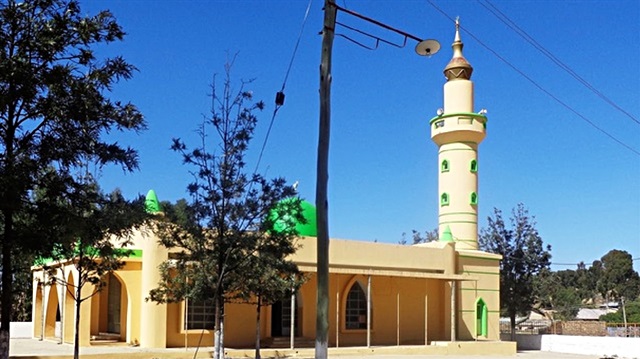
Al-Nejashi Mosque
It has only been a few months since an ancient mosque in Ethiopia got a major facelift by Turkey's aid agency, but the Islamic heritage site is already seeing growing numbers of international tourists.
Located in the town of Wuqro, 790 kilometers (over 490 miles) north of Ethiopia's capital Addis Ababa, Al-Nejashi is said to be the first mosque in Africa. It is named after Nejashi, the then Ethiopian king who hosted companions of the Prophet who escaped persecution in Mecca.
The companions fled persecution in Saudi Arabia and came to Ethiopia on the orders of the Prophet who said there was a just Abyssinian King.
According to Turkish Coordination and Cooperation Agency (TIKA), the renovation of the mosque was part of a scheme to promote common cultural values and assets abroad and to contribute to the development of inter-governmental cooperation.
The mosque stands majestically on a spacious location, which also is the site of the 15 tombs of the Prophet’s companions. A road leads to this glorious site at a short distance from the town of Wuqro, in the regional state of Tigray.
Al-Nejashi saw the last Ashura celebration as a uniquely colorful event with Ethiopian Muslims side by side with their Eritrean brothers.
Authorities at Nigeria’s first modern mosque in southwestern Lagos state have called for a partnership with the Turkish government in the running of the religious edifice, famed for its Ottoman-like architecture.Estimated to cost £3,000 at the time, the Shitta-Bey Mosque was built in 1891 and commissioned in 1894 by dignitaries that included Abdullahi Quillam, a representative of Ottoman Sultan Abd-al-Hamid.The mosque was named after Mohammed Shitta, the financier of the construction, whom the sultan honored with the title of “bey” for his contributions to Islam in the then-British colony of Lagos and elsewhere.Born in 1824 in Sierra Leone, Shitta was said to have visited then-Ottoman Turkey in appreciation of his recognition.At its commissioning, the mosque was deemed the most modern and costliest ecclesiastical edifice in British West Africa.The Shitta-Bey mosque, one of Nigeria’s national monuments, retains its unique architecture and interior designs, which were credited to Senghor Baptista Da Costa.“We will appreciate any support from the Turkish authorities especially in the area of providing cheap and renewable energy for the running of the mosque,” Sheikh Habeeballahi Taofeeq-Yushau, head of the historical mosque, told Anadolu Agency, mentioning the possibility of solar energy“We will also appreciate scholarships for indigent Muslim students at the mosque.”Devotion to Islam and MuslimsExplaining the title “bey,” the imam said it was a recognition of the role Mohammed played and the efforts of Ottoman Turkey to help the cause of Muslims and Islam across the world.“The title was conferred on him at the official commissioning of the mosque on July 4, 1894. That is why he is known till today as Shitta Bey. He was reputed for his devotion to Islam and the affairs of Muslims,” said Sheikh Habeeballahi.He said the Shitta family remains a pillar of the Islamic community in southwestern Lagos, where Mohammed’s descendants now take the title of Seriki n Musulumi (traditional head of Muslims).Mohammed Shitta was the first to be conferred with the title.The imam said the bey was also at the forefront of other Islamic efforts, including the clamor for the British colonial masters to let the Muslim community -- which formed half of the colony’s population -- have sharia as their own law, culminating in a petition to the British authorities in 1894.Many historical accounts have confirmed the claim.
Nigeria’s oldest mosque seeks partnership with Turkey
'A pleasant surprise'
Nasir Saidi Salih, a visitor from Germany, was obviously delighted to have the opportunity to make it to the site.
Pointing to the whitewashed outside walls and green minarets, Salih said, “From what I have read, the mental picture I had about the mosque was it that it was old. But, it actually looks it was built one or two years ago.”
“It is a nice surprise for us,” he said, explaining how he and his wife Flourans Lang ended up at the ancient site of Islamic heritage. The couple first visited the walled city of Harar in eastern Ethiopia -- which also reveals ancient Islamic tradition and the relics of which TIKA helped preserve.
According to Salih, they learned about Al-Nejashi from the residents of Harar who recommended to the couple that a trip to “Africa’s first mosque” would be worth traveling.
“We did some research and saw that it was on the road so we came here,” he told Anadolu Agency with a smile in his face. “For the restoration and the investment, it is a good thing for Islam and for the world. I think everybody should come here. After Mecca, you should come here.”
Lang, for her part, said, “We find it very, very beautiful. For us, Ethiopia has always the image of being a place of peace. We are happy to be able to come here.”
“There is so much to see and it is very important place of Islam. It is a very nice heritage,” she said, also advising people living anywhere in the world to consider a trip to Al-Nejashi -- where one would get a rare chance of revisiting the proud history of the Ethiopians who embraced refugees.
“I think it is good that Ethiopia and the government of Turkey have this relation. It is good because the site is important,” she added.
Increase of int'l visitors
Ali Mohammed Ibrahim, the imam of the mosque, said he is grateful to TIKA for having renovated Al-Nejashi.
“After the renovation the number of visitors greatly increased,”Ibrahim told Anadolu Agency.
He said, “Not only Muslims, but Christians are also coming here to visit the mosque and its proud history, which the heritage site is full of.”
Ibrahim went on to say the site offers a serene and safe stay to visitors, and that more people should come visit as it is "worth traveling from any distance to come here”.
He recalled that the last Ashura was celebrated this year with prayers and other religious ceremonies as Ethiopian Muslims assembling at the mosque were joined in by their Ethiopian brethren after two decades.
Eritrea seceded from Ethiopia in 1993. From 1998 to 2000, the two neighbors fought a bloody conflict in which tens of thousands of people -- on both sides -- are believed to have perished.In an April inaugural address, the Ethiopian PM offered an olive branch to the Eritrean president, ending two decades of hostile relations.
Nebiat Tekle Bahru, tourism promotion expert at the Tigray Regional State Tourism Bureau, told Anadolu Agency that the regional state houses ancient mosques and churches, and TIKA’s restoration of Al-Nejashi would tremendously help attract international visitors.
After the renovation, the bright features of the church stand in stark contrast with the meadows in its surroundings, which has fields strewn with low-growing bushes.
Now in tune with the season, the sky is high and blue and the weather is pleasantly hot and sunny. Meanwhile, the ancient Al-Nejashi mosque expects to see people who would explore its glorious history.
The mosque is a mere representation of the history that laid the foundation for the sense of mutual respect and love Ethiopian Muslims and Christians have for each other to this day.