

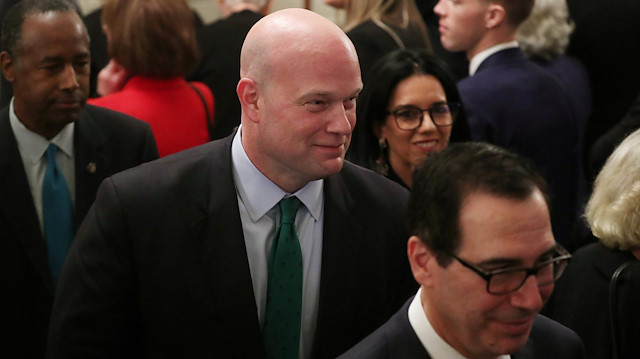
Acting U.S. Attorney General Matthew Whitaker departs between U.S. Treasury Secretary Steven Mnuchin (R) and Housing and Urban Development Secretary Ben Carson (L) after a ceremony where President Donald Trump awarded the 2018 Presidential Medals of Freedom in the East Room of the White House in Washington, US.
The fight over President Donald Trump's appointment of Matthew Whitaker as acting attorney general has reached the U.S. Supreme Court, with lawyers in a pending gun rights case set to ask the justices on Friday to decide if the action was lawful.
Critics have said the Republican president's appointment of Whitaker, who now will oversee Special Counsel Robert Mueller's investigation into Russia's role in the 2016 U.S. election, on Nov. 7 to replace the ousted Jeff Sessions as the chief U.S. law enforcement official violated the Constitution and federal law.
Lawyers for Barry Michaels, who filed a lawsuit in Nevada challenging a U.S. law that bars him from buying a firearm due to prior non-violent criminal convictions, decided to make Whitaker's appointment an issue in their pending appeal before the high court because Sessions was named as a defendant in the case.
The lawyers told the justices in a motion set to be filed on Friday that Deputy Attorney General Rod Rosenstein should be the acting attorney general.
The court is not required to decide one way or another and could simply ignore or reject the motion.
Michaels' lawyers argued that Rosenstein, the department's No. 2 official, should have succeeded Sessions under a federal succession law that vests full authority in the deputy attorney general should the office of attorney general become vacant.
Some of the same lawyers behind Friday's motion also are involved in a similar effort brought before a federal judge on Tuesday. In that case, Maryland Attorney General Brian Frosh asked U.S. District Judge Ellen Hollander to bar Whitaker from appearing in an official capacity as acting attorney general in the state's ongoing lawsuit against the Trump administration over the Affordable Care Act healthcare law.
Maryland also argued that the Republican president violated the so-called Appointments Clause of the Constitution because the job of attorney general is a "principal officer" who must be appointed by the president and confirmed by the Senate.
The Justice Department on Wednesday defended the legality of Whitaker's appointment, saying Trump was empowered to give him the job under a 1998 law called the Federal Vacancies Reform Act even though he was not a Senate-confirmed official.
Trump had repeatedly criticized Sessions for recusing himself in March 2017 from the Russia investigation. Sessions' recusal gave Rosenstein authority over the investigation, and he appointed Mueller two months later. Congressional Democrats have voiced concern that Whitaker, a Trump loyalist who has questioned the scope of Mueller's investigation, could undermine or even fire Mueller.
Mueller's investigation has led to criminal charges against a series of former Trump aides and has cast a cloud over Trump's presidency.
Forced out of the White House in a feud with first lady Melania Trump, Mira Ricardel on Friday expressed admiration for U.S. President Donald Trump and his wife as a tumultuous week ended for the former deputy national security adviser.Ricardel ran afoul of the first lady in negotiations over government resources for use in Mrs. Trump's trip to Africa in October. She was forced to resign on Wednesday after a showdown with Mrs. Trump and her staff.In a statement, Ricardel said she had been honored to serve as deputy national security adviser and proud of her tenure working for national security adviser John Bolton."I admire the President and First Lady and have great respect for my colleagues who are dedicated to supporting the president’s policies, and I look forward to working with them in the months ahead," she said.Ricardel is currently looking for another job within the Trump administration. She came to the White House from the Commerce Department.Bolton sent an email to the staff of the National Security Council on Thursday saying he was grateful to Ricardel "and her unwavering commitment to the president," according to a senior NSC official.Aides stressed that Ricardel had never actually met Melania Trump. The White House had said in a statement on her departure on Wednesday that Ricardel "will continue to support the President as she departs the White House to transition to a new role within the administration."
Forced out, Bolton aide Ricardel expresses admiration for Trump, Melania
Rescue workers searched on Friday for 630 people reported missing in a northern California town reduced to ashes by the deadliest wildfire in state history.At least 63 people were killed in and around Paradise by the Camp Fire that erupted a week ago in the Sierra foothills 175 miles (280 km) north of San Francisco. The fire is among the most lethal U.S. wildfires since 2000.Authorities attribute the death toll in part to the speed with which flames raced through the town of 27,000, driven by wind and fueled by desiccated scrub and trees.Tally of missing in California's deadliest blaze surpasses 600Nearly 12,000 homes and buildings burned hours after the blaze erupted, the California Department of Forestry and Fire Protection (Cal Fire) said. The fire left a ghostly expanse of empty lots covered in ash and strewn with debris.Thousands of additional structures are still threatened as firefighters, many from distant states, labored to contain and suppress the flames.The revised roster of 630 missing people is up from 297 listed on Thursday by the Butte County Sheriff's Office.Sheriff Kory Honea on Thursday said the remains of seven victims have been located since Wednesday's tally of 56. Nearly 300 people reported missing have been found alive and the list of missing https://bit.ly/2BaiYxy would fluctuate, he said.DNA firm schooled in war zones helps ID California fire victimsDNA SAMPLESThe sheriff has asked relatives of the missing to submit DNA samples to hasten identification of the dead. But he said some of those unaccounted for may never be identified.The were other smaller blazes in southern California including the Woolsey Fire that is linked to three fatalities and destroyed at least 500 structures near the Malibu coast west of Los Angeles.Scientists say two seasons of devastating wildfires in California are linked to drought they say is symptomatic of climate change.Two electric utilities say they sustained equipment problems close to the origins of the blazes around the time they were reported.The White House said on Thursday that President Donald Trump plans to visit the fire zones on Saturday to meet displaced residents. Critics say Trump politicized the fires by casting blame on forest mismanagement.Cal Fire said 40 percent of the Camp Fire's perimeter is contained, up from 35 percent, even as the blaze footprint grew 2,000 acres to 141,000 acres (57,000 hectares). The Woolsey fire is 57 percent contained.Public schools in Sacramento and districts 90 miles (145 km) to the south, and as far away as San Francisco and Oakland, said Friday's classes would be canceled as the fire worsened air quality.Many of those who survived the flames but lost homes stayed with friends or relatives or at American Red Cross shelters.
Wildfire that destroyed California town leaves 63 dead and 630 missing
British Prime Minister Theresa May was fighting for survival on Friday after a draft divorce deal with the European Union provoked the resignations of senior ministers and calls for a vote of no confidence in her leadership.More than two years after the United Kingdom voted to leave the EU, it is still unclear how, on what terms or even if it will leave the EU as planned on March 29, 2019.May, who won the top job in the turmoil that followed the 2016 referendum, has sought to negotiate a Brexit deal ensuring the United Kingdom leaves in the smoothest way possible.But Brexit minister Dominic Raab resigned on Thursday over her deal, sending the pound tumbling. Mutinous lawmakers in her own party openly sought to challenge her leadership and bluntly told her that the Brexit deal would not pass parliament.Who has submitted letters of no confidence in UK PM May?May, who has vowed to stay on as prime minister, was asked by a caller on LBC radio to "respectfully stand down". She did not immediately address that part of the caller's question.British media have been awash with rumours that May would face an imminent vote of no confidence in her leadership from her own Conservative Party lawmakers.When 48 Conservatives submit letters to the party's so-called 1922 committee, May will face a confidence vote, needing a simple majority of the total votes in order to win."For the sake of the Conservative Party and indeed for our country's destiny, I honestly believe that (it) is now time to seek fresh leadership that can carry this country forward outside of the European Union," Brexit-supporting lawmaker Mark Francois wrote in a letter headlined "She Just Doesn't Listen".I'm no Neville Chamberlain: UK PM May rejects comparison to mocked war leaderHowever in a boost to May, Michael Gove, 51, the most prominent Brexit-supporting minister in her government, gave his backing to the prime minister, saying he would stay on in government as environment minister.Asked if he had confidence in May, Gove, who torpedoed former foreign minister Boris Johnson's leadership bid in 2016, told reporters: "I absolutely do.""I think it's absolutely vital that we focus on getting the right deal in the future, and making sure that in the areas that matter so much to the British people we can get a good outcome."Other eurosceptic ministers also agreed to stay, according to a tweet from Tim Shipman, Sunday Times political editor.How Britain's Raab tripped on 'Barnier's staircase'"RESIGNING WILL NOT HELP""Resigning and joining a rebellion is not going to help anything," he quoted an unnamed source as saying.Sterling, which has see-sawed on Brexit news since the referendum, was flat at $1.2783 on Friday, down almost three cents since a deal was struck on Tuesday.Brexit will pitch the world's fifth largest economy into the unknown. Many fear it will divide the West as it grapples with both the unconventional U.S. presidency of Donald Trump and growing assertiveness from Russia and China.Jo Johnson, who resigned as a minister last week, said the situation marked the worst failure of statesmanship since the 1956 Suez canal crisis, when Britain was forced by the United States to withdraw its troops from Egypt.Brexit divorce deal thrusts UK PM May into biggest crisis of premiershipAmid the turmoil the ultimate outcome remains uncertain.Scenarios include May's deal ultimately winning approval; May losing her job; Britain leaving the bloc with no agreement; or even another referendum.To leave the EU on the terms of her deal, May would need to get the backing of about 320 of parliament's 650 lawmakers. The deal is due to be discussed at an EU summit on Nov. 25.Politicians, officials and diplomats in London openly questioned how long May had left as speculation swirled around London that a leadership challenge could come soon.France preparing transport, customs measures in case of no-Brexit dealBy seeking to preserve the closest possible ties with the EU, May has upset her party's many advocates of a clean break, and Northern Ireland's Democratic Unionist Party (DUP), which props up her minority government.The Daily Telegraph newspaper reported that the DUP had demanded May be replaced as prime minister."Oh I haven't had a testy exchange with Arlene," May said. "They've raised some questions with us, they've raised some concerns with us and yes we are looking at those."We are still working with the DUP," she said.UK PM May will face no confidence vote next weekNIGHTMARE FOR BUSINESS?The EU and Britain need an agreement to keep trade flowing between the world's biggest trading bloc and the United Kingdom, home to the biggest international financial centre.May said she felt the threat of a no deal Brexit personally as she was Type 1 diabetic: "I depend on insulin every day. My insulin is produced by a country elsewhere in the European Union."May's spokeswoman said there had been strong support from the country's business community for her draft deal but British aero-engine maker Rolls-Royce said it was continuing with its no-deal contingency plans.Top UK court says to consider government appeal in Brexit reversal caseThe plans include "buffer stocks so that we have all the logistical capacity that we need to carry on running our business," said Chief Executive Warren East.Proponents of closer relations with the EU in her own party and the Labour opposition say the deal squanders the advantages of membership for little gain.Supporters of Brexit say that while the divorce might bring some short-term instability, in the longer term it will allow the United Kingdom to thrive. 
UK PM May battles to sell Brexit deal amid rumours of no-confidence vote
U.S. President Donald Trump’s administration ordered federal law enforcement agencies to examine legal methods of getting Fetullah Terrorist Organization (FETÖ) leader Fetullah Gülen out of the U.S. in an attempt to convince Turkish President Recep Tayyip Erdoğan to ease pressure on Saudi Arabia following the murder of journalist Jamal Khashoggi, NBC News reported citing four sources.Khashoggi, a royal insider turned critic of Saudi policy and the crown prince’s reforms, was killed in the country’s Istanbul consulate on Oct. 2, after a struggle.The move suggests Trump could be seeking ways to appease Erdoğan over the Khashoggi murder without harming his alliance with Saudi Crown Prince Mohammed bin Salman.Turkey says will not link fate of FETÖ leader Gülen to KhashoggiThe White House asked for details about Gülen’s residency status. Officials initially “pushed back on the White House requests, but once they realized it was serious they were furious.”A total of 249 people were martyred and nearly 2,200 injured in the July 15 failed coup which was perpetrated by FETÖ, led by ringleader Fetullah Gülen, who lives in self-imposed exile in Pennsylvania.“One option that Turkish and Trump administration officials recently discussed is forcing Gülen to relocate to South Africa rather than sending him directly to Turkey if extradition is not possible, said the U.S. officials and people briefed on the discussions. But the U.S. does not have any legal justification to send Gülen to South Africa, they said, so that wouldn't be a viable option unless he went willingly,” NBC News reported.FETÖ-linked daily’s ex-columnist gets prison sentenceErdoğan and other Turkish officials reiterated to U.S. Secretary of State Mike Pompeo, who visited Turkey on Oct. 17, that they sought the extradition of Gülen. Pompeo allegedly queried whether there was “any new evidence” of Gülen links to the 2016 failed coup.Erdoğan told Pompeo that Gülen has “terrorist ties,” a senior U.S. official briefed on the meeting said.Following the coup, Turkey delivered “boxes of materials to the U.S.” that Ankara says proves Gülen was the mastermind. However, the FBI and U.S. Justice Department state they “didn't find evidence that met the standard for extradition, which requires U.S. prosecutors to determine that someone committed crimes abroad that would also be illegal in the U.S.”Gülen pursued a long-running campaign to overthrow the Turkish government through the infiltration of state institutions, particularly the military, police and judiciary, forming what is commonly known as the parallel state.Germany not meeting Turkey's demands on FETÖ: FM
Trump administration seeks ways to kick FETÖ leader Gülen out of US
U.S. President Donald Trump didn't make it to this week's summit of Asian nations in Singapore, but his influence was still keenly felt among the leaders who gathered in the city.One prime minister warned that the trade war between Washington and Beijing could trigger a "domino effect" of protectionist steps by other countries. Another fretted that the international order could splinter into rival blocs."The most important and talked-about ... leader, President Trump, is the only one that did not turn up," said Malcolm Cook, a senior fellow at the ISEAS-Yusof Ishak Institute in Singapore.And yet, in Trump's absence, countries from South to East Asia pressed on with forging multilateral ties on trade and investment among themselves, including with China.China's representative at the meetings, Premier Li Keqiang, egged them on."Now the world is facing rising protectionism. It is all the more important for us to come together and respond to the complex world situation to uphold multilateralism and free trade," Li said on Thursday.The U.S. president's lack of engagement with Asian nations came just days after a trip to France for World War One commemorations at which he appeared isolated from NATO allies.Simon Tay, chairman of the Singapore Institute of International Affairs, said Trump was inadvertently bringing Asian nations together."Not necessarily by design, but because he is not being a consistent and reassuring presence, and because his policies have tended to fracture the natural order that Asia is dependent upon," he said. "Asians are trying to figure out what else they can do without relying on America too much."The White House did not respond to a request for comment.TWO POWERS: TWO STRATEGIESAs well as the summits of the Association of Southeast Asian Nations (ASEAN) and East Asian nations in Singapore, Trump will also skip the Asia Pacific Economic Cooperation (APEC) forum in Papua New Guinea at the end of the week.At APEC on Friday, President Xi Jinping will showcase China's Belt and Road initiative to Pacific leaders, several of whom are expected to sign up to the infrastructure investment drive.Xi's multi-billion-dollar plan, which aims to bolster a sprawling network of land and sea links with Asian neighbours and far beyond, is viewed with suspicion in Western capitals as an attempt to assert Chinese influence.Trump attended both the ASEAN and APEC meetings in 2017, and his decision to stay away this year has raised questions about Washington's commitment to a regional strategy to counter China.Vice President Mike Pence, who represented Trump in Singapore, told the meeting that United States' commitment to the Indo-Pacific is "steadfast and enduring."Asia presents the Trump administration with some of its most pressing foreign policy challenges, including its strategic rivalry with China and efforts to persuade North Korea to give up its nuclear weapons programme.Washington has touted what it calls an "Indo-Pacific" strategy aimed at greater regional cooperation, notably with India, Australia and Japan, to counter China's influence, including in the disputed South China Sea, where it conducts naval patrols to challenge what it sees as Beijing's excessive territorial claims.Pence said on Thursday - without naming China - that there was no place for "empire and aggression" in the Indo-Pacific.His comments follow a major speech in October in which he flagged a tougher approach by Washington toward Beijing, accusing China of "malign" efforts to undermine Trump and reckless military actions in the South China Sea.A U.S. State Department spokesman said: "We welcome contributions by China to regional development, so long as it adheres to the highest standards the people of the region demand. We are concerned by China's use of coercion, influence operations, and implied military threats to persuade other states to heed China's strategic agenda."Shortly before Pence spoke in Singapore, the U.S. Navy announced that two of its aircraft carriers with around 150 fighter jets were conducting warfare drills in the Philippine Sea, a show of force in waters south of China and within striking distance of North Korea.TAKING SIDESPence told reporters in Singapore that he had been struck in conversations with world leaders by "the connection that President Trump has made" with them through his vision for a free and open Indo-Pacific.However, analysts say that countries across Asia are waiting for the United States to put substance behind its Indo-Pacific rhetoric, and Trump's absence from the summits only served to heighten concerns among Southeast Asian states that Washington no longer has their back.Singapore Prime Minister Lee Hsien Loong said on Thursday it was "very desirable" for ASEAN not to have to take sides with world powers, but there may come a time when it would "have to choose one or the other."Some Southeast Asian nations may be quietly impressed by the United States' robust approach to Beijing on trade, intellectual property issues and the South China Sea, but others have made it clear they already see China's rise as inevitable.Philippines President Rodrigo Duterte, asked on Thursday about the U.S. Navy drills, noted that China already occupies contested South China Sea islands and added: "Why do you have to create frictions ... that will prompt a response from China?."But Cook said Southeast Asian states' hedging and unwillingness to publicly criticise Chinese aggression have contributed to Washington's posture shift in Asia."This change is certainly not all because of Trump," he said. "The choices of Southeast Asian states in the end bear some responsibility." 
Trump's summit no-show draws Asian nations closer together