

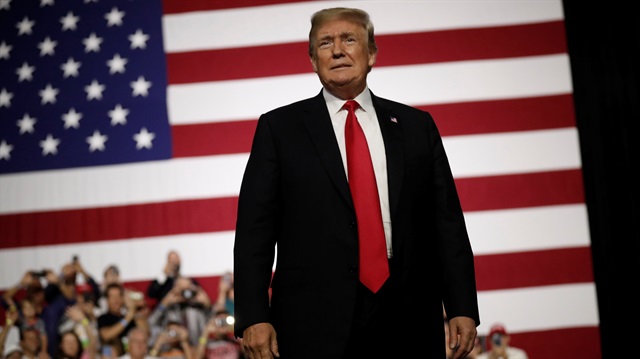
U.S. President Donald Trump
The Trump administration plans to propose slapping a 25-percent tariff on $200 billion of imported Chinese goods after initially setting them at 10 percent, in a bid to pressure Beijing into making trade concessions, a source familiar with the plan said on Tuesday.
President Donald Trump's administration said on July 10 it would seek to impose the 10-percent tariffs on thousands of Chinese imports.
They include food products, chemicals, steel and aluminum and consumer goods ranging from dog food, furniture and carpets to car tires, bicycles, baseball gloves and beauty products.
While the tariffs would not be imposed until after a period of public comment, raising the proposed level to 25 percent could escalate the trade dispute between the world's two biggest economies.
The source said the Trump administration could announce the tougher proposal as early as Wednesday. The plan to more than double the tariff rate was first reported by Bloomberg News.
There was no immediate reaction from the Chinese government.
In July it accused the United States of bullying and warned it would hit back.
Investors fear an escalating trade war between Washington and Beijing could hit global growth, and prominent U.S. business groups have condemned Trump's aggressive tariffs.
Stock markets edged up globally on Tuesday on a report that the United States and China were seeking to resume talks to defuse the budding trade war.
Representatives of U.S. Treasury Secretary Steven Mnuchin and Chinese Vice Premier Liu He have been speaking privately as they seek to restart negotiations, Bloomberg reported, citing sources.
A spokeswoman for the U.S. Trade Representative's Office declined to comment on the proposed tariff rate increase or on whether changing them would alter the deadlines laid out for comment period before implementation.
In early July, the U.S. government imposed 25-percent tariffs on an initial $34 billion of Chinese imports. Beijing retaliated with matching tariffs on the same amount of U.S. exports to China.
Washington is preparing to also impose tariffs on an extra $16 billion of goods in coming weeks, and Trump has warned he may ultimately put them on over half a billion dollars of goods - roughly the total amount of U.S. imports from China last year.
The $200 billion list of goods targeted for tariffs -- which also include Chinese tilapia fish, printed circuit boards and lighting products -- would have a bigger impact on consumers than previous rounds of tariffs.
Erin Ennis, senior vice president of the U.S. China Business Council, said a 10 percent tariff on these products is already problematic, but more than doubling that to 25 percent would be much worse.
"Given the scope of the products covered, about half of all imports from China are facing tariffs, including consumer goods," Ennis said. "The cost increases will be passed on to customers, so it will affect most Americans pocketbooks."
Trump had said he would implement the $200 billion round as punishment for China's retaliation against the initial tariffs aimed at forcing change in China's joint venture, technology transfer and other trade-related policies.
He also has threatened a further round of tariffs on $300 billion of Chinese goods. The combined total of over $500 billion of goods would cover virtually all Chinese imports into the United States.
The U.S. Trade Representative's office initially had set a deadline for final public comments on the 10 percent proposed tariffs to be filed by Aug. 30, with public hearings scheduled for Aug. 20-23.
It typically has taken several weeks after the close of public comments for the tariffs to be activated.
President Donald Trump stepped up his onslaught on federal Special Counsel Robert Mueller's probe into Russia and the 2016 U.S. election on Tuesday, saying that his campaign did not collude with Moscow but that collusion is not a crime anyway.Trump launched his new attack hours before his former campaign chairman, Paul Manafort, was due to go on trial on tax and bank fraud charges in Virginia. As the first trial in the 14-month Russia probe, the case throws a fresh spotlight on an investigation that has dogged Trump's presidency. Mueller is investigating whether Trump campaign officials worked with Moscow to try to sway the 2016 U.S. presidential election, something commonly referred to as collusion by the media and public officials."Collusion is not a crime, but that doesn't matter because there was No Collusion (except by Crooked Hillary and the Democrats)!" Trump wrote on Twitter.Collusion is not a crime, but that doesn’t matter because there was No Collusion (except by Crooked Hillary and the Democrats)!— Donald J. Trump (@realDonaldTrump) 31 Temmuz 2018 While collusion is not a technical legal charge, Mueller is probing any coordination between the Russian government and the Trump campaign, and could bring conspiracy charges if he finds that any campaign member worked with Russia to break U.S. law.Trump has denied any collusion for months. On Tuesday, he echoed his personal lawyer, Rudy Giuliani, who said in television interviews on Monday that collusion is not a crime. The strategy may be the latest in Trump's efforts to strip legitimacy from the Mueller probe, which he has long denounced as a "witch hunt." Legal experts said that working with a foreign national with the intent of influencing a U.S. election could violate multiple laws.A campaign finance law makes it a crime to solicit a "contribution or donation of money or other thing of value" from a foreign national in connection with an election, which could include opposition research."Collusion is basically a partnership in crime, which is conspiracy," said Randall Eliason, a former federal prosecutor and a law professor at George Washington University.Trump has denied that the campaign worked with Russia to try to engineer his victory against Democratic candidate Hillary Clinton and bristles at the suggestion he might owe his White House victory to Moscow.Russia has denied the finding of U.S. intelligence agencies last year that it interfered to sway the election to Trump.Ex-Trump aide Paul Manafort is first to go on trial in Russia probe"As a matter of law, the central question is not whether members of the Trump campaign coordinated or colluded with Russia, but whether they conspired with Russians to break a criminal statute or they broke the law themselves," the Council of Foreign Relations wrote in a background paper.That could include hacking into Democratic Party computers, it said. "'Collusion' and 'coordination' are not legally relevant terms, but they are often used as shorthand to refer to such a criminal conspiracy," it said.Manafort, 69, faces 18 criminal counts, which center on allegations that he hid much of the $60 million he earned working for a pro-Russian politician in Ukraine in undisclosed overseas bank accounts and failed to pay taxes on it.A Manafort conviction would give momentum to Mueller, who has indicted or secured guilty pleas from 32 people and three companies since the probe started 14 months ago.
'Collusion is not a crime': Trump
A top Turkish business leader on Tuesday blasted recent threats against Turkey made by the U.S. administration.Turkish businesspeople disapprove of the remarks of U.S. President Donald Trump and Vice President Mike Pence, said Erol Bilecik, chair of the Turkish Industry and Business Association (TUSIAD), while visiting Parliament Speaker Binali Yıldırım."We can never approve of the remarks of Pence and Trump, especially over social media," Bilecik told reporters.Erdoğan: Turkey will stand its ground faced with US sanctionsHe added that the remarks were "not part of a solution but the issue."Bilecik called on the two countries to make statements "with high diplomacy and aim for a solution."Relations between the countries soured after Trump and Pence threatened on Twitter to impose sanctions on Turkey over American pastor Andrew Craig Brunson, who faces terrorism-related charges.Turkey expects 'mutual respect' in ties with US‘Turkish justice will have final say on pastor case’Brunson’s charges include spying for the PKK -- listed as a terrorist group by both the U.S. and Turkey -- and the Fetullah Terrorist Organization (FETÖ), the group behind the defeated coup attempt of July 2016.
Turkish business leader blasts threats by Trump, Pence
Iran said on Tuesday U.S. President Donald Trump was mistaken to expect Saudi Arabia and other oil producers to compensate for supply losses caused by U.S. sanctions on Iran, after OPEC production rose only modestly in July.The comments, from Iran’s OPEC governor, came a day after a Reuters survey showed OPEC production rose by 70,000 barrels per day in July. Saudi production increased but was offset by a decline in Iranian supply due to the restart of U.S. sanctions, the survey found.'I would meet Iran without preconditions': Trump"It seems President Trump has been taken hostage by Saudi Arabia and a few producers when they claimed they can replace 2.5 million barrels per day of Iranian exports, encouraging him to take action against Iran,” Hossein Kazempour Ardebili told Reuters.UN plans talks with Iran, Russia, Turkey on Syria constitutional panel"Now they and Russia sell more oil and more expensively. Not even from their incremental production but their stocks."He said oil prices, which Trump has been pressuring the Organization of the Petroleum Exporting Countries to bring down by raising output, will rise unless the United States grants waivers to buyers of Iranian crude."They are also calling for the use of the U.S. SPR (Strategic Petroleum Reserve). This will also mean higher prices. U.S. waivers to our clients if they come is due to the failure of bluffers (Saudi and the other producers) and, if not given, will again push the prices higher," he said.'Returning to nuclear deal can pave way for talks with US': Rouhani ally"So they hanged him (Trump) on the wall. Now they want to have a mega OPEC, congratulations to President Trump, Russia and Saudi Arabia.”OPEC governors represent their respective country on the organisation’s board of governors and are typically the second most senior person in a country's OPEC delegation after the oil minister.“The longer-term solution, Mr President, is to support and facilitate capacity building in all countries, proportionate to their reserves of oil and gas. And we will remain the biggest opportunity,” Kazempour said. 
Tehran says Trump wrong to expect Saudis to cover loss of Iran oil supply