

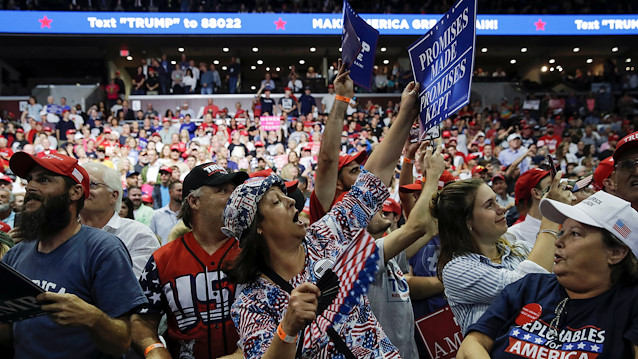
Supporters of U.S. President Donald Trump attend a rally in Springfield, Missouri
In rally after rally, President Donald Trump exhorts throngs of red-hatted supporters to treat next week’s congressional elections as a referendum on Trumpism and the grass-roots movement that swept him to power.
“You’re voting for me in 2018,” Trump told a raucous crowd in a late September appearance for Republican candidates in Missouri. “You’re voting for me.”
The plea speaks to the challenge facing the president and his supporters: With Democrats threatening to take over the House of Representatives and key governors’ offices, the success of his legislative agenda over the next two years hinges on whether he can energize his backers around candidates who are not named Trump.
This year’s election is the first real test of whether the coalition behind Trump’s “Make America Great Again” slogan can evolve from a diffuse, personality-driven following to an organized political force able to boost candidates outside his electoral strongholds.
Reuters surveyed officials from 18 Republican campaigns, analyzed data from polling partner Ipsos and interviewed dozens of candidates, strategists and Trump supporters to assess the reach and influence of the president’s self-styled “MAGA Movement” ahead of the elections.
With just four days until millions of Americans head to polling stations across the U.S., President Donald Trump is on a mission.Trump is set to continue a campaign blitz in battleground states pivotal to Republican success in the U.S. midterm elections that will see him embark on trips to Montana and Florida on Saturday and Georgia and Tennessee on Sunday.The intense electoral push will be capped on the eve of the Nov. 6 polls when Trump will visit three states in one day – Ohio, Indiana and Missouri – in a sign of how important these races are for a president seeking to fulfill his legislative agenda with just two years left on his first, and possibly sole, term.The president’s travel schedule is based on internal White House planning first made public by Bloomberg and is subject to change. But parts of the schedule that have already come to pass have squared with the president’s visits.Turkish deputy foreign minister in US for talksRepublicans currently hold a razor-thin one-seat majority in the Senate, and while their hold on the House of Representatives is far firmer, it is most threatened in that chamber. The party and the president can ill-afford to lose either part of the bicameral legislature.Every House member’s seat will be up for grabs in this fall's elections, as will just over one-third of Senate seats.Whether Trump will prove to be a boon or an albatross for the Republicans is unclear amid predictions of a possible blue wave, or massive legislative inroads for the Democratic Party.Democrats are seeking to seize on discontent that has fomented among some segments of American society following Trump’s successful 2016 White House bid, particularly those who take issue with his personal life, controversial policies -- notably his hardline immigration crackdown and efforts to roll back the U.S.’s universal healthcare law -- and unorthodox approach to the American presidency.Ankara shares footage on joint Turkey-US patrols in ManbijWith less than a week until Americans cast their ballots, the Pew Research Center found that wide segments of both Republican partisans – 73 percent – and their Democratic counterparts – 77 percent – say which party controls Congress is a factor in how they vote.Each group of partisans expects their party to control the House of Representatives following the midterms, with 77 percent of Democrats saying they expect their party will control the chamber following the polls, compared to 82 percent of Republicans who expect the same.Pew tracked what it said is the highest level of voter enthusiasm in the past two decades as over two-thirds – 67 percent – of Democrats say they are more enthusiastic than normal.Fifty-nine percent of Republicans say the same.US urges return of Khashoggi's remains to familyTrump continues to loom large for registered voters, with 60 percent of voters saying he will factor into how they cast their ballots. Well over a third of voters – 37 percent – say their vote will be against him, compared to just 23 percent who said it will be for him.Republicans likely to remain in control of the SenateIn all, 35 seats are being contested in the Senate – 33 of which are being contested under normal Senate rules, in addition to two which are being contested because the incumbents, both Republicans, are retiring: Senator Jeff Flake of Arizona and Bob Corker of Tennessee.Normally, one-third, or about 33, seats are contested every two years.Trump announces plans to limit asylum seekersFlake’s seat continues to be tightly contested in a race between Democrat Kyrsten Sinema and Republican Martha McSally. Sinema holds a narrow 6-point lead in the contest.The Republican seeking to succeed Corker, Marsha Blackburn, holds about the same margin over her Democratic challenger, Phil Bredesen.Real Clear Politics, a polling aggregator website, counts six toss-up seats in the 100-member chamber with four of those seats held by Democrat incumbents.Republicans have a lock on 46 seats that are either safely Republican or are not up for election compared to just 37 for Democrats. Meanwhile, seven seats are either likely to go Democrat or lean Democrat, compared to four for Republicans.The Senate’s two Independents caucus with the Democrats, and both are expected to keep their seats.Democrats face good odds in taking the House of RepresentativesIn the 435-member House, however, the likelihood that Republicans will maintain their hold is increasingly in doubt.Either party will need to claim a 218-seat majority to control the chamber, a challenge that may prove insurmountable for Republicans.The party currently holds a 43-seat advantage in the House but is facing serious challenges to 30 seats it currently controls. Only four such tight races are for seats held by Democratic incumbents.In addition to those 34 races, Democrats appear likely to take four seats from Republicans with an additional 11 currently held by Republicans now leaning Democratic.Should Democrats take either chamber, that would mark a major upset for the president, who is seeking to round out his four-year term with major legislative victories, particularly long-promised immigration initiatives such as his border wall with Mexico and a repeal of former President Barack Obama’s universal healthcare law.Democrats have staunchly opposed his agenda, particularly his efforts to curtail immigration and fully repeal the Affordable Care Act.Should Democrats take either, or possibly both chambers, Trump would be forced to come to terms with a legislature no longer in the hands of his political allies.At least 65 Muslims running for office across nationIn addition to the federal legislature, Americans will be voting on dozens of state governors and troves of other local officials and referendums.Across the nation, at least 65 Muslim-Americans are in the running for a variety of state, local and federal posts, according to Jetpac, a nonprofit working to increase Muslim-American civic engagement.That is up from the nonprofit’s previous estimates of around 40 candidates as more individuals have been found in contests that are relatively lower on electoral ballots and garner less media attention.In all, at least 128 Muslim-Americans ran for office in this election cycle, the highest number since the Sept. 11, 2001 terrorist attacks, according to Shaun King, Jetpac’s co-founder and executive director.
US midterm elections: Trump's agenda at stake
United behind Trump’s “America First” agenda of tighter borders, protectionist economic policies and unilateralist diplomacy, the MAGA coalition swept up 2016 voters who felt ignored by Washington and welcomed Trump’s vows to upend its institutions. Today, it attracts Tea Party conservatives, evangelical Christians, gun rights advocates, and working-class voters drawn to Trump’s outsider persona.
Trump’s populist base is firmly established in the mostly southern and western parts of the country where he’s most popular. MAGA supporters turn out in force for Trump-backed candidates in those areas, boosting them in opinion polls and volunteering for their campaigns. In some cases, they have taken control of state party machines, harnessing their infrastructure and money for candidates in Trump’s mold.
But outside of Trump’s strongholds, the influence of MAGA supporters is more pocketed, especially in Rust Belt states, such as Pennsylvania and Ohio, and the upper Midwest. So, while Trump loyalists can tip the scales in specific U.S. House districts in those areas, they have done less to boost Trump-backed candidates in statewide contests for governor and U.S. Senate.
With no central organization and little regard for Republican hierarchies, MAGA enthusiasts agitate largely through social media and Internet forums, such as Facebook and Reddit, the social networking site. In dozens of interviews, Reuters found their willingness to back local campaigns often has less to do with party loyalty than with helping Trump.
China’s foreign ministry said on Friday that the previous day’s telephone call between Chinese President Xi Jinping and U.S. President Donald Trump was quite positive.The two heads of state think they should enhance trade relations, ministry spokesman Lu Kang told a daily news briefing.Trump asks officials to draft possible trade deal with China
China says Xi-Trump call was quite positive
U.S. President Donald Trump announced plans Thursday to change the country's immigration policy to limit asylum seekers.In a speech at the White House, Trump said he plans to get rid of the “catch and release” policy where immigrants who are caught crossing the border are released back into the U.S. community while they await their immigration hearings.While Trump claimed the policy was created by the Democrats, it was first enforced under the George W. Bush administration."We're not releasing anymore. We're going to catch, we're not going to release. They are going to stay with us until the deportation hearing," Trump said.Trump also claimed that only three percent of immigrants who enter the country attend their immigration hearings. But according to data from the Department of Justice, around 60-75 percent of them show up.He sharply criticized current asylum policies, saying many of them are fraudulent and processing cases takes too long."The biggest loophole drawing aliens to our borders is the use of fraudulent or meritless asylum claims to gain entry into our great country," Trump said.Trump’s remarks come ahead of midterm elections as a late effort to stoke fear over a "migrant caravan" attempting to enter the U.S. and in a bid to bolster support from Republican voters.They also follow his announcement Wednesday that he may send as many as 15,000 troops -- more than the number currently in Afghanistan -- to the country's southern border in a bid to stop or detain those in the caravan.The military will be putting up "massive cities of tents" to hold any immigrants entering the country illegally, according to the president.Air Force Gen. Terrence O’Shaughnessy noted that some of the troops being sent to the border will be armed. In response to a question, Trump said that any rocks thrown by asylum-seeking migrants at the U.S. military will be "considered a firearm".The announcement is the latest move to drastically change U.S. immigration policy after the president recently announced plans to end birthright citizenship with an executive order.Birthright citizenship has its foundation in the 14th Amendment of the Constitution, ratified in 1868, and was meant to stymie efforts to deny citizenship to former slaves. Ending it would likely require a constitutional amendment, according to many legal scholars.Trump asks officials to draft possible trade deal with China
Trump announces plans to limit asylum seekers
“The 2018 elections will be a test of how popular Trump is, how popular his policies are, did we organize well or do we need to do better and improve things for 2020,” said Scott Presler, a MAGA activist in Virginia Beach, Virginia.
Among the 18 Trump-endorsed Republicans running for Senate or governor in states where Trump won the presidential race by more than 10 percentage points in 2016, more than 80 percent are ahead in opinion polls, based on data aggregated by RealClearPolitics and 538.com, non-partisan websites that gather polling from multiple sources.
Yet among the 16 Trump-backed candidates for Senate or governor in states where he won by fewer than 10 points, just four – a quarter – are polling ahead.
The challenge is starkest where Trump-backed candidates are trying to flip governors’ offices and Senate seats held by Democrats, Reuters found.
In states where Trump won by double digits in 2016, two of the five candidates he has endorsed in races for Democrat-held Senate and governors’ seats are leading in the polls, and two others are within a few points. But in states where Trump won by less than 10 points, all six candidates he has endorsed in races for Democratic seats are behind in recent polls, five of them by at least 10 points.
Through much of the campaign season, Trump supporters in many places were “leaning on their shovels,” because they were over-confident of victory, Steve Bannon, a former Trump adviser and campaign strategist, told Reuters.
MAGA loyalists have grown more energized in recent weeks, realizing Trump’s agenda “would come grinding to a halt” if Democrats capture the U.S. House, Bannon added. “You've seen the establishment and the hardcore anti-establishment in the Trump base all come together.”
The president remains enormously popular with that base - Reuters/Ipsos polling gives him an 84 percent approval rate among Republicans - and more than two-thirds of those who voted for him in 2016 say they identify with MAGA ideals.
Yet their views diverge on what MAGA means: while more than half equate it with strengthening the economy and tightening borders, upwards of a quarter say MAGA simply means “Donald Trump.” (Graphic: https://tmsnrt.rs/2RuhKTv)
That raises questions about the future of MAGA once Trump leaves office.
On Oct. 1, Trump whipped up a crowd of nearly 10,000 at a rally supporting Marsha Blackburn’s U.S. Senate campaign in Tennessee, where Trump won in 2016 by 26 points.
“A vote for Marsha is really a vote for me and everything that we stand for,” he told the audience.
Soon after, opinion polls showed Blackburn, a U.S. House member, pulling ahead of her Democratic opponent, former two-term governor Phil Bredesen.
“We knew President Trump would be an extraordinary surrogate in East Tennessee," Republican Party spokesman Garren Shipley told Reuters. Bredesen’s campaign dismissed the polls: “The only poll that matters is on election day,” said spokeswoman Alyssa Hansen.
On Oct. 10, the president held another rally 500 miles (800 km) away with a similar message for Lou Barletta’s U.S. Senate campaign in Pennsylvania, where Trump eked out a one-point victory in 2016. “I need you,” Trump told the crowd. “Vote for Lou!”
It was Trump’s second rally with Barletta since August. But Barletta, also a U.S. House member, trails incumbent Democratic Senator Bob Casey, and has remained behind by more than 10 points in polls.
The divergent fortunes of Blackburn and Barletta reflect the challenge in harnessing Trump’s MAGA coalition.
Following Trump’s victory in 2016, Tennessee’s Republican establishment embraced his agenda and welcomed his supporters. Many are volunteering now for Blackburn and other Trump-backed candidates, helping with phone banks, neighborhood canvassing and other get-out-the-vote efforts.
The state party leaders who didn’t support Trump initially have “figured out they have to help him,” says Todd Fowler, who heads the local party in Johnson City, Tennessee, and serves on the state party’s executive committee. “Tennessee likes what he’s doing.”
In Pennsylvania, where Trump’s 2016 win was razor-thin, his support is mostly concentrated in rural and working-class areas. Polls show Trump’s pick for governor, Scott Wagner, running well behind incumbent Democratic Governor Tom Wolf.
Trump is drawing people to congressional campaigns in Pennsylvania, but they are coming “very tentatively,” says Eugene Sorrentino, 76, a retired power company technician and member of the local Republican committee in Erie, Pennsylvania.
Sorrentino recently staffed a welcome tent set up by the party at a county fair and “all I heard was requests for Trump paraphernalia,” he said. The congressional races “weren’t on their agenda,” he added.
In Trump’s strongholds, his ability to help candidates goes beyond a bounce in the polls. Nearly all the Trump-backed campaigns contacted by Reuters reported a surge of volunteer activism – a “Trump bump” – after the president’s endorsement.
In Western Pennsylvania, a corner where Trump is enormously popular, U.S. Representative Mike Kelly says his campaign relies heavily on MAGA volunteers. Kelly’s district, redrawn this year, includes counties where Trump won by as much as 20 points in 2016, according to PlanScore.org, a nonpartisan group.
Trump provides “that shot of adrenaline you need from time to time,” Kelly told Reuters as he prepared to join the president for an Oct. 10 rally in Erie.
One engine for turning out Trump’s base in his stronghold regions is America First Action, a “Super PAC” allowed to spend unlimited amounts of money on elections.
The group has spent more than $26 million on phone messaging and advertising in five battleground Senate races – Arizona, Montana, Indiana, Missouri and North Dakota – and across 11 congressional districts in Texas, Minnesota, Maine, Michigan, West Virginia, New York, Pennsylvania, Nevada and North Carolina.
It is run by Trump loyalists and relies on big donations from Republican Party stalwarts, including casino magnates Sheldon Adelson and Steve Wynn and mining engineer and businessman Robert Murray.
In an Oct. 1 memo, White House political director Bill Stepian advised congressional campaigns that the best way to capture MAGA support is to align “closely, clearly and boldly” with Trump. The president, he wrote, is “ready, willing and able to put the power and force of his coalition to work for the candidates with whom he stands, and who stand with him.”
At the national level, Republican Party officials have fallen in line and embraced the president, routinely echoing Trump’s nationalist campaign themes. But for candidates in areas where the president doesn't dominate the electorate, embracing Trump has mixed success.
In Florida, where Trump prevailed by one point in 2016, he endorsed Republican gubernatorial candidate and die-hard supporter Ron DeSantis before the party primary. But now, in a state that hasn’t elected a Democratic governor in 20 years, DeSantis is polling slightly behind in the general election contest against Andrew Gillum, the Democratic mayor of Tallahassee.
Some Republican candidates in areas with moderate voters who view Trump less favorably have steered clear of the president, a Reuters analysis found last month.
MAGA supporters have become a force in many state party offices, including some states outside the president’s established southern and western strongholds.
In Ohio, a swing state where Trump won by eight points in 2016, the state Republican Party selected Jane Timken, a Trump friend and loyalist, to take over as chairwoman in the wake of the election.
In Nevada, where Democrat Hillary Clinton won the 2016 presidential vote, the state Republican Party has launched weekly events, such as MAGA Mondays and Trump Tuesdays, to attract the president’s supporters.
Rochelle Swanson, 30, a MAGA activist in Reno who began posting pro-Trump articles and interviewing local Republican candidates on social media, was asked by a party official in July to help with voter outreach. She now aligns her social media and canvassing with the party’s messaging, she says, and “there is good unity happening.”
Yet even as MAGA supporters have become woven into the fabric of the Republican Party, many acknowledge it will be a challenge to preserve their coalition and continue shaping U.S. politics once Trump leaves office. In a Reuters/Ipsos poll earlier this month, more than a quarter of Trump voters said they did not know who would carry Trump’s vision if he leaves politics.
“I don’t think anybody could take Trump’s spot,” said Jimmy Messina, a MAGA activist in upstate New York who runs a political advertising media company. “I don’t see it.”