

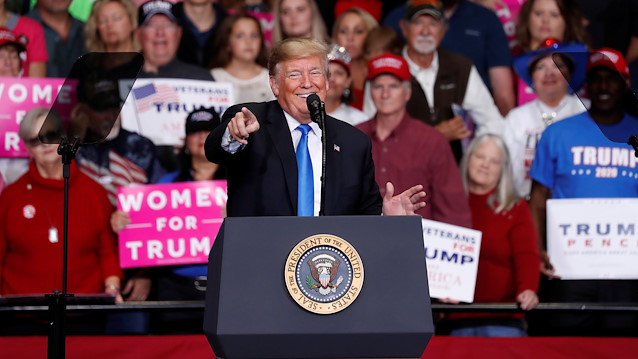
File photo: U.S. President Donald Trump points towards the crowd
U.S. President Donald Trump has put forward a long-time Republican Party figure as his pick for ambassador to Australia, the White House said, hoping to fill a key diplomatic post that has been vacant for two years.
The nomination of Arthur B. Culvahouse, a lawyer and counsel to former U.S. President Ronald Reagan, will have to be confirmed by the Senate.
Australia is a key U.S. ally in the strategically important Asia Pacific region where China is asserting greater influence, especially in the disputed South China Sea.
Trump in February named then U.S. Pacific Commander Admiral Harry Harris as ambassador to Australia but then picked him for South Korea amid heightened tensions with North Korea over its nuclear and missile programs.
In 2016, Culvahouse led vetting of Mike Pence as Republican Party nominee for vice president.
In 1989, Reagan awarded Culvahouse the Presidential Citizens' Medal, the White House said in a statement on Monday. In 1992, then Secretary of Defense Cheney awarded him the Defense Medal for Distinguished Public Service.
U.S. President Donald Trump said Monday he is cautious about the effects his sanctions will have on global oil markets, saying the penalties will be imposed gradually."I don’t want to drive the oil prices in the world up," he said addressing reporters shortly after the U.S. reinstated all of the sanctions it lifted as part of a nuclear accord world powers struck with Iran."I’m not looking to be a great hero and bring it down to zero immediately," he said, referring to global imports of Iranian oil. "I could get the Iran oil down to zero immediately, but it would cause a shock to the market. I don’t want to lift oil prices."The U.S. earlier announced that eight countries -- China, Greece, India, Italy, Japan, South Korea, Taiwan and Turkey -- are being granted temporary six month waivers from the economic penalties targeting imports of Iranian crude. Iran is OPEC's third largest oil exporter.US's Bolton says more sanctions on Iran comingSenior official says Iran not concerned about reimposed US sanctionsSecretary of State Mike Pompeo said the exemptions are intended to ensure oil markets continue to be well-supplied.Pompeo said each country which received waivers “has already demonstrated significant reductions of the purchase of Iranian crude over the past six months," adding two of the eight have reduced imports of Iranian crude to zero."We continue negotiations to get all of the nations to zero," he said.Trump unilaterally withdrew the U.S. from the 2015 Joint Comprehensive Plan of Action in May, setting the stage for Washington to reimpose all of the sanctions it lifted as part of the agreement.All of the other signatories -- China, the European Union, France, Germany, Iran, Russia and the United Kingdom -- have remained in the deal.The accord provided Iran with billions of dollars in relief from international sanctions in exchange for sweeping curbs on and inspections of its nuclear program.Airbus China CEO says 'no winner' from US-China trade war
Trump wary of sanctions effect on oil prices