

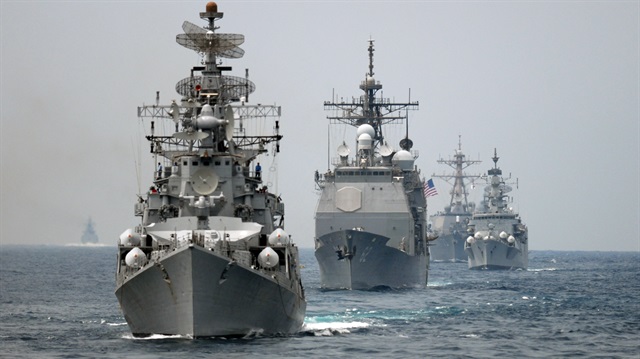
File photo
The United States, Australia, France and Britain will open new embassies in the Pacific, boost staffing levels, and engage with leaders of island nations more often in a bid to counter China's rising influence in the region, sources have told Reuters.
The battle for influence in the sparsely populated Pacific matters because each of the tiny island states has a vote at international forums like the United Nations, and they also control vast swathes of resource-rich ocean.
China has spent $1.3 billion on concessionary loans and gifts since 2011 to become the Pacific's second-largest donor after Australia, stoking concern in the West that several tiny nations could end up overburdened and in debt to Beijing.
In response, Australia, New Zealand and the United States say they will increase economic aid and expanding their diplomatic presence to countries in the region, government officials and diplomats told Reuters.
Indonesian President Joko Widodo and Australian Prime Minister Scott Morrison hope to announce on Friday the completion of negotiations on an economic partnership pact between the two countries, a foreign ministry official said.Director for East Asia and Pacific Edi Yusuf told a briefing ahead of a visit by Morrison to Indonesia this week that negotiations were still continuing on the Indonesia Australia Comprehensive Economic Partnership Agreement (CEPA).The deal is set to be signed later this year and should include the opening-up of investment in Indonesia's university sector by Australia, he said. Australia's new PM due in Indonesia this week amid hopes on tradeNew Australian PM gets to work; govt support plummets
Indonesia, Australia hope to announce economic partnership on Friday
"We are concerned about Chinese practices that lead to unsustainable debt," said a U.S. government source with direct knowledge of Washington's plan for the region, who spoke on condition of anonymity.
The U.S. official said Washington needed to have adequate representation in the Pacific countries in order to let their governments know what options were open to them and the consequences of taking offers from elsewhere.
China's embassy in Australia did not immediately respond to a request for comment. Earlier this year, China's ambassador said Beijing was careful to ensure that borrowers were able to meet debt repayments.
The U.S. government source said Washington would boost diplomatic staffing numbers in Palau, the Federated States of Micronesia and potentially Fiji within the next two years.
Tsunami waves as tall as a metre above the tide level were possible along the coasts Fiji, New Caledonia and Vanuatu following a powerful earthquake in the South Pacific, the Pacific Tsunami Warning Center said on Wednesday.The magnitude 7.1 undersea quake hit off New Caledonia about 0350 GMT, and had already sent small waves radiating out toward the Loyalty Islands, some 250 km (155 miles) west of the epicentre.Waves between 30 cm and 1 metre (1 to 3.3 ft) were possible at some coasts of Fiji, New Caledonia and Vanuatu, while smaller waves could reach dozens of other islands, the warning center said.
Strong quake sends small waves radiating out to South Pacific islands
Australia's government is expected to name its first High Commissioner to Tuvalu within weeks, rushing to fill a post Canberra decided upon establishing only several months ago, a government source told Reuters. He declined to be identified as he is not authorised to talk to the media.
Britain will open new High Commissions in Vanuatu, Tonga and Samoa by the end of May 2019, while French President Emmanuel Macron is seeking to organise a meeting of Pacific leaders early next year, diplomatic and government sources have told Reuters.
Earlier this month, Tongan Prime Minister 'Akilisi Pōhiva sought support from other governments in the region to make a coordinated request for China to forgive mounting debts. The Pacific leader then abruptly backed down after Beijing complained about the plan.
Palau and Tuvalu both recognise Taiwan, which is claimed by Beijing as a Chinese territory, and has become one of China's most sensitive issues.
Australia has banned Chinese telecoms firm Huawei Technologies Co Ltd from supplying equipment for a 5G mobile network, citing risks of foreign interference and hacking which Beijing dismissed as an "excuse" to tilt the playing field against a Chinese firm.The move, following advice from security agencies, signals a hardening of Australia's stance toward its biggest trading partner as relations have soured over Canberra's allegations of Chinese meddling in Australian politics.It also brings Australia in line with the United States, which has restricted Huawei and compatriot ZTE Corp from its lucrative market for similar reasons.The government said in an emailed statement on Thursday that national security regulations typically applied to telecom carriers would now be extended to equipment suppliers.Firms "who are likely to be subject to extrajudicial directions from a foreign government" would leave the nation's network vulnerable to unauthorised access or interference, and presented a security risk, the statement said.It did not name the Chinese firm specifically, but an Australian government official said the order was aimed at Huawei and precluded its involvement in the network.Huawei's Australian arm, which strenuously denies it is controlled by Beijing, said on Twitter on Thursday that the action was an "extremely disappointing result for consumers".In Beijing, Chinese foreign ministry spokesman Lu Kang said China expressed "serious concern", adding that Australia should not "use various excuses to artificially erect barriers"."We urge the Australian government to abandon ideological prejudices and provide a fair competitive environment for Chinese companies' operations in Australia," Lu said at a daily news briefing.Chinese law requires organisations and citizens to support, assist and cooperate with intelligence work, which analysts say can make Huawei's equipment a conduit for espionage."That's what you get when you have the aligned strategy of a Chinese company with the Chinese government," said John Watters, Executive Vice President and Chief Corporate Strategy Officer of cybersecurity firm FireEye Inc."(Australia) basically made a decision to spend more money to have more control over their national communication system, because they're up against a competitor that will sacrifice near-term margin for long-term intelligence advantage," he said.Australia had previously banned Huawei, the world's largest maker of telecommunications network gear, from providing equipment for its fibre-optic network and moved to block it from laying submarine cables in the Pacific.But Huawei's exclusion from the mobile network comes at a time of particularly strained relations between Australia and China, which Prime Minister Malcolm Turnbull had two weeks ago sought to reset with a conciliatory speech."It is ... out of step with this attempt to reset the relationship," said James Leibold, Associate Professor of Politics and Asian Studies at La Trobe University."They're not going to forget Turnbull's earlier strident language anytime soon," he said.Turnbull's tenure as prime minister appeared doomed on Thursday as his ruling party struggled with an internecine leadership battle which saw ministers desert Turnbull and call for a leadership vote. US, China to resume trade talks in Washington amid low expectationsChina reiterates support for Turkey's economyChina complains about Pentagon report, says it is 'pure guesswork'China think tank slammed for "procreation fund" idea
Australia bans China's Huawei from mobile network project, angers Beijing
NAVAL DIPLOMACY
China isn't only offering funds to build influence.
By the end of 2018, Fiji expects to receive a Hydrographic vessel that can map the sea bed, Viliame Naupoto, the head of Fiji's armed forces told Reuters. It will be the first military gift from China to a Pacific nation, and Western diplomats saw it as an attempt by Beijing to find favour with Fiji, one of the region's larger economies.
"Fiji has a strong economy on the back of a vibrant tourism sector, it will have plenty of finance options," said a former Australian diplomat.
The Western allies are also working on building relations. Forces from Papua New Guinea, Fiji and Tonga will next week join two weeks of military drills off Australia's northern coast, along with personnel from the United States, France and Japan. China is also attending at the invitation of host nation Australia.
"There is a sustained push by allies in the region. The Indo-Pacific is a large body of water; a strong navy makes for a strong national defence," Andrea Thompson, U.S. Under Secretary for International Security and Arms Control told Reuters.